Here is how the outdoor kitchen story goes wrong. Three quotes come back. One is thousands under the other two, so you sign it. Then the gas line shows up as a change order. Then the permit. Then the slab that has to be poured before anything can sit on it. You end up paying more than the highest quote, and you wait longer to cook on it.
An outdoor kitchen in Southwest Florida runs $8,000 to $80,000. Every number in this guide includes the gas and electrical work, the permits, and the construction, not just the appliances.
That is the whole point. No hidden fees, no change-order games. You see every line item before the first block is set.
This guide breaks that range into three tiers, explains what moves the number inside each tier, and shows you what a real estimate looks like on paper. It comes from the outdoor kitchens we build in Fort Myers, Estero, Bonita Springs, and Naples.
Outdoor Kitchen Cost by Tier in Southwest Florida
Most outdoor kitchens land in one of three tiers. The tier you pick is a set of choices about cooking, hosting, and shade, not a grade of quality. A grill station built right will outlast a full outdoor living space built wrong.
| Tier | Price | What it includes | HomeWorks build time |
|---|---|---|---|
| Basic grill station | $8,000 to $15,000 | A single run of cabinetry, a built-in grill, a durable counter surface, storage, and the gas and electrical to support it | 1 to 2 weeks |
| Mid-range outdoor kitchen | $20,000 to $40,000 | Grill, refrigerator, sink with supply and drain, a dedicated refrigeration circuit, more counter space, and bar seating | 3 to 4 weeks |
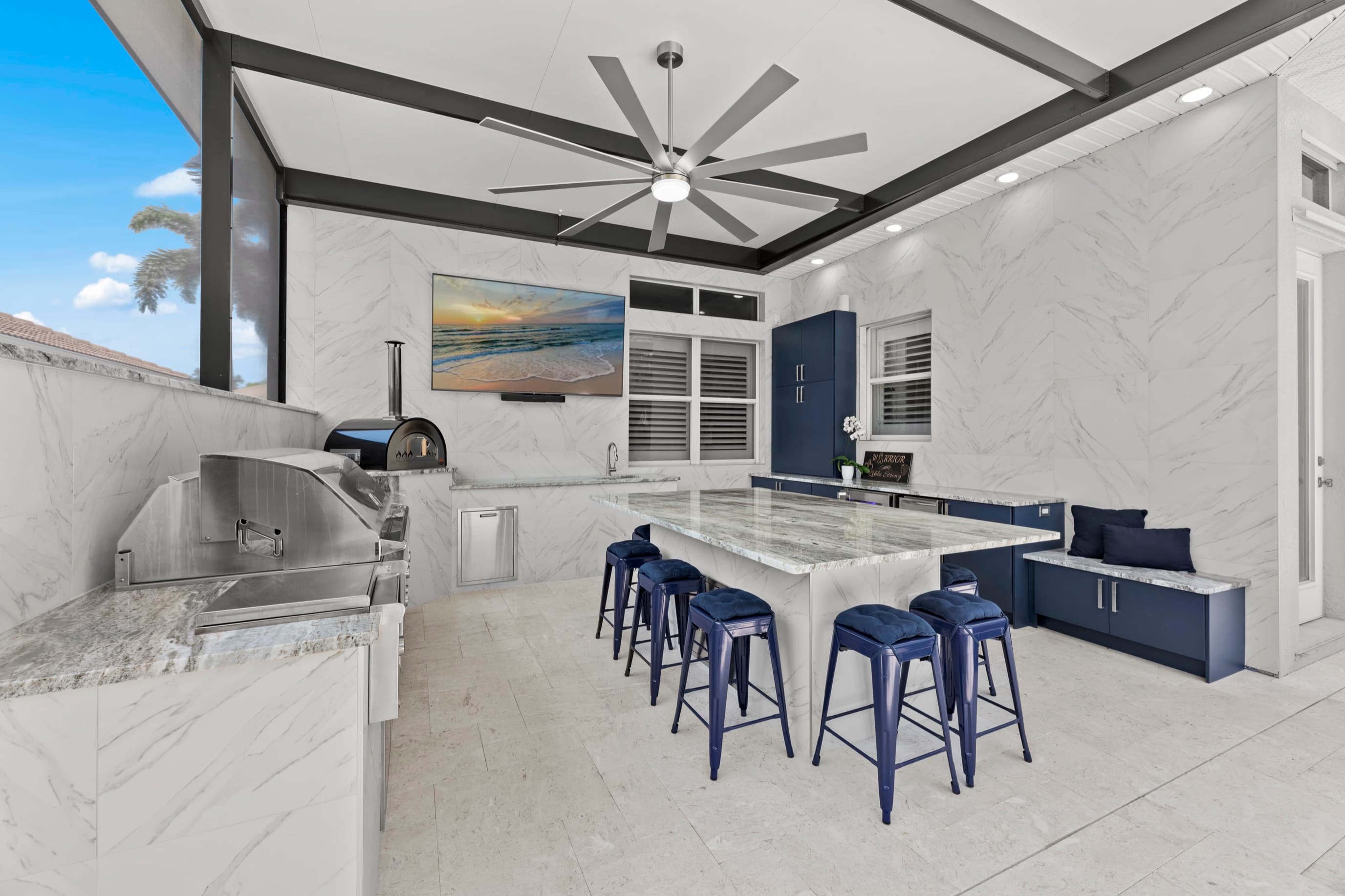
| Full outdoor living space | $40,000 to $80,000 and up | A covered structure, lighting, a fire feature, premium appliances, and the engineering that goes with a roof | 4 to 6 weeks |
Build times are what our own crews run on these projects. Permit approval adds 2 to 4 weeks before construction starts, which we cover further down.
Basic Grill Station ($8,000 to $15,000)
A grill station is one straight run. Cabinetry, a built-in grill, a counter you can work on, and storage underneath. It is the right call when you already cook outside and want the grill to stop being a rolling appliance parked against the house.
What is included at this tier: the island structure, the counter surface, the built-in grill, weather-rated cabinet doors and drawers, and the gas and electrical work that makes the whole thing legal and safe.
What is not included: a sink, a refrigerator, a roof, or seating. Adding a sink means water supply and drain lines, which moves the project into the next tier.
Reality check. The gas and electrical are already in this number. That is the line item most cheap quotes leave out, and it is the reason a grill station quote can come back far under what we charge. Running a gas line to the island, pressure testing it, and pulling power for the outlets and the grill light is real work by licensed trades. It does not disappear because a quote does not mention it. If you are still deciding between a compact island and something larger, our breakdown of a BBQ island versus a full outdoor kitchen walks through the sizing question.
Mid-Range Outdoor Kitchen ($20,000 to $40,000)
This is the tier most Southwest Florida homeowners actually want. A grill, a refrigerator, a sink, and enough counter and bar seating to host people instead of running back and forth to the indoor kitchen.
Three things change at this level. The sink brings plumbing: a water supply line and a drain that has to go somewhere legal. The refrigerator gets a dedicated circuit so it is not sharing power with the grill light and the outlets. And the counter grows, because seating needs an overhang and prep needs landing space on both sides of the grill.
What moves the number inside this tier: the length of the run, the counter material, whether the layout is a straight line or an L with a return, and how many appliances get built in. A beverage refrigerator, a side burner, and a warming drawer each add cabinetry, power, and cutouts.
The other variable is where the sink drain ties in. A kitchen close to an existing plumbing wall is a shorter run than one at the far corner of a lanai.
Full Outdoor Living Space ($40,000 to $80,000 and up)
At this tier you are building a room that happens to be outside. A pergola or roof over the cooking area, task and ambient lighting, a fire feature, and premium appliances.
The covered structure is what separates this tier from the one below it. A roof or pergola is a structure, it carries wind load, and it gets engineered and inspected as one. That is not a line item you can shop away.
Inside this tier the cost drivers are the size of the covered area, whether you add a pizza oven or a beverage center, and the fire feature. An outdoor fireplace adds height and a chimney, which changes the footing and the structural math in a way a fire table does not.
What pushes past the top of the range: a fully roofed and screened outdoor room, a long slab run that needs new footings, a full appliance package, and stone selections that have to be sealed and maintained for outdoor exposure.
What Drives Outdoor Kitchen Cost in Southwest Florida
The tiers tell you the range. These are the levers that move your number inside it.
The Structure Under the Counters
You never see it, and it decides how long the kitchen lasts. We build on concrete block or welded steel. Never wood.
A wood frame in this climate is a future termite and rot problem sitting under a stone counter. Pulling a failed frame out means demolishing everything on top of it. The structure is the cheapest thing to get right on day one and the most expensive thing to fix later. What a permanent outdoor structure has to survive here covers the wind and storm side in full.
Materials That Survive Salt Air and Sun
Interior-grade materials fail fast outside in Southwest Florida. Here is what we specify and why.
Marine-grade 316 stainless steel for cabinets, doors, and appliance housings within about five miles of the coast. Standard 304 stainless is fine inland, but near salt air it develops the surface rust called tea staining, so closer to the water we step up to 316. The full comparison of outdoor cabinet materials goes deeper on the grades.
Sealed natural stone or full-body porcelain for counters. Granite and quartzite hold up outdoors when they are sealed for it, and porcelain slabs resist UV fading and heat better than most surfaces. Indoor quartz is not made for direct sun and can discolor, so we steer clients away from it on uncovered runs.
Powder-coated aluminum for pergolas and shade structures, rated for the local wind load. Aluminum does not rust and it can be engineered to code.
Material choice is the single biggest swing inside a tier. The same layout in coastal-rated stainless and sealed stone costs more than the same layout in a lesser grade, and it is the difference between a kitchen that still looks right in five years and one that looks tired in two summers.
Gas, Electrical, and Plumbing
This is the hidden half of the budget, and it is the half homeowners never see in a photo.
The gas line has to be run, sized for the appliances, and pressure tested before anyone connects a grill to it. That is true for natural gas and for propane.
The electrical has to be built for weather. HomeWorks installs weather-rated, GFCI-protected outlets with covers, on circuits sized for what is actually plugged in, so the refrigerator is not fighting the grill light for power.
The plumbing is supply and drain. A sink needs water to it and a legal path for water away from it, and the counters and cabinets get built to shed water instead of trapping it.
None of this shows up in the finished photos. All of it shows up in a real quote.
Appliances
Appliances are the part homeowners shop hardest. The built-in around them costs what it costs either way, so pick the appliance first and let the island get designed around it.
HomeWorks installs and integrates TrueFlame gas grills and Primo ceramic grills. We handle the gas line connection, the counter cutout, and the ventilation, so you get one warranty on the whole installation instead of chasing separate warranties from separate trades. Choosing between a built-in and a freestanding grill is worth settling before the island gets designed, because the cutout is built around the appliance.
A Roof or Pergola
Shade is the upgrade people underestimate. In Southwest Florida a kitchen you cannot stand at in July afternoon sun is a kitchen you use less.
A pergola or roof is a structure. It gets designed for wind load, it gets reviewed, and it gets inspected. The engineering is part of the price, and it is one of the clearest tells between a quote from a licensed contractor and a quote from a handyman with a truck.
Permits and Inspections
Permits are in every HomeWorks number. They are not a surprise fee at the end.
Florida law makes it unlawful to construct, alter, or repair a building without first getting a permit (Florida Statute 553.79), and the Florida Building Code requires a permit to install, alter, or replace any electrical, gas, mechanical, or plumbing system it regulates (FBC s. 105.1). An outdoor kitchen with a gas line, power, and a sink hits all three.
We pull them, we schedule the inspections, and we close them out. Our full guide to outdoor kitchen permits in Lee and Collier County covers what triggers a permit, what the inspections look at, and what happens when a build gets skipped past the county.
Why a Cheap Outdoor Kitchen Quote Is Missing Something
When a quote comes back far below this range, three things are the reason.
The permit is not in it. Someone plans to build without one, or plans to hand you the permit problem after the fact.
The gas line is not in it. The quote covers the island and the appliances and leaves the licensed gas work for later, as a change order or as your problem to solve with a separate trade.
The hurricane-rated structure is not in it. A wood frame goes in instead of block or steel, or a shade structure goes up without engineering.
The pattern is the same every time. The low number gets you to sign, and the missing scope comes back as change orders while your yard is torn up and saying no costs you more than saying yes. That is the contractor horror story, and it is the reason HomeWorks puts the permits, the gas, and the structure on the quote up front. The number you sign is the number you pay.
Outdoor Kitchen Cost by City in Southwest Florida
The tiers hold across our whole service area. What changes is the material spec, the review process, and which county you are dealing with.
Fort Myers: Lee County permitting, riverfront and older-neighborhood lots, and post-storm rebuilds. Older lots turn up more surprises under the slab on a Fort Myers build, which is what the contingency is for.
Estero and Bonita Springs: Planned and gated communities add an architectural review step to Estero and Bonita Springs projects before the village or city building department ever sees the plans. It changes the schedule more than the price.
Naples: Collier County permitting plus gated-community architectural review. Material selections on Naples projects run toward the upper half of each tier.
How to Budget for an Outdoor Kitchen
Start With How You Cook and Host
Before you price anything, answer two questions. How do you cook out there, and how many people are you feeding?
A couple who grills twice a week needs a grill station. A family that hosts twelve people every holiday needs seating, a refrigerator that holds more than drinks, and a sink so nobody is carrying dirty platters through the house.
Budget follows use. Homeowners who over-build regret the appliance they never touch. Homeowners who under-build regret the counter space they do not have.
Add a 15 Percent Contingency
Every HomeWorks quote puts a 15 percent contingency on the table before work starts. Not hidden in a markup. On the quote, where you can see it.
Outdoor work turns up conditions nobody can see from the driveway: an existing slab that will not carry the load, a gas meter on the wrong side of the house, an electrical panel with no room for another circuit, drainage that has to be corrected before a counter goes anywhere near it.
Those are not contractor mistakes. They are what is under the yard. A 15 percent contingency covers them without a conversation about money in the middle of your project.
Where to Invest and Where to Save
Invest in the parts you cannot change later. The structure under the counters. The stainless grade if you are near the water. The counter material. The gas and electrical capacity, because adding a circuit after the stone is set means cutting into finished work.
Save on the parts you can swap. Appliances come out. A grill can be upgraded later without touching the island. Cabinet fronts and lighting fixtures are changeable. Bar stools are changeable.
The rule holds everywhere in remodeling: spend on what is buried, economize on what is bolted on.
How Long an Outdoor Kitchen Takes
These are our own build times, not a county schedule.
A basic grill station takes 1 to 2 weeks. A mid-range outdoor kitchen takes 3 to 4 weeks. A full outdoor living space with a pergola and a fire feature takes 4 to 6 weeks.
Permit approval adds 2 to 4 weeks before construction starts in our projects, and custom appliance orders can add lead time on top of that. We tell you both numbers up front. Our walkthrough of the outdoor kitchen installation process lays out what happens in each phase.
What a Good Outdoor Kitchen Estimate Includes
An estimate you can actually evaluate is itemized. Ours lists:
- The structure: block or steel framing, footings, and any slab work
- Materials: the specific stainless grade, the counter material, and the finishes, named
- Gas: the line, the sizing, the pressure test, and the connection
- Electrical: circuits, weather-rated and GFCI-protected outlets, and lighting
- Plumbing: sink supply, drain, and drainage detail
- Appliances: make and model, not an allowance
- Permits: listed as their own line, not folded into overhead
- Cleanup: the yard put back, daily
- Timeline: build weeks and permit weeks, stated separately
- The 15 percent contingency, disclosed before you sign
If a quote does not name the material grades and does not list permits, you cannot compare it to anything. That is the point of a lump sum.
Red Flags in Outdoor Kitchen Quotes
A number far below the ranges above. Something is missing. Ask which of the three: the permit, the gas line, or the structure.
No permit line item. A contractor planning to skip the permit is creating a problem you inherit at resale and after a storm.
A lump sum with no itemization. You cannot tell what you are buying or what got left out.
A wood-framed island. In this climate that is a rot and termite problem under a stone counter.
No stainless grade named. "Stainless" is not a specification near salt water. 316 or 304 is.
A large deposit up front. Payments should track milestones.
No license number offered. In Florida, contractors are licensed and the number is public. Ask for it, then verify it at the Florida DBPR license search.
Ready to Talk Numbers?
Every yard is different. The honest way to price an outdoor kitchen is for someone to stand in your yard, look at the gas meter, the panel, the slab, and the drainage, and then write a real number.
That is what we do. Chad and Lyndee started HomeWorks in 2017 with more than 25 years in the trade behind them, and the company has run 100+ projects since, at 4.8 stars across 60 reviews with 81 percent finishing on schedule. We handle everything: design, permits, gas, electrical, construction, and cleanup. We are not done until you're 100% satisfied.
Call (239) 880-4700 or request a quote. You will get an itemized number with the permits, the gas, and the electrical already in it, and the 15 percent contingency on the table before anyone touches your yard. Done right, on time, on budget, no excuses.
HomeWorks Construction and Design, LLC. License CBC-1261775. Serving Fort Myers, Estero, Bonita Springs, and Naples.