A new bathtub is rarely the goal. The point is to be rid of an old one that is stained, cracked, the wrong size, or in the way.
Replacing an alcove tub means opening the wall around it, disconnecting the drain and overflow, lifting the old tub out, correcting whatever is behind it, and then setting, waterproofing and finishing the new one. How long that takes depends on four things you can check before work starts: whether the drain moves, what is behind the surround, how much tile goes back, and what the permit and inspections require.
This post walks through the actual sequence, two Florida code requirements that change the job, and how to read a schedule for your own bathroom. For the wider project, start with bathroom remodeling in Southwest Florida.
The Tub Is Trapped by the Room
An alcove tub is not set into a room like furniture. It is built into it.
The tub sits between three walls. Its rim goes behind the wall board, and the tile or surround goes over the top of that. The drain and the overflow connect below and behind it. The valve you turn is inside the wall at one end.
So a tub cannot be lifted out. It has to be released, and releasing it means opening the wall around it. That single fact is the whole schedule story, and it is why the quote for "replacing a bathtub" is really a quote for replacing a tub, a surround, a valve trim, and some amount of wall.
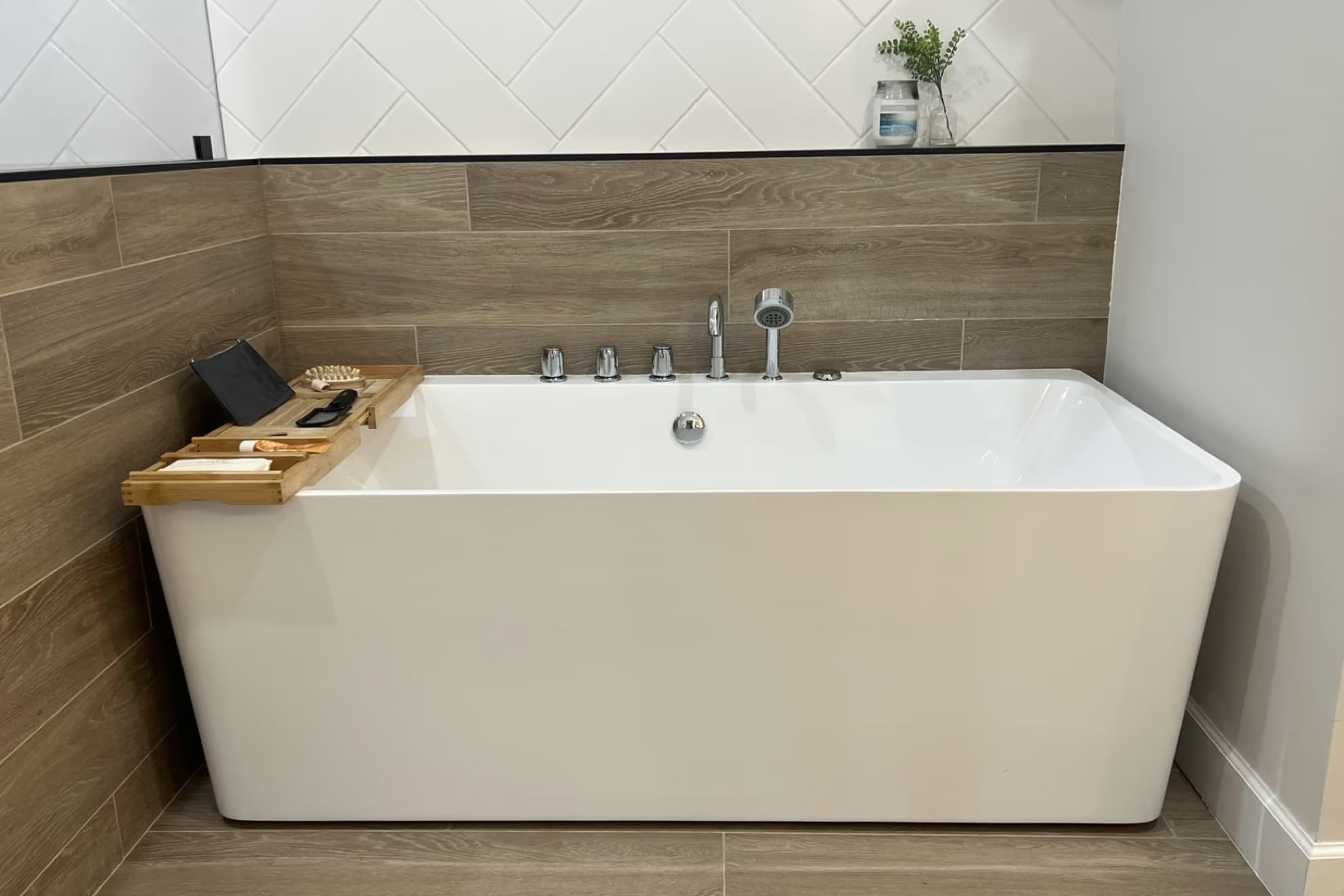
A freestanding tub is a different situation, because it stands on the floor and is not built into anything. It still needs a drain under the spot where its own drain sits, so a freestanding tub in a new position raises the same drain question covered below.
What Actually Happens, In Order
- The water gets shut off and the tub gets drained and disconnected at the waste and overflow.
- The surround comes off. That means the tile or the surround panels, taken back to the studs where the wall needs it.
- The tub gets unfastened from the framing and removed. Older cast iron is heavy enough that it is often broken up to get it out.
- Everything that was hidden becomes visible. This is the step that changes jobs.
- The framing, the ledger, and the drain rough-in get corrected for the new tub.
- The new tub gets set level and fastened, and the drain and overflow are connected and tested.
- Waterproofing and backer go on, then the tile or the surround.
- The valve trim, the spout and the fixtures go on last, and the whole thing gets tested again.
Step 4 is the one that decides everything. If the tub has been failing, water may have been getting behind it, and what is behind it is not known until the surround is off. Any honest contractor tells you this before starting, and prices the known work with a plan for the unknown.
Two Code Requirements That Change the Job
Both of these come from Chapter 27 of the Florida Building Code, Residential, 8th Edition (2023), current as of October 2026.
The valve has a temperature limit
Section P2713.3 requires bathtub and whirlpool bathtub valves to have, or be supplied by, a water temperature limiting device that conforms to ASSE 1070/ASME A112.1070/CSA B125.70. In plain terms, that is a temperature limit that keeps tub water from reaching scalding heat. Combination tub and shower valves are covered by Section P2708.4 instead.
The device has to be able to limit its maximum setting to 120 degrees Fahrenheit, and where it is adjustable, it has to be field adjusted to the manufacturer's instructions so the hot water does not exceed that.
The section also requires access to those devices, with an exception for a nonadjustable device built into a fixture fitting that can itself be reached for replacement.
In plain terms, the valve is a code item and not just a finish choice, and it sits inside the wall you are opening. Swapping the tub does not automatically mean the valve has to be replaced, and the building department for your address decides how the code applies to your existing valve. But with the wall open, this is the easiest time to replace it if it needs it.
A whirlpool tub needs an access opening
Section P2720.1 requires access to the circulation pump in accordance with the manufacturer's instructions. Where the instructions do not specify the location and size, the code says "an opening of not less than 12-inches by 12-inches (305 mm by 305 mm) shall be installed for access to the circulation pump." For a pump set farther back, it says "Where pumps are located more than 2 feet (610 mm) from the access opening, an opening of not less than 18 inches by 18 inches (457 mm by 457 mm) shall be installed."
Section P2720.2 adds that "The circulation pump shall be accessibly located above the crown weir of the trap."
So a whirlpool tub means an access panel exists somewhere, and where it goes is a design decision. Decide it during the drawings, not on the day the tile setter arrives.
The Drain Is the Part That Sets the Schedule
Section P2713.1 of the same code requires a bathtub waste outlet of not less than 1-1/2 inches in diameter, with a water-tight stopper. Where an overflow is installed, it has to be at least that same size.
The size is rarely the issue. The location is.
An alcove tub has its drain at one end, and freestanding tubs vary, with some draining at the center. If the new tub puts the drain within reach of the existing rough-in, the connection is straightforward. If it does not, the drain has to move, and where it moves through decides the week.
If your bathroom sits over a crawl space or above another floor, moving a tub drain means working from below. If your house is on a slab, the drain is in the concrete, and moving it means opening the slab, which is a different job with a different schedule and different inspections. Our tub-to-shower guide explains why Florida slabs change the answer. Before you choose a tub, find out which kind of floor your bathroom has.
This is why "how long does it take" cannot be answered from a photograph of the tub. It can be answered by somebody standing in the room who knows where the drain is and what the floor is made of.
What Decides How Long It Takes
We are not going to publish a number of days, because the honest answer depends on four things, and each of them can be checked before the work starts.
| Factor | What changes the schedule | Who decides |
|---|---|---|
| Drain location | Whether the new drain lines up with the old rough-in, and if not, whether it moves from below or through a slab | The tub you pick and the floor under your bathroom |
| What is behind the surround | Rot or failed waterproofing turns a tub swap into a repair | The condition of the wall, which is unknown until it is open |
| Tile going back | How much wall gets tiled, and the cure times of the setting materials | Your design and the material manufacturer's instructions |
| Permit and inspections | The plumbing rough-in has to pass inspection before the wall closes | The building department for your address |
The permit row comes from Section 105.1 of the Florida Building Code, Building, which says an owner or agent who intends to "erect, install, enlarge, alter, repair, remove, convert or replace any ... plumbing system ... shall first make application to the building official and obtain the required permit."
The building department for your address enforces the code, can add local amendments and its own procedures, and has the final word on how it applies to your job.
One local point can change the paperwork. In unincorporated Lee County, the county's page on substantial improvement and the 50 percent rule says that if a property is in a FEMA flood zone and below the required flood elevation, and the cost of the work equals or exceeds 50 percent of the building's value, "the structure may need to be brought into compliance with current flood regulations" (as of October 2026). A tub that is part of a larger bathroom remodel adds to that cost, so if your home is in a flood zone, ask about it before the scope grows. If you live in a city or in Collier County, ask your own building department how it applies its flood rules. Our kitchen permits guide explains how the 50 percent rule is measured.
Cost follows the same factors as time. Our bathroom remodel cost guide shows typical ranges and what moves them.
What you should get is not a guess. It is a schedule with the unknowns named, and a plan for what happens if step 4 of the removal sequence turns up something.
If you have seen a bathtub replaced in one day, that is usually a different product. Our guide to what a one-day bathroom remodel really includes explains the difference between a liner fitted over the old tub and a tub that is actually pulled out and replaced.
If the Tub Isn't the Real Problem
If nobody bathes in the tub, or getting over the rim is the real problem, a like-for-like replacement solves the smaller problem. Our guide to what a tub-to-shower conversion involves covers that decision, including when keeping a tub is the better call, and designing a bathroom to age in place covers the access question.
Frequently Asked Questions
How long does it take to install a bathtub?
It depends on whether the drain moves, what is found behind the surround, how much tile goes back, and when the permit inspections fall. Setting the tub itself is the short part. Any single number quoted before someone has looked at the drain location and the floor construction is a guess, so ask what happens in each of those four cases.
Do I need a permit to replace a bathtub?
The state code text points to yes. The plumbing exemptions in Section 105.2 of the Florida Building Code, Building cover repairs only where they "do not involve or require the replacement or rearrangement of valves, pipes or fixtures," and a new tub is a replaced fixture. Confirm with the building department for your address before work starts.
Getting the Tub Out Without the Horror Story
Chad is on every HomeWorks project, a single tub swap included, and he owns the company with Lyndee. The company is licensed as a Florida certified building contractor under CBC-1261775 and holds permits in both Lee and Collier County.
Your estimate is built from a recorded site visit, and a 15 percent contingency is disclosed up front, before any work starts. HomeWorks keeps 81 percent of its projects on schedule, and Google reviewers give it 4.8 stars across 60 reviews.
To see finished work, browse a bathroom remodeled by HomeWorks in Southwest Florida. When you are ready, request a quote, and the visit starts in the room with the tub in it.