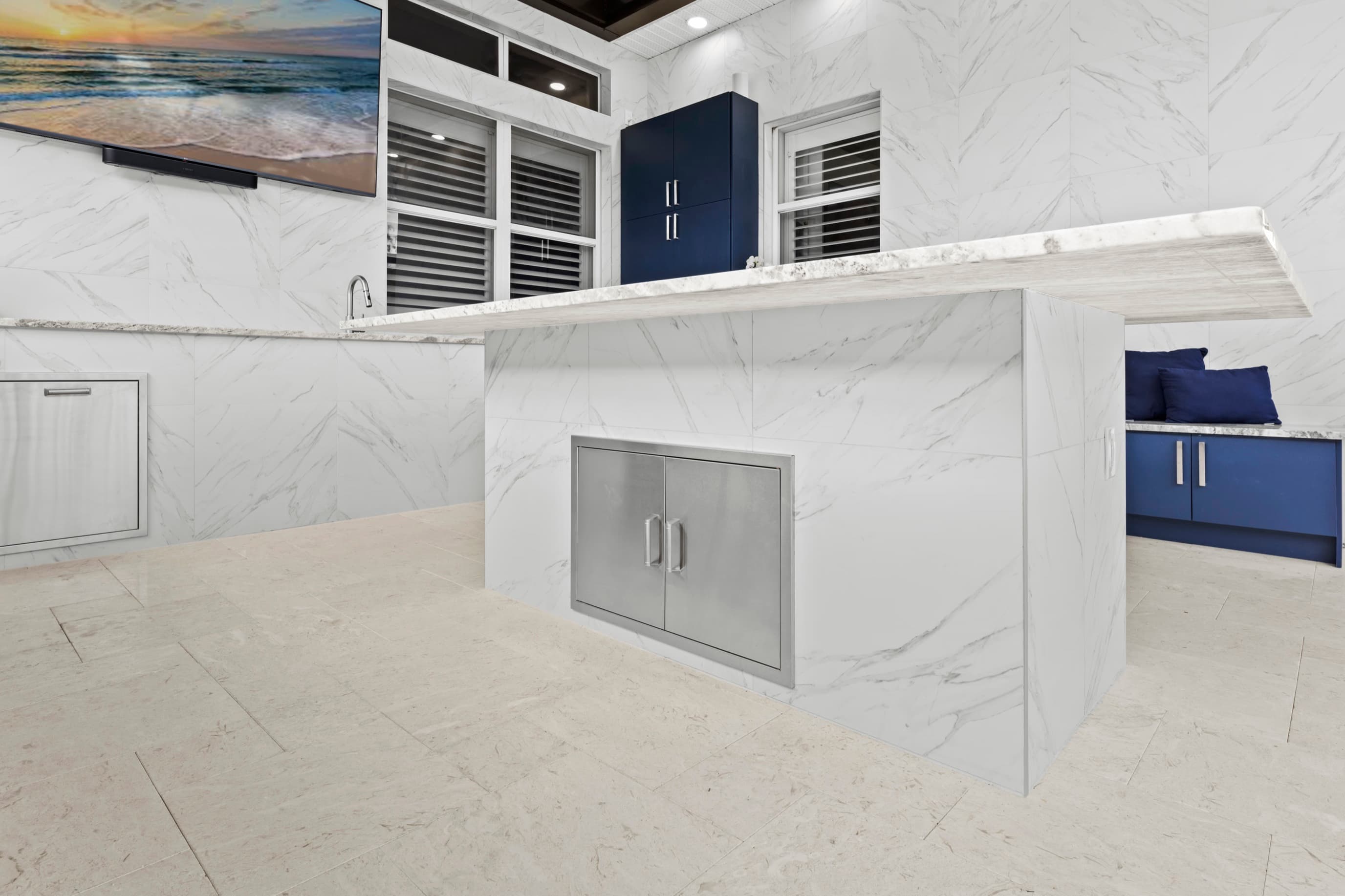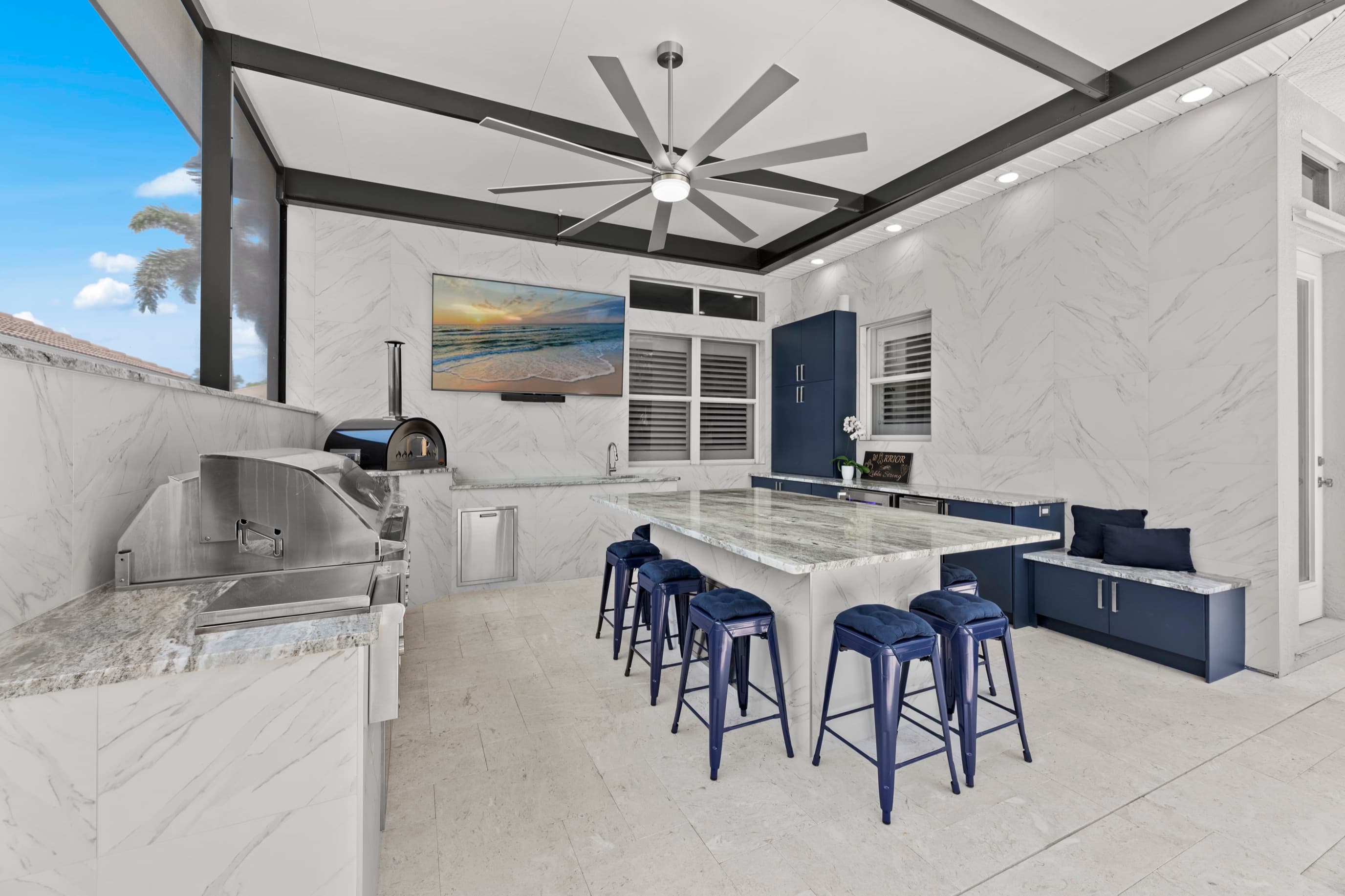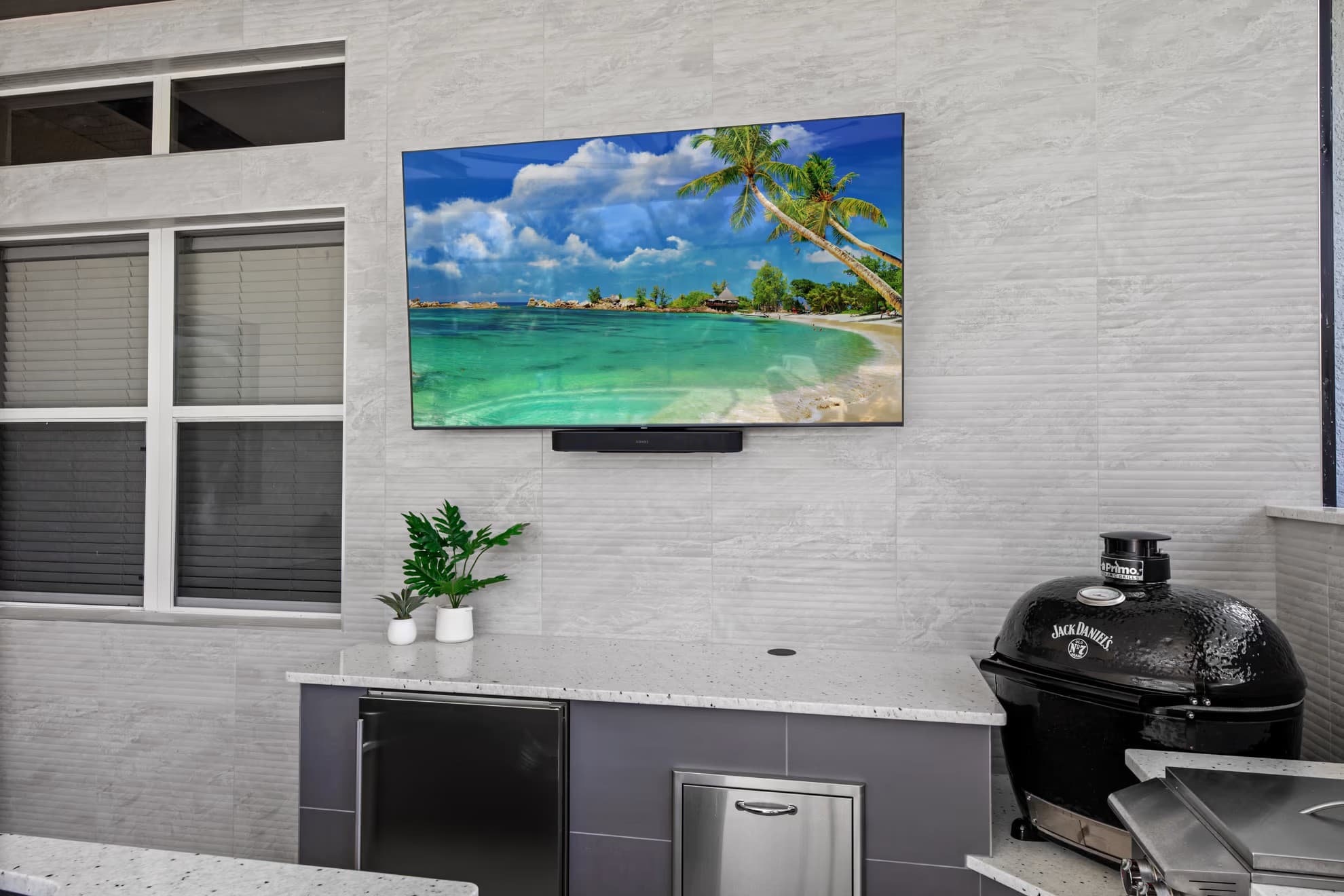
Every outdoor kitchen showroom is built to make the biggest layout look like the only serious option. A grill island with one burner and a plain counter looks like an afterthought next to a display with a fridge, a sink, and a full bar. That doesn't make the smaller one wrong. For plenty of Southwest Florida yards and budgets, a compact BBQ island is the right amount of outdoor kitchen, not a compromise.
The difference between a compact BBQ island and a full outdoor kitchen comes down to how many zones it has, not how well either one is built. A compact island is a built-in grill with a small counter and maybe a side burner. A full outdoor kitchen adds a sink, a refrigerator, and more counter and storage. The right choice depends on how often you cook outside, whether you want to stop walking in and out of the house, and how much usable space you actually have, not on which one looks more impressive.
This post covers that decision. It doesn't cover whether a built-in grill beats a freestanding one, or what a fully custom grill build involves. Those are separate decisions. For how HomeWorks approaches outdoor kitchens overall, see our full guide to outdoor kitchens in Southwest Florida.
What a Compact BBQ Island Actually Includes, and What a Full Outdoor Kitchen Adds
Both are permanent, permitted structures. Neither is a lesser version of the other, they're sized for different uses.
The Compact BBQ Island
A basic grill island needs less room than most homeowners assume. Design guidance from Houzz puts the minimum practical footprint at around 6 linear feet, enough for a grill with counter space on both sides, with roughly 36 inches of total workspace around the grill considered the functional minimum (Houzz). That's one built-in grill, maybe a single side burner, and a small counter, no sink, no refrigerator, no roof structure required. It's still a genuine, permanent structure, not a kit dropped on the patio, and it carries the same permitting requirements covered below. A compact island isn't a smaller version of a full outdoor kitchen that got scaled back. It's a complete project built for a specific use, someone who grills regularly but isn't trying to replace a full kitchen outside.
The Full Outdoor Kitchen
A full outdoor kitchen adds zones, not just square footage. A sink means plumbed drainage and a water line. A refrigerator means its own dedicated electrical circuit, not a shared outlet. More counter and storage space usually means an L-shape or a longer galley layout instead of a straight run. Each of those additions is its own utility connection, which is the real reason a full outdoor kitchen costs more to build than a bigger island with the same materials. It isn't the extra countertop driving the price up. It's everything running underneath it.
How to Tell Which One Fits Your Yard
Three questions settle this decision faster than a showroom tour ever will.
How often do you actually cook outside? If grilling happens a few times a month, not most nights, a sink and a refrigerator outside solve a problem you don't have. A compact island covers that use case completely, and there's no reason to pay for zones that sit unused.
Do you want to stop walking in and out of the house? This is the honest question a full outdoor kitchen answers. A sink means you're not carrying dishes inside mid-cookout. A refrigerator means drinks and marinating meat stay outside instead of a dozen trips through the door. If that's a real daily friction point for how your household actually uses the space, a full outdoor kitchen earns its cost. If it isn't, it's a feature you paid for and won't use.
How much usable space do you actually have? Measure before you decide anything else. A compact island's footprint, roughly 6 linear feet with 36 inches of clearance around the grill, is the honest minimum even for the smallest version (Houzz). If your lanai doesn't clear that after accounting for furniture and walking room, a full outdoor kitchen with more zones isn't realistic there, regardless of budget. On an Estero lanai, the screen enclosure sets the outer edge of what you have to work with.
Answer honestly, not aspirationally. The project that matches how you actually live outside is the one you'll still be glad you built in five years.
Built-In Grill or Propane Tank: Why the Gas Line Changes the Job
Two builds that look nearly identical on paper can carry very different scopes of work once you get into the specifics. A permanent natural gas line extended from the house is treated as code-governed gas piping work that should be installed by a trained, licensed plumber or mechanical contractor, according to building-code consultant Glenn Mathewson (Deck Builder Magazine, reprinted by the International Code Council). A propane tank feeding the same grill doesn't involve extending the house's gas supply at all. That's the practical difference in scope, not just in appliance size: one project runs a permanent utility line, the other doesn't.
Clearance matters too, and it isn't one universal number. How far a built-in grill has to sit from combustible material, cabinetry, wood framing, anything that burns, is set by the grill's own certified listing and installation manual. Building codes call for observing that clearance specifically to reduce fire risk, per the same source cited above. That figure varies by model, so two "built-in grill" quotes for the same lanai can call for different clearance and a different cabinet layout. Always check the specific model's install manual rather than assuming a number.
None of this changes whether a permit is required. Almost any permanent built-in grill setup in Lee or Collier County needs one, small island or full kitchen. A compact island in a Fort Myers backyard is no exception. More on exactly what that process involves is below.
What a BBQ Island Costs vs. a Full Outdoor Kitchen
National cost calculators will give you a per-square-foot average for this, and none of them can see your lanai. Here is the honest local answer instead: at HomeWorks, outdoor kitchen projects run $8,000 to $80,000, and the tiers hold across our whole service area. The $8,000 to $15,000 grill station is exactly the compact end of this decision: a built-in grill, a countertop, and storage, with the gas and electrical already in the number. Add a sink and you add supply and drain lines, which moves the project into the $20,000 to $40,000 mid-range tier. A full outdoor kitchen with more zones, and especially one with a roof structure, climbs from there.
What pushes either option toward the top of that range is rarely the grill itself. It's the utility work: a plumbed sink, a dedicated electrical circuit for a refrigerator, or a permanently run gas line instead of a propane tank, plus the permits and licensed trade work that come with each one.
The real number for your yard depends on the site, the scope, and current material costs, which is exactly why we start every quote with a recorded site visit instead of a catalog price. Every HomeWorks proposal also discloses a 15% contingency up front, so the number you agree to accounts for what a site visit can't always catch in advance. For the more detailed, Southwest-Florida-specific cost breakdown by project tier, see our full cost breakdown for outdoor kitchens built to last here.
Frequently Asked Questions
Does a small BBQ island still need a permit in Lee or Collier County?
Yes, generally. A permanent structure with a gas line extension is treated as code-governed work requiring licensed trades and inspection, regardless of how small the footprint is, per the same code guidance cited above (Deck Builder Magazine, reprinted by the International Code Council). Our walkthrough of the outdoor kitchen installation process covers what that actually involves, step by step.
Can a compact BBQ island be expanded into a full outdoor kitchen later?
Usually, but not for free. Expanding later means cutting back into the existing slab and the existing gas or plumbing runs to add the new zones, rather than building them in from the start. If there's a real chance you'll want a sink or a refrigerator eventually, it's worth deciding the full footprint up front, even if you build it in phases.
Built for How You Actually Use It
The right size isn't the one that photographs best. It's the one that matches how you actually cook and entertain outside, and HomeWorks builds both: a compact island for someone who grills a few times a month, and a full outdoor kitchen for someone who's basically moving dinner outside for good. Every project starts with a real site visit, gets documented in JobTread as it goes, and carries a 15% contingency disclosed before work starts, not discovered halfway through. You can see what a finished build looks like in an outdoor kitchen built by HomeWorks in Southwest Florida.
If you're trying to figure out which size actually fits your yard and your budget, request a free quote. We'll come look at the space and tell you straight.