The permit that never got filed is the one that finds you later. It shows up when you sell the house and the buyer's inspector or permit search turns up an open or missing permit. It shows up after a storm, when an adjuster asks who inspected the structure. Sometimes it shows up as a demand to take the whole thing out.
Here is the short answer. Yes, an outdoor kitchen needs a permit in Lee County and Collier County once gas, electrical, plumbing, or a roof is part of it. That is nearly every outdoor kitchen worth building.
This guide covers what triggers the permit, what the inspections look at, how each county handles it, and who should be pulling the paperwork. Every code statement below links to the actual source so you can read it yourself. For the pricing side, see what an outdoor kitchen costs in Southwest Florida, where the permits are already in the number.
Do You Need a Permit for an Outdoor Kitchen in Florida?
Yes. Florida law makes it unlawful to construct, erect, alter, modify, repair, or demolish a building without first getting a permit from the local building department (Florida Statute 553.79, s. 553.79(1)(a)).
The Florida Building Code says the same thing in more detail. A permit is required to construct, enlarge, alter, or repair a structure, and to erect, install, alter, or replace any electrical, gas, mechanical, or plumbing system the code regulates (FBC Building, 8th Edition, s. 105.1).
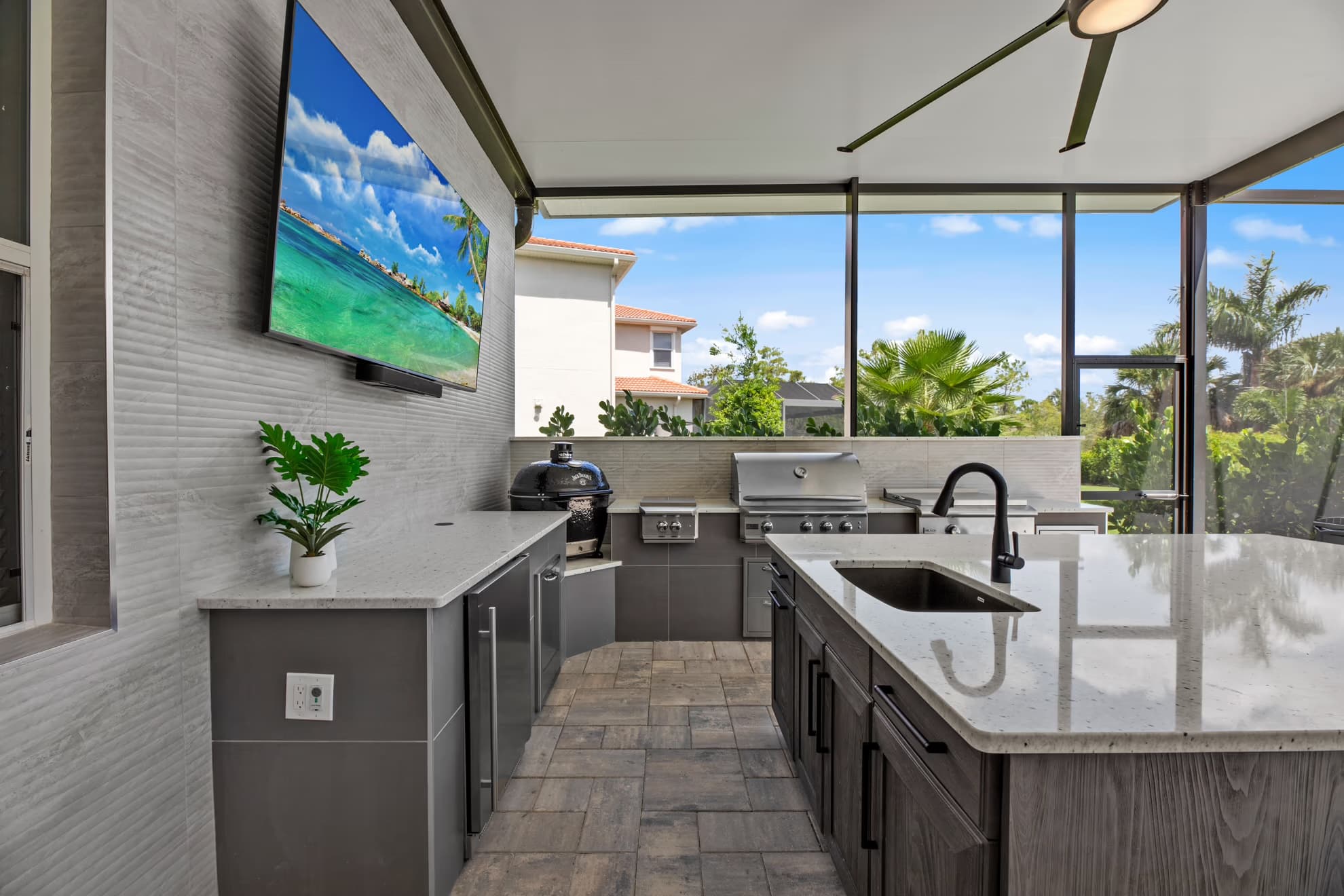
An outdoor kitchen is a structure with a gas system, an electrical system, and a plumbing system attached to it. It hits every trigger in that sentence.
What Triggers a Permit
Any one of these puts your outdoor kitchen under s. 105.1:
- A gas line, natural gas or propane, run to a built-in grill or side burner
- New electrical circuits, outlets, or lighting at the island
- Sink plumbing: a water supply line and a drain
- A pergola, roof, or any covered structure over the cooking area
- Anything structurally attached to the house or to a screen enclosure
You do not need all five. One is enough.
What Does Not Trigger a Permit
A rolling grill on a patio is furniture. So are a table, chairs, and a portable heater. The Florida Building Code exempts portable heating appliances and minor part replacements from a gas permit, and exempts stopping leaks and clearing stoppages from a plumbing permit (FBC s. 105.2).
Each local government also publishes its own list of minor work that needs no permit. Lee County points to FBC 105.2 and to its own Land Development Code s. 6-117, which covers small items like a garden trellis under 200 square feet and under 12 feet tall. The City of Naples publishes an exemption list covering items such as replacing a plumbing fixture or a countertop in the same location. The Village of Estero exempts low-voltage work and a garden trellis under 200 square feet, and states that accessory structures may not include electrical or plumbing.
Read those lists closely. None of them exempt a built-in kitchen with gas and power.
The $7,500 Exemption Does Not Cover Outdoor Kitchens
This is the question homeowners ask most, so here is the plain answer.
Since July 1, 2026, Florida requires local governments to exempt qualifying work valued at less than $7,500 on a single-family home from a building permit. The exemption specifically excludes any electrical, plumbing, structural, mechanical, or gas work, excludes property in a flood hazard area, and forbids splitting a project into pieces to get under the threshold (Florida Statute 553.79, s. 553.79(1)(g); the change came from House Bill 803, and Collier County posts its own notice).
An outdoor kitchen is electrical work, plumbing work, structural work, and gas work. It is excluded four times over. The $7,500 number is real, and it does not apply to your outdoor kitchen.
Inspections an Outdoor Kitchen Goes Through
The permit is the beginning. The inspections are what actually gets signed off.
Required inspections include the foundation, the framing, and a final, and the building official sets their timing and sequence (FBC s. 110.3). On an outdoor kitchen, the gas, electrical, and plumbing work each get their own inspection inside that sequence.
Two of those are worth understanding before you sign anything.
The gas pressure test. Gas piping has to be visually inspected and pressure tested before it is accepted and put into operation (FBC Fuel Gas, 8th Edition, s. 406.1). A pressure test means the line is sealed and charged to prove it holds. Nobody connects a grill to an untested line.
Wind load on a roof or pergola. Buildings, structures, and parts of structures have to be designed for the wind loads in the Florida Building Code (FBC s. 1609.1). Wind load is the force a storm puts on the structure. Put a roof over your kitchen and it gets engineered and reviewed for that force, the same as any other roof. What a permanent outdoor structure has to survive here goes deeper on that side of the build.
Our walkthrough of the outdoor kitchen installation process shows where each inspection lands in the schedule.
Lee County Permits for Outdoor Kitchens
Lee County Community Development issues permits for unincorporated Lee County only. Bonita Springs, Estero, Fort Myers, Fort Myers Beach, and Sanibel each run their own building department.
That distinction matters more than people expect. A Fort Myers mailing address does not mean the City of Fort Myers issues your permit, and the wrong department is wasted time.
Lee County requires a building permit to construct, enlarge, alter, or repair a structure and to install or replace any electrical, gas, mechanical, or plumbing system, and applications run through its eConnect portal (Lee County Building Permit Service). Inspections are scheduled through eConnect or the county's automated system, and subcontractors attach to the permit.
If you are inside a city, start with that city instead:
- City of Fort Myers Building, Permitting and Inspections, through the EnerGov portal (Fort Myers outdoor kitchens)
- Bonita Springs Community Development and its online permit portal
- Village of Estero (Estero outdoor kitchens)
The flood zone rule. If your home sits in a FEMA Special Flood Hazard Area, which is the mapped area where flooding is expected, and the building is below the required flood elevation, Lee County applies a 50 percent rule: when the cost of the work equals or exceeds 50 percent of the building's value, the structure has to be brought into current flood compliance. The county's own cost list excludes items that are not a permanent part of the structure, including plans, permits, pools, screens, sheds, gazebos, and fences (Lee County substantial improvement). Ask about this before you design, not after.
Collier County Permits for Outdoor Kitchens
Collier County building permits run through the Growth Management Community Development Department, and applications go through the CityView permit portal.
The City of Naples runs its own building department. Permits there are required under FBC 105.1 for any electrical, gas, mechanical, or plumbing system, and the city publishes its own list of what is exempt. If you live inside city limits, that is your department (Naples outdoor kitchens).
Collier also posts the county's own exemption list for qualifying work under the state threshold on its building permits page. Read it there rather than taking a contractor's word for what is exempt.
What Happens If You Skip the Permit
An unpermitted outdoor kitchen can stall a future home sale, fail an insurance claim after a storm, or have to be torn out.
Those are not three hypotheticals. They are three ways the same shortcut comes back. A buyer's permit search turns up the missing permit, and the closing stalls until it is resolved. A storm damages the structure, and the claim runs into the fact that nobody inspected it. Or the county learns about the work and the fix is removal.
The homeowner carries all three, not the contractor who is long gone. That is the horror story worth avoiding, and it costs less to avoid it than to unwind it.
Should You Pull Your Own Permit?
Florida lets you. It also hands you the job.
An owner may act as their own contractor on a one-family or two-family residence they own and occupy, as long as it is not for sale or lease. The owner has to personally appear and sign the permit application, and accepts the responsibilities laid out in the statute's disclosure statement (Florida Statute 489.103, s. 489.103(7)(a)).
Read that disclosure before you sign it. You become responsible for the work, for supervising the trades, and for the inspections.
The City of Fort Myers requires proof of license from contractors who pull permits, and tells homeowners to require the contractor to pull the permit in the contractor's name, not the homeowner's. That is good advice everywhere in Lee and Collier.
Here is the tell. A contractor who asks you to pull the permit is asking you to carry their accountability. Verify any contractor's license at the Florida DBPR license search before you hire, and let the licensed party sign for the work.
How HomeWorks Handles Outdoor Kitchen Permits
We handle everything. We pull the Lee and Collier permits, schedule the inspections, run the gas, electrical, and plumbing through licensed trades we manage, and close the permits out. You never set foot in a building department.
The permits are in the quote. They are a line item you can see before you sign, not a fee that appears at the end. No hidden fees, no change-order games.
Permit approval adds 2 to 4 weeks before construction starts in our projects. We tell you that number up front so your schedule is built on the real timeline.
If your kitchen sits inside or beside a screen enclosure, we design the ventilation and the fire clearances that setup requires as part of the plan, before it goes to the county.
Chad and Lyndee started HomeWorks in 2017 with more than 25 years in the trade behind them. The company holds Florida license CBC-1261775 and has run 100+ projects at 4.8 stars across 60 reviews, with 81 percent finishing on schedule. We are a licensed contractor, not a handyman with a truck. Done right, on time, on budget, no excuses.
Questions Before You Start?
If you are planning an outdoor kitchen anywhere in Lee or Collier County, the permit question is worth settling before you fall in love with a layout. We will tell you what your project triggers and what it will take.
Call (239) 880-4700 or request a quote. We will walk your yard, confirm which department covers your address, and give you an itemized number with the permits already in it.
Planning the indoor kitchen too? See our guide to kitchen remodel permits in Lee and Collier County. For what the whole project costs, start with outdoor kitchen pricing by tier or the outdoor kitchens we build.
HomeWorks Construction and Design, LLC. License CBC-1261775. Serving Fort Myers, Estero, Bonita Springs, and Naples.