Every outdoor kitchen showroom wants you looking at the biggest built-in structure on the floor. For plenty of Southwest Florida yards, that's the wrong grill. A freestanding grill is the right answer when you cook outside a few times a month and don't want to commit a permanent structure to it. A built-in earns its cost when the gas line, the ventilation, and the permanent footprint are things you actually want, not things you're being sold.
This post is about that decision, and about what "custom" actually means once you pick built-in. It covers the ventilation a built-in grill's enclosure actually needs, what committing to a gas line and a permanent structure locks in, and what it costs to change your mind later. It doesn't cover choosing between a compact grill island and a full outdoor kitchen, that's a separate sizing question the yard and the budget answer on their own.
For how HomeWorks approaches outdoor kitchens overall, see how HomeWorks builds outdoor kitchens in Southwest Florida.
What "Custom" Actually Means in an Outdoor Grill Build
Custom doesn't mean picking the biggest model in a catalog. It means the grill, the cutout, and the counter height get built around the household that's going to use them, not the other way around.
HomeWorks designs a custom grill build in a single day, in one showroom visit with the client present. The proposal includes Design Flex renderings, so what gets approved is what gets built, not a rough sketch that changes once construction starts.
HomeWorks is a dealer for TrueFlame, American Made Grills, and Primo, which covers gas grills built for coastal conditions and ceramic kamado-style grills, built from ceramic rather than a stainless shell to begin with (AmazingRibs). Coastal conditions are the normal case on a Naples lanai near the Gulf, not the exception. Picking the grill first, before the island gets designed around it, is what makes a build custom instead of a catalog layout with a name on the invoice.
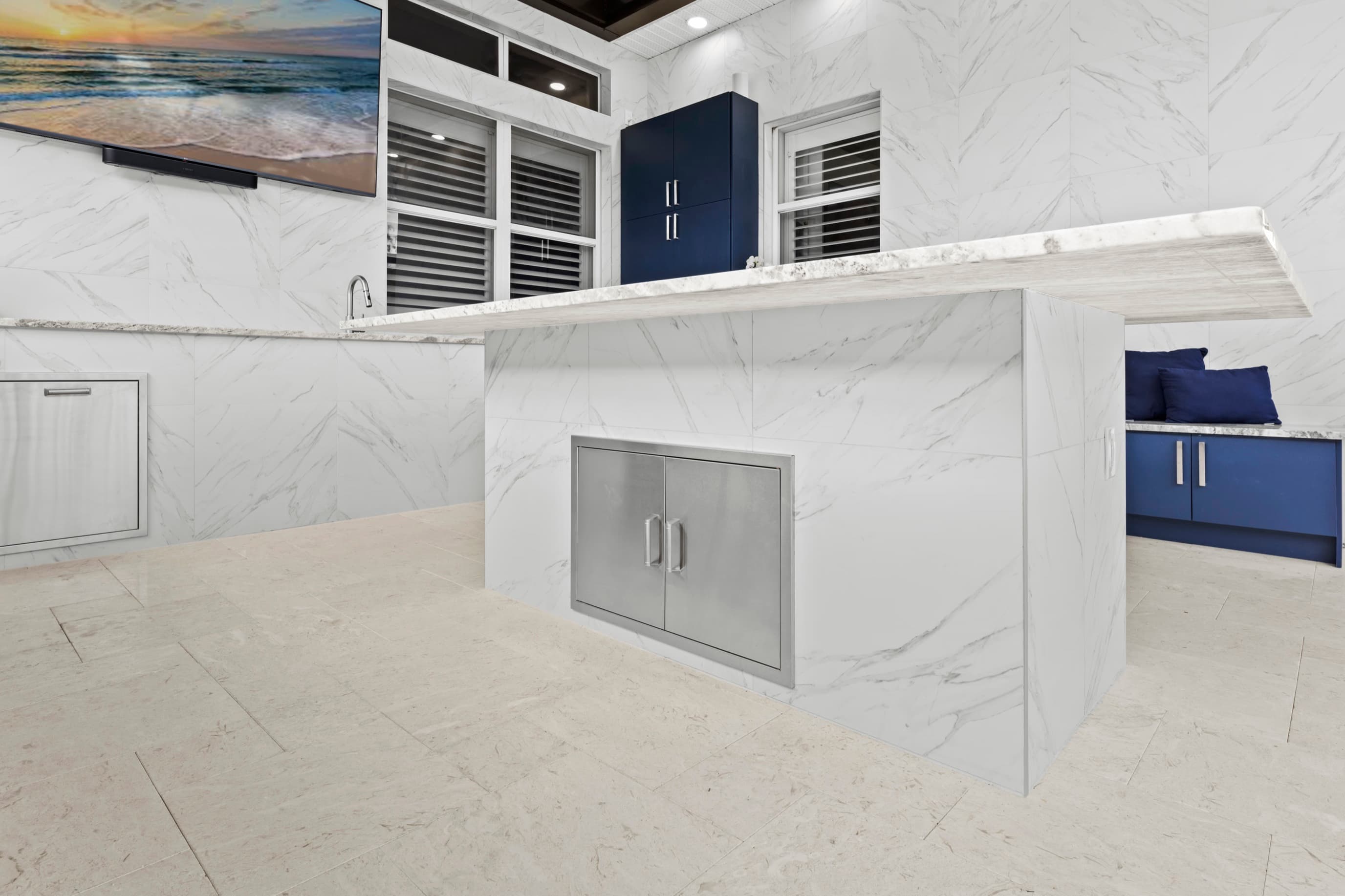
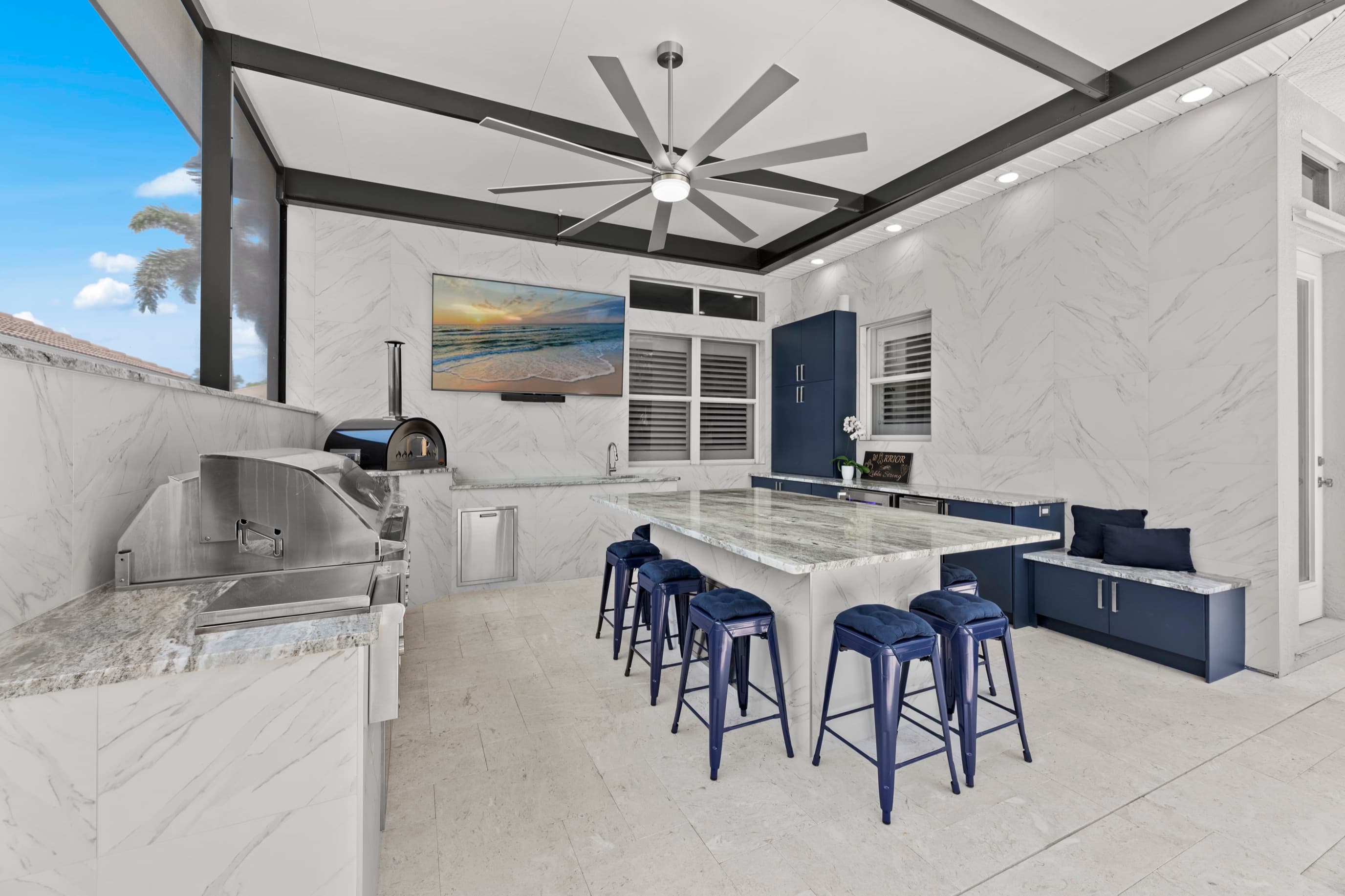
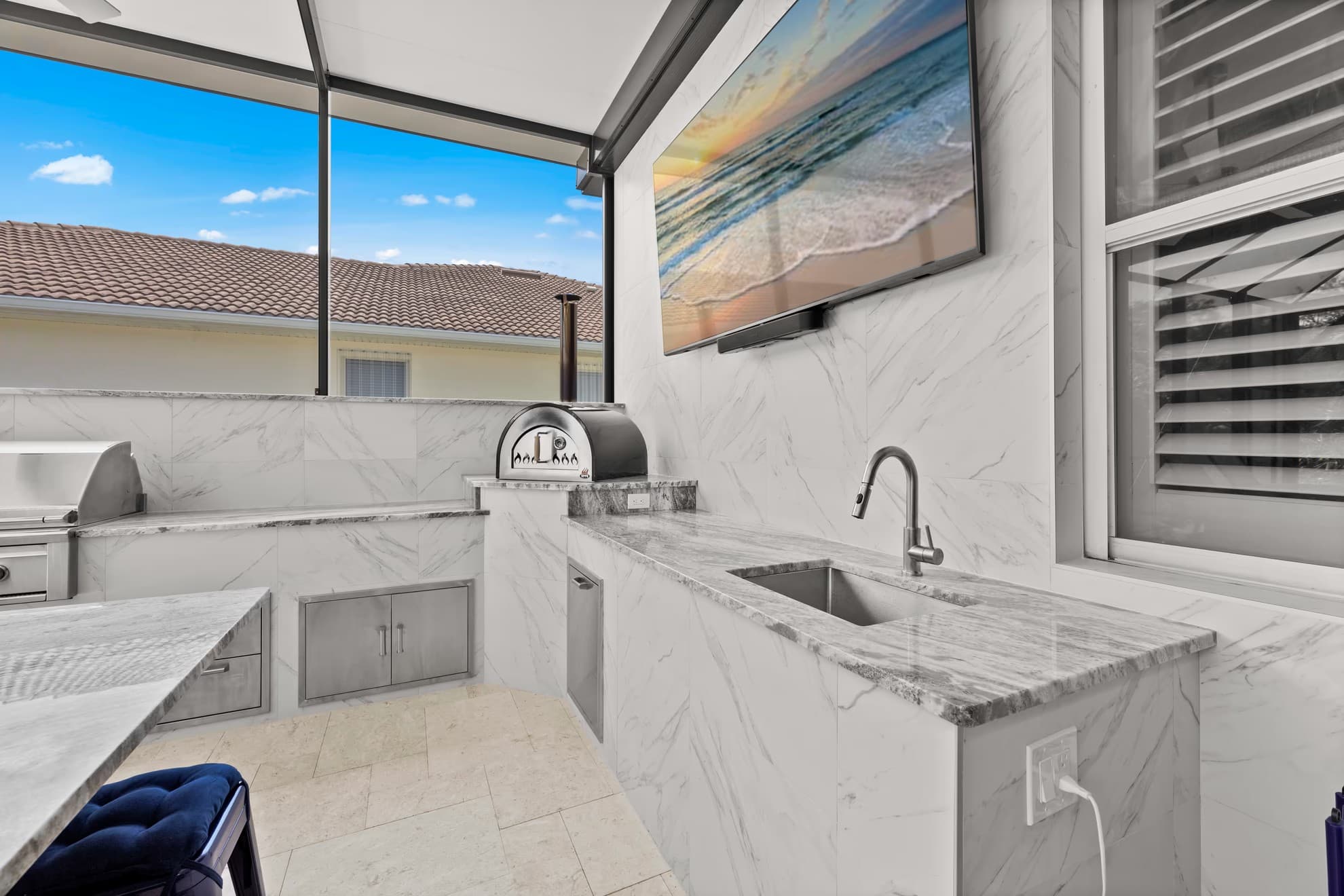
You can see a finished custom grill build, an outdoor kitchen built by HomeWorks in Southwest Florida, for what that actually looks like once it's finished.
Built-In or Freestanding, the Real Difference
The honest version of this decision comes down to four things: how long each one lasts, whether it moves, what it does for resale, and what it actually costs to put in. None of them make one option universally right.
| Freestanding | Built-In | |
|---|---|---|
| What usually fails first | Thin shell, burners, and cart, built to a price | A serviceable head in a masonry or steel structure |
| What the install involves | Delivery and a propane tank | Licensed gas and electrical work, permits, and the structure itself |
| Can you move it? | Yes, it's portable | No, it's permanent once installed |
| Resale relevance | None, it's personal property | Adds to the property |
How long each one lasts mostly comes down to construction. A budget freestanding grill is built to a price, and the thin shell, the burners, and the cart are usually what fail first. A built-in head is built to be installed once and serviced in place, inside a structure that outlives it. What you own is different too: a freestanding grill is personal property that leaves with you when you move, while a built-in is a permanent part of the home. The cost difference follows the same line. A freestanding grill's total cost stays close to its sticker price, since there's no structure being built around it. A built-in is a construction project: the structure, the counter, licensed gas and electrical work, and the permits that come with them. At HomeWorks, that kind of project falls inside our normal outdoor kitchen range of $15,000 to $75,000, and the entry point of that range buys exactly this kind of build: a quality grill, a countertop, a flat top, and a sink.
When Freestanding Is the Right Call
If you cook outside a few times a month, not most nights, and you're not ready to commit a permanent structure or its cost to the yard, a freestanding grill is the right amount of commitment. It isn't a downgrade. It's the correct answer for how a lot of households actually use their yard. It's also the right call if you're not sure yet how much you'll really use an outdoor kitchen. A freestanding grill lets you find out without committing the yard to it first.
When a Built-In Earns Its Cost
A built-in earns its cost when the household already knows it wants a fixed gathering spot outside. On screened lanais in Estero, the enclosure decides where that spot goes. It earns its cost when the longer lifespan and the resale relevance actually matter to the homeowner, and when moving the grill around isn't a feature anyone wants. It also earns its cost once ventilation, the gas line, and the permit process are things you're planning around from the start, not surprises that show up mid-project.
Ventilation a Built-In Grill Actually Needs
A built-in grill isn't just a grill dropped into a hole in a counter. For a propane setup, and propane is the common case here, the cabinet it sits in has to vent, and that's a code requirement, not a design choice.
Propane vapor is heavier than air, which means it settles toward the lowest available space instead of rising and dispersing, according to propane supplier Ferrellgas (Ferrellgas). That's why an enclosed cabinet needs a real way out for it. Grill manufacturer AEI Corporation's own installation guidance for tank enclosures shows what that looks like in practice: two separate vent openings (AEI Corporation). An upper opening sits within about 5 inches of the top of the enclosure. A lower opening sits within about 1 inch of the floor. Each one is sized to at least 3 square inches for every 1,000 BTU per hour of the largest burner's rated input. The venting your specific unit needs comes from its own installation instructions and listing, and it's one of the things the gas inspection checks.
Skipping either opening, or covering them for a cleaner look, is the kind of shortcut that doesn't show up until there's a problem. Gas that can't vent doesn't disperse, it collects.
Natural gas isn't available in about 90 percent of Lee and Collier County. Propane with the homeowner's own tank is the norm here, and HomeWorks builds for either, which is why the propane venting rules above are the relevant case for most Southwest Florida built-ins, not the exception. On Fort Myers lanais, that's the setup we build around.
The gas line itself, and how far the grill has to sit from anything combustible, is a related but separate question, one that depends on the specific grill's certified listing and installation manual.
What a Built-In Commits You To
A built-in grill is married to its cutout. Grill manufacturers change model dimensions or discontinue models often enough that replacing a built-in grill head with the exact same model later is possible only rarely, according to grill retailer Gas Grill Warehouse (Gas Grill Warehouse). Switching brands, or upgrading a decade later, usually means finding a new grill that fits an old cutout, not the other way around.
That's the tradeoff for the built-in's durability and permanence covered above. Once it's installed, it isn't moving. A freestanding grill you regret can go to the curb. A built-in you regret is a demolition and a rebuild.
A permanent structure is also exposed to the same wind and storm questions as the rest of an outdoor kitchen. What a permanent structure has to survive here is covered in full elsewhere. The point here isn't to re-explain hurricane-rated construction, just to note that the commitment runs both directions: a built-in lasts longer, and it also has to survive what Southwest Florida throws at it.
Frequently Asked Questions
Can a built-in grill run on propane, or does it need natural gas?
Yes. Natural gas isn't available in about 90 percent of Lee and Collier County, so propane with the homeowner's own tank is the norm here, and HomeWorks builds for either.
Can I replace a built-in grill later with a different brand?
Usually not as a simple swap. Cutout dimensions are brand-specific and model-specific, and manufacturers change them often enough that matching an old cutout to a new grill is the real constraint, not preference. Sizing the outdoor grill correctly before the island gets built around it is where this decision actually gets made.
Does a freestanding grill need the same permit as a built-in?
Not usually. A permit is required for any work that touches potable water, electricity, or gas. A freestanding grill on its own propane tank isn't tied into the house's water, electrical, or gas systems, so it generally doesn't trigger that requirement. A built-in almost always does, whether that's a gas line, a dedicated electrical circuit, or both, which is part of why it costs more to install and why it takes longer to plan around.
The Grill You'll Actually Use, Not the One That Photographs Best
The right choice isn't the one that looks most impressive in a showroom. It's the one that matches how the household actually cooks and gathers outside. HomeWorks builds both: a freestanding setup for someone who grills a few times a month, and a custom built-in for someone who's ready to commit the yard to it permanently.
Every project starts with a recorded site visit, gets documented in JobTread as it goes, and carries a 15% contingency disclosed before work starts, not discovered halfway through.
Call us at (239) 880-4700 or request a free quote. We'll come look at the space and tell you honestly which one actually fits.