The cabinet looked fine on the showroom floor, or in the rendering you approved before construction started. A season or two into Gulf coast salt air and summer heat, the finish yellows, a drawer box swells and starts sticking, or rust streaks show up on the hinges. Of everything that goes into an outdoor kitchen, cabinet material is the decision that matters most and shows the least at the time you make it.
There's no single best material for outdoor kitchen cabinets that works everywhere. For Southwest Florida specifically, marine-grade HDPE polymer is built for this climate. PVC and stainless steel each work, under the right conditions. "Composite" is more of a marketing term than a standardized material, and that's worth knowing before you sign off on a spec sheet. This post compares outdoor kitchen cabinet materials on the criteria that actually decide how long they last here: salt air corrosion, humidity, UV exposure, and thermal cycling. Countertops, framing, and exterior finishes are their own decision, covered separately, not here.
The Four Materials, Compared for Southwest Florida
Every one of these materials will look good in a showroom. What separates them is what happens after a few years of chloride in the air, standing humidity, direct sun, and a slab that heats up well past ambient temperature every afternoon.
| Material | Salt Air / Chloride Resistance | Humidity Tolerance | UV Behavior | Thermal Cycling | What Fails First |
|---|---|---|---|---|---|
| Marine-Grade HDPE Polymer | Excellent, non-porous and does not corrode | Excellent, does not absorb water | UV-stabilized against chalking and fading | Moves predictably, expansion gaps engineered for it | Rarely fails outright; cosmetic wear over decades |
| PVC | Good, non-porous | Good, resists moisture and mildew | Can lose shape and stiffness if surface temperature runs too high | Meaningfully higher expansion than wood, needs room to move | Heat distortion in dark colors in direct sun |
| Composite | Depends entirely on what it actually is, see below | Depends on the underlying material | Depends on the underlying material | Depends on the underlying material | The undefined spec itself, before any physical failure |
| 304 Stainless | Marginal near the coast | Good | Not UV-sensitive | Nearly identical to 316 | Visible chloride corrosion on hardware and edges |
| 316 Stainless | Correct choice for coastal sites | Good | Not UV-sensitive | Nearly identical to 304 | Cost is the tradeoff, not durability |
Polymer Outdoor Kitchen Cabinets: Built for This Climate
HDPE, high-density polyethylene, is non-porous. It does not absorb water or saltwater, which is the mechanism that matters more than any marketing claim: a material that cannot absorb moisture cannot swell, cannot rot, and cannot host the mold growth that ruins a porous cabinet from the inside. It is also UV-stabilized against chalking and fading (Piedmont Plastics), which is why HDPE cabinets that have sat outside for years still hold their color. It's the same reasoning behind the one line on outdoor cabinetry in our guide to remodeling for Florida's humidity, which covers indoor kitchen cabinets in depth and points outdoors to marine-grade material without expanding on it. This is that expansion.
It does move with temperature, just predictably. King StarBoard, a benchmark marine-grade HDPE sheet product, expands and contracts at roughly 6×10⁻⁵ inches per degree Fahrenheit, about 1/32 inch per linear foot across a 40 degree swing (King Plastic Corporation). A cabinet built with that in mind, with the right expansion gaps at joints and edge banding, handles a Southwest Florida summer without binding doors or cracked seams. That predictability, more than any single spec, is why this is the default recommendation for coastal cabinetry.
There's a warranty nuance worth understanding before you compare quotes, and it gets its own section below.
PVC Outdoor Kitchen Cabinets: Where Southwest Florida Heat Becomes the Real Problem
PVC outdoor kitchen cabinets are non-porous, the same underlying property that makes HDPE work outdoors, which is part of why PVC shows up as an outdoor cabinet material at all. The part that a mild-climate comparison article misses is what direct Florida sun does to it.
Cellular PVC has a heat distortion temperature of roughly 145 degrees Fahrenheit. Above that, it starts losing its shape (ThisIsCarpentry.com, quoting John Pace, president of PVC trim manufacturer Versatex). A dark-colored PVC surface in direct sun on a west-facing lanai can push past that threshold, which is exactly why manufacturers restrict full warranty coverage to paint colors with a Light Reflectance Value of 55 or higher. A darker finish that looks right in the rendering can void the warranty in practice. That's a Southwest Florida-specific detail, not a generic PVC caveat, because it only becomes a real risk where summer surface temperatures actually get this high.
PVC also moves more than wood does with heat. Rigid PVC expands at roughly 3.5×10⁻⁵ inches per inch per degree Fahrenheit, and cellular PVC at roughly 4.5×10⁻⁵, both meaningfully higher than wood's roughly 0.0000027 to 0.0000028 (InspectAPedia). Joinery has to be built to account for that movement, the same way it does with HDPE.
Composite: A Marketing Term, Not a Standardized Material
This is the category where honesty matters more than a confident-sounding spec sheet. "Composite" does not describe one standardized material in outdoor kitchen cabinetry. In practice it usually means one of two things: a fiber-cement backer panel installed behind stone or stucco cladding, a real manufactured product built specifically for this use (NewAge Products), or marketing shorthand for the same marine-grade polymer already covered above.
Both of those are fine choices when you know which one you're actually getting. Neither is fine when "composite" is the entire spec on a quote. If a vendor lists composite outdoor kitchen cabinets, ask them to name the actual base material, fiber-cement backer, HDPE polymer, or something else, before you compare it against anything else on this list. In coastal Bonita Springs, that answer decides how long the cabinet lasts. A material name that can mean two different things isn't a spec, it's a placeholder.
Stainless Steel: 304 vs. 316, and Why It Matters More at the Coast
Most mass-market stainless cabinet hardware and framing uses 304 stainless, roughly 18% chromium and 8% nickel. 316 stainless, sometimes called marine grade, swaps in roughly 16% chromium, 10% nickel, and 2% molybdenum (Masteel UK). That molybdenum is what significantly improves resistance to chloride-driven pitting corrosion (Klöckner Metals), which is exactly the kind of corrosion salt air causes. Near the Gulf, that difference shows up as visible corrosion on hardware and edges over time with 304, and it doesn't with 316.
It's worth knowing that heat isn't what separates these two grades. Their thermal expansion rates are nearly identical, 304 at roughly 17.3 ppm per degree Celsius and 316 at roughly 16.0 (InspectAPedia). Corrosion resistance is the entire difference, not how the metal handles a hot afternoon. For a site within a few miles of the Gulf, 316 is the correct specification for cabinet hardware and framing. That's the spec we write for Naples homes near the water. For how HomeWorks specifies coastal-rated stainless across an entire build, including appliances, see our guide to building an outdoor kitchen that survives Florida hurricanes.
The Warranty Question: Raw Material vs. Finished Cabinet
Here's a detail that's easy to miss when comparing quotes: a warranty length quoted for HDPE can describe two completely different things. King Plastic Corporation's own warranty on raw King StarBoard sheet stock, the material before anyone builds a cabinet from it, covers 60 days, replacement or refund only (King Plastic Corporation). A finished-product manufacturer, DuroGreen, warrants its assembled HDPE outdoor furniture and cabinetry against cracking, splintering, chipping, rot, or peeling for 20 years residential use and 5 years commercial use (DuroGreen Outdoor).
Neither number is wrong. They're answering different questions. The 60-day figure covers the raw sheet, the 20-year figure covers a finished, assembled cabinet from a specific manufacturer standing behind its own construction. If a quote leads with a warranty length, ask directly whether it covers the material or the finished cabinet as built. That single question tells you more than the warranty number by itself.
Where Cabinet Choice Ends and the Rest of the Kitchen Begins
Cabinet material is one decision in a build that also includes countertops, framing, and exterior finishes, each with its own failure modes and its own material tradeoffs for a coastal climate. That's a separate set of decisions from the one covered here.
Frequently Asked Questions
Is marine-grade HDPE the same thing as plastic outdoor kitchen cabinets?
Not the thin, budget kind. Marine-grade HDPE is a dense, UV-stabilized, non-porous engineered polymer built specifically for continuous outdoor and marine exposure. Thin injection-molded plastic outdoor kitchen cabinets sold as a budget option are a different product entirely, without the same UV stabilization or resistance to warping under heat.
Do outdoor kitchen cabinets need a vapor barrier or waterproofing behind them?
Material choice affects what happens if water does reach the cabinet, not whether the surrounding structure needs to manage water and drainage in the first place. How a specific build handles waterproofing and drainage behind the cabinetry is a construction detail that gets worked out during design, not something a material comparison alone can answer.
Ready to Specify the Right Cabinet Material?
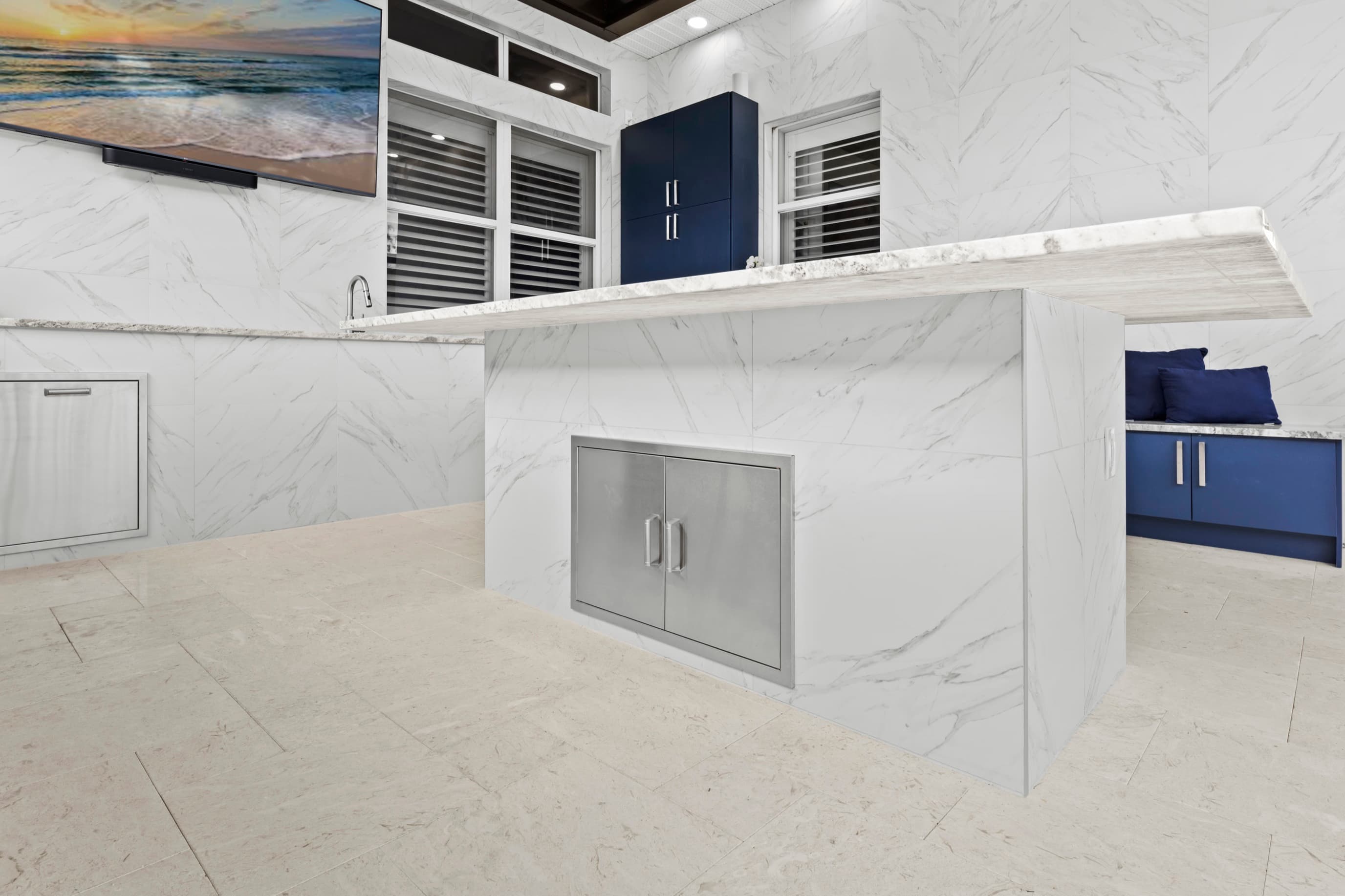
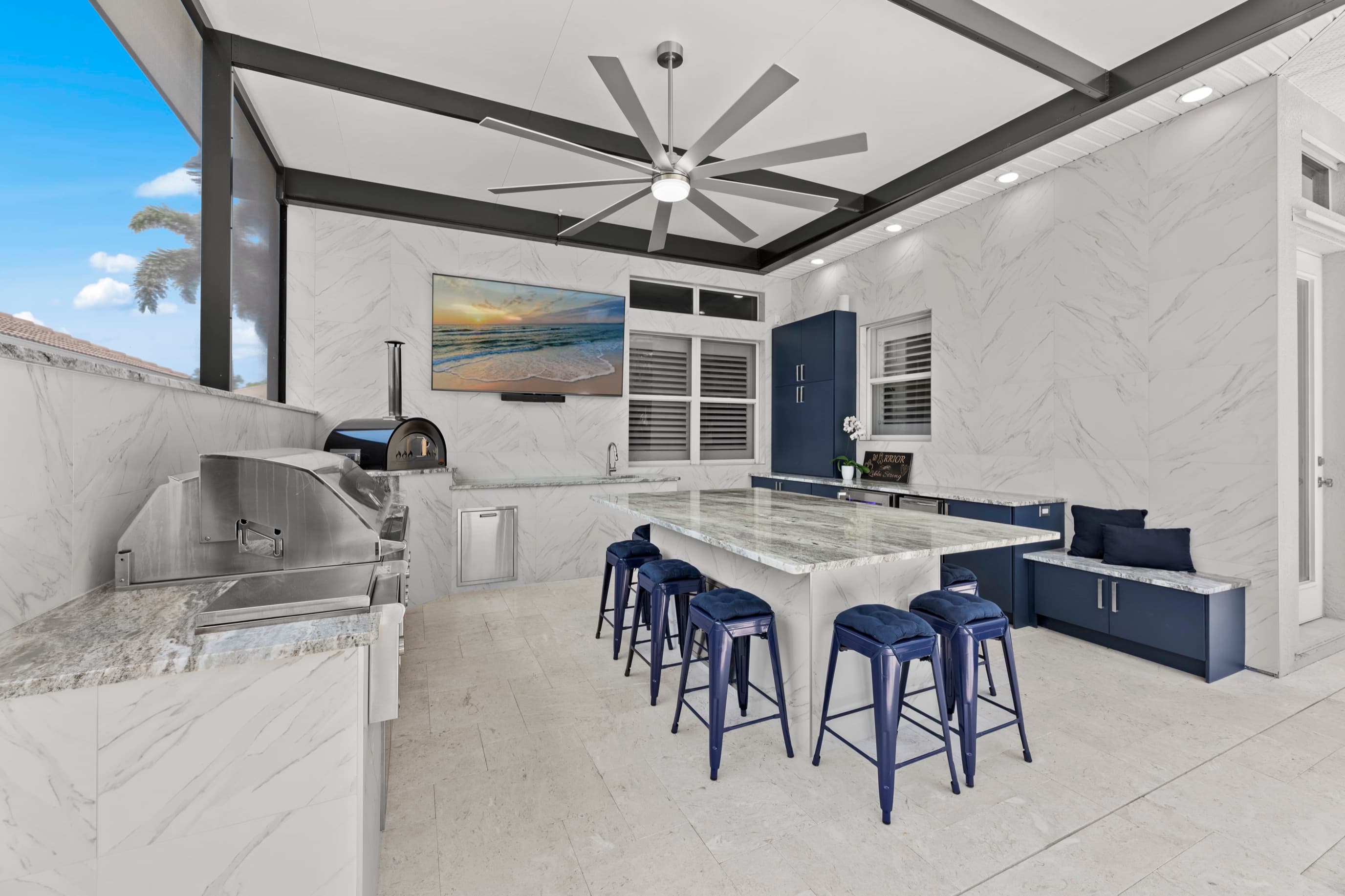
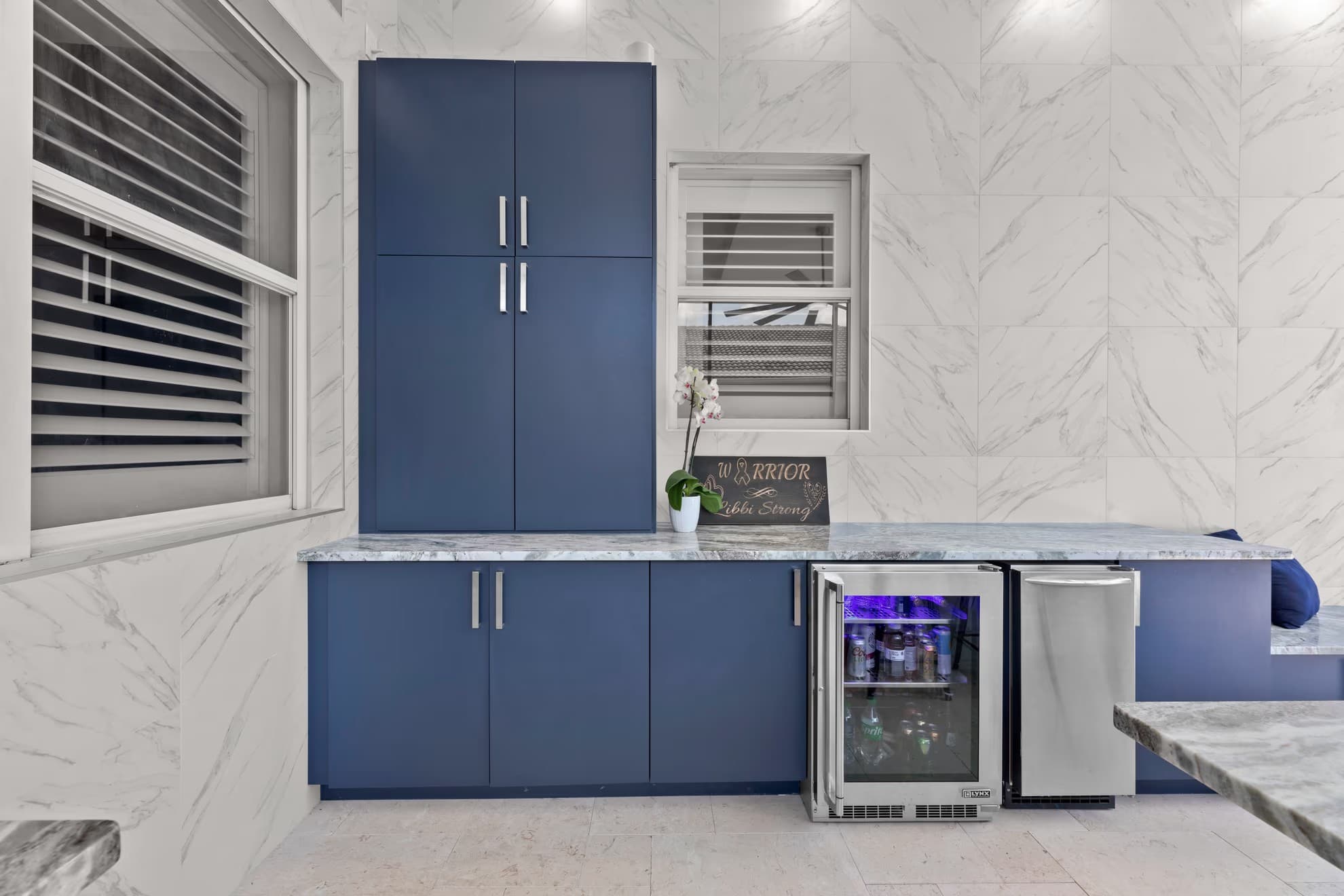
Getting this decision right up front is a lot cheaper than replacing swollen or corroded cabinets a few years in. HomeWorks specifies coastal-appropriate cabinet materials as a matter of course on every build, not as an upsell, the same way we approach outdoor kitchens across the rest of the project. You can see what that looks like finished in an outdoor kitchen built by HomeWorks in Southwest Florida.
If you're planning an outdoor kitchen and want a straight answer on which materials make sense for your site, request a free quote.