Every outdoor kitchen on a showroom floor looks great. Most of them wouldn't survive a Southwest Florida summer, let alone a Category 1 hurricane.
The problem isn't design — it's that the outdoor kitchen industry is largely driven by aesthetics, and most products are built for mild climates. There's a big difference between an outdoor kitchen built for a backyard in California and one that needs to hold up against Gulf-coast salt air, 90% humidity, 150+ mph wind gusts, and driving rain for decades.
This guide covers what actually lasts in SW Florida: the materials, the construction methods, the permits you need, and what to expect to spend.
Why Most Outdoor Kitchens Fail in Florida
Standard Stainless Corrodes
Not all stainless steel is equal. Most mass-market outdoor kitchen components use 304 stainless steel — the same grade used in commercial kitchen equipment. It holds up fine in dry climates and many inland areas. In coastal Southwest Florida, it's not adequate.
304 stainless corrodes visibly in salt air environments. The mechanism is chloride-driven pitting from airborne salt, and it shows up as rust streaks on appliance faces, cabinet edges, and hardware (Klöckner Metals). The closer a site sits to the Gulf, the more chloride reaches the metal and the sooner the streaks appear.
316 stainless (sometimes called "marine grade") has a higher molybdenum content that makes it significantly more resistant to chloride corrosion (Masteel UK). It costs more. For coastal SW Florida, it's the correct specification.
Wood-Frame Islands Rot
A significant portion of the outdoor kitchen industry sells prefabricated islands built on a wood stud frame — covered with cement board or a stone veneer exterior. They look solid. They are not.
Wood framing in a SW Florida outdoor environment gets wet repeatedly — from rain, from dew, from humidity. Eventually, the wood rots. The island structure becomes compromised. Tile pops off as the substrate moves. Mold grows inside the framing cavity.
Wood decay fungi need moisture, oxygen, and a mild temperature range, and a Southwest Florida outdoor kitchen frame supplies all three over and over for as long as it stands (USDA Forest Service, Forest Products Laboratory). A wood frame outdoors here is a question of when decay establishes, not whether. Concrete block and steel do not feed that process, which is why they are the standard for structures built to stay.
Unsealed Countertops
Natural stone (granite, quartzite) used outdoors needs to be properly sealed before installation and resealed when the sealer's rated life runs out. A countertop installed without sealing, or sealed and never maintained, will absorb moisture and stains.
Concrete countertops outdoors are even more demanding — they require robust sealing and can develop hairline cracks from thermal cycling.
Unpermitted Builds Blow Apart
An outdoor kitchen that isn't anchored to the concrete slab — or that's built as a freestanding unit that can be moved — is a projectile in a hurricane. The number of unpermitted outdoor kitchens that became neighbor-damaging debris during Ian and Irma is not small.
Beyond the structural issue, unpermitted structures create real problems:
- Insurance claims can be denied for hurricane damage to unpermitted structures
- Unpermitted additions are disclosed at sale and can kill deals or require removal
- Neighboring property damage from your structure's debris is a liability issue
The Catalog Photo Problem
Outdoor kitchen catalogs and Instagram accounts show gorgeous spaces that were photographed the week they were installed — in California, Arizona, or a studio. They don't show you what those same kitchens look like after two SW Florida summers and a tropical storm.
The visual reference that most homeowners are working from doesn't exist in this climate. Your outdoor kitchen needs to be spec'd for the environment it's actually in.
Materials That Last in SW Florida
Cabinets and Enclosure
Marine-grade HDPE polymer is the best cabinet material for Florida coastal outdoor kitchens. HDPE (high-density polyethylene) is the same material used in cutting boards and marine dock hardware. It doesn't corrode, doesn't absorb moisture, doesn't rot, and holds color well. You can hose it down, leave it in the rain, and it will be fine. Premium brands (Werever, Danver HDPE) carry meaningful warranties.
Downside: It's not cheap, and the appearance is more utilitarian than cabinetry. For homeowners who want the furniture aesthetic, it's a compromise.
Powder-coated aluminum is the next tier. Aluminum doesn't rust. Powder coating protects the finish. Well-built powder-coated aluminum outdoor kitchen frames hold up well in SW Florida if the coating is thick and complete (no bare spots that allow moisture entry). Look for commercial-grade powder coating, not decorative.
304 stainless is acceptable inland but marginal within 5 miles of the coast. 316 stainless is the correct choice for coastal sites — expect 30-50% premium over 304.
What to avoid: Anything with wood framing, MDF, or particleboard substrates. Any prefabricated island that doesn't specify its frame construction.
Countertops
Porcelain slab (2cm or 3cm thickness) is an excellent outdoor countertop for Florida. Non-porous (no sealing required), UV-stable (doesn't fade), extremely hard, and weather-resistant. Large-format porcelain slab countertops are increasingly the default spec for high-end outdoor kitchens. Looks like natural stone. Performs better outdoors.
Sintered stone (Dekton, Neolith, Lapitec): Ultra-compact surface made by fusing minerals under extreme heat and pressure. Zero porosity, no sealing, UV-stable, thermal shock resistant. Very good choice for outdoor use in Florida. Premium pricing.
Sealed granite or quartzite: Works well outdoors when sealed with a quality penetrating sealer, and the maintenance commitment is smaller than often claimed. The Natural Stone Institute's consumer guidance puts a quality penetrating sealer's life expectancy at 10 to 15 years, and notes that most granite does not strictly need sealing at all (Natural Stone Institute). If you choose natural stone, use a penetrating sealer (not topical) rated for outdoor use, and treat resealing as a once-a-decade task.
What to avoid: Quartz (engineered stone with polymer resin) — the resin degrades with UV exposure. White or light quartz will yellow outdoors. Most quartz warranties explicitly exclude outdoor use. Marble — porous, etches with acids (citrus, rain), high maintenance outdoors.
Framework: Concrete Block vs. Steel
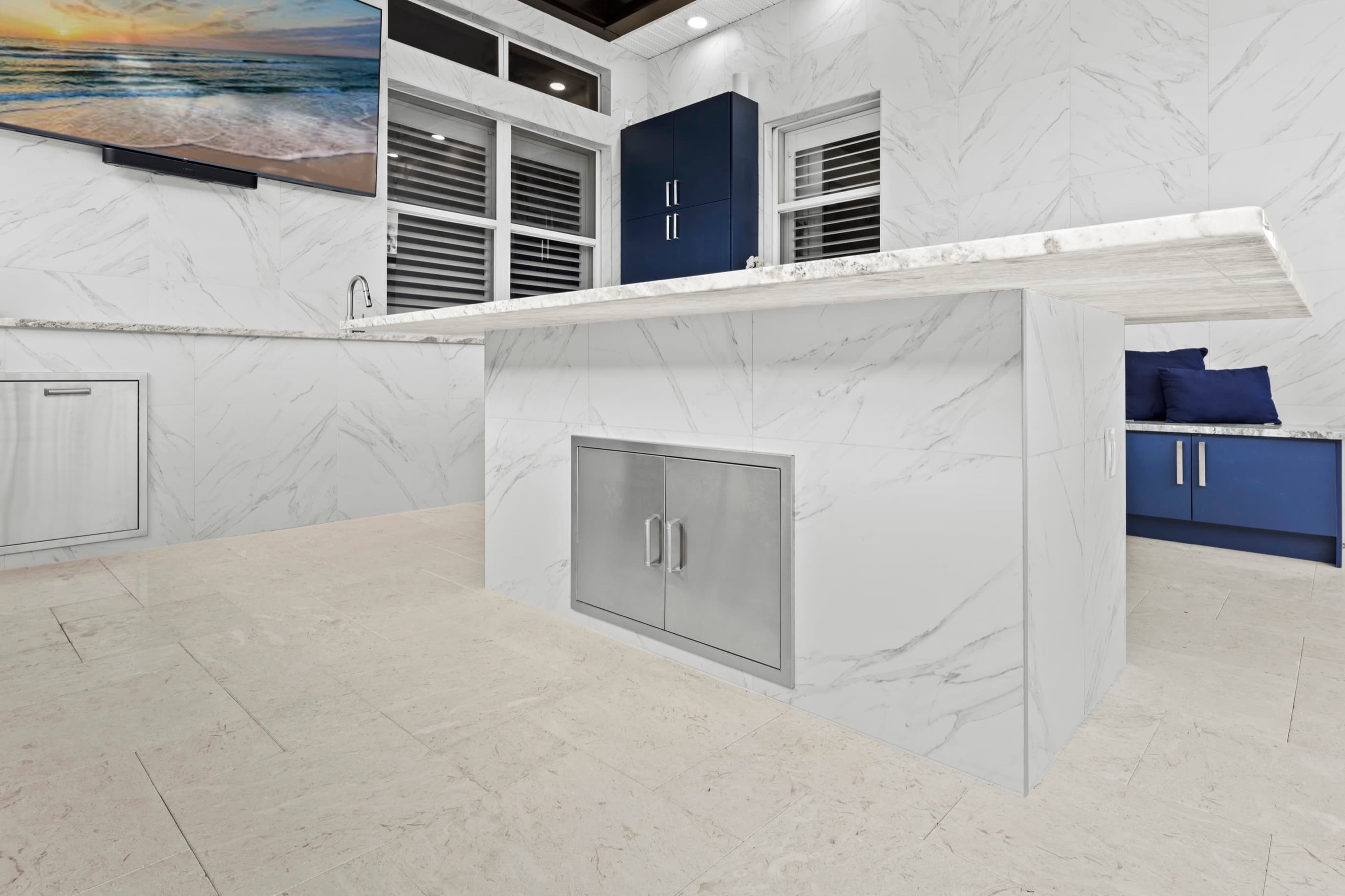
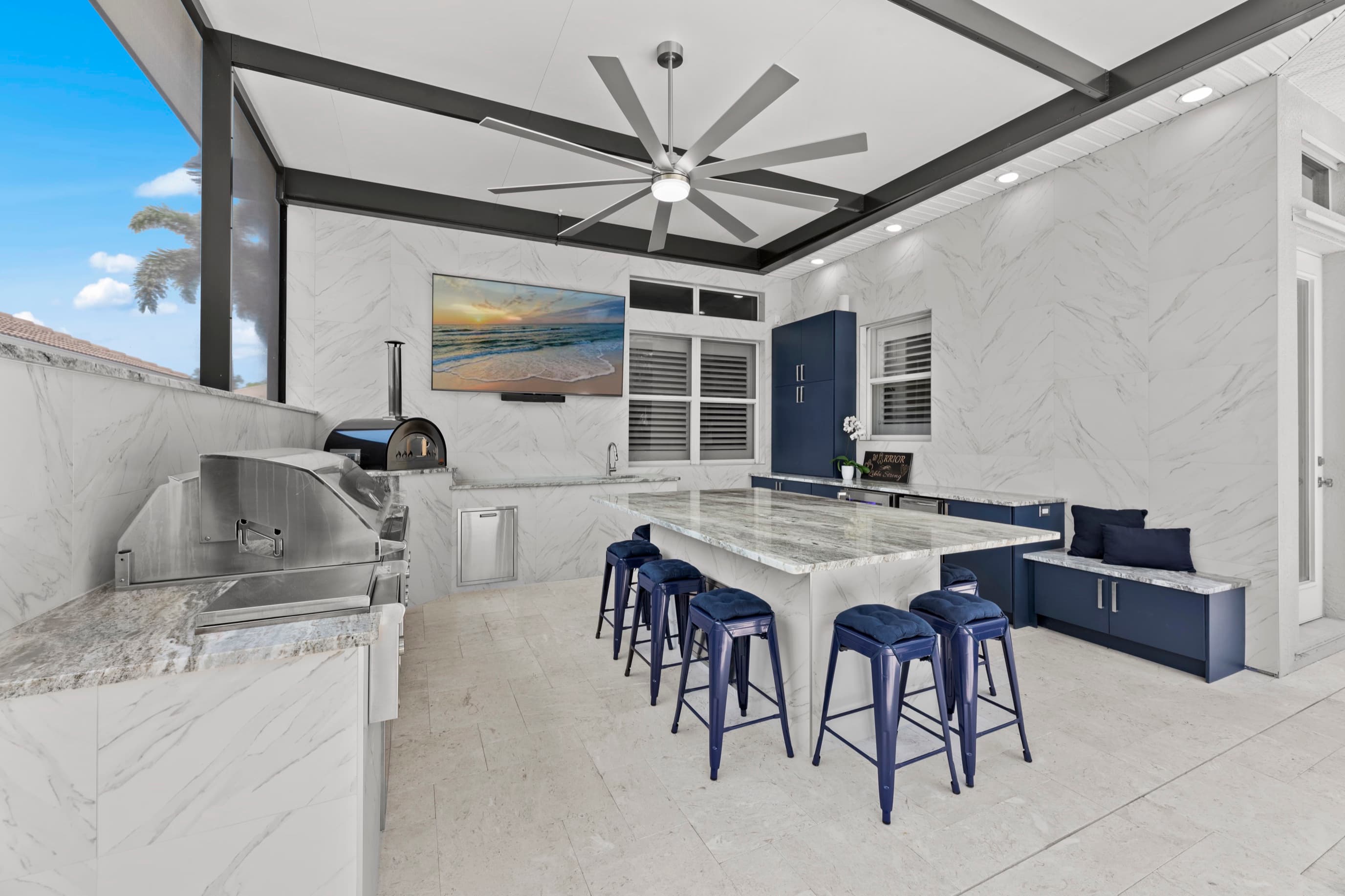
Concrete block (CBS) with stucco is the best outdoor kitchen frame for Florida. It's the same construction method as the homes themselves — which tells you everything. Impervious to moisture, rot, and insects. Handles hurricane loads when properly anchored to the slab. Finishes with stucco, tile, or stone veneer. Permanent. Requires a permit.
Steel frame (hot-dipped galvanized or powder-coated steel studs) is the second option. Doesn't rot like wood, handles wind loads better than wood framing. Requires proper sheathing and waterproofing. Used in commercial applications and some higher-end residential builds.
What to avoid: Standard wood framing (2x4 or 2x6 PT lumber used as the primary structure). It will rot. It will fail. It will look fine for a few years and then get worse fast.
Appliances: 304 vs. 316 Stainless
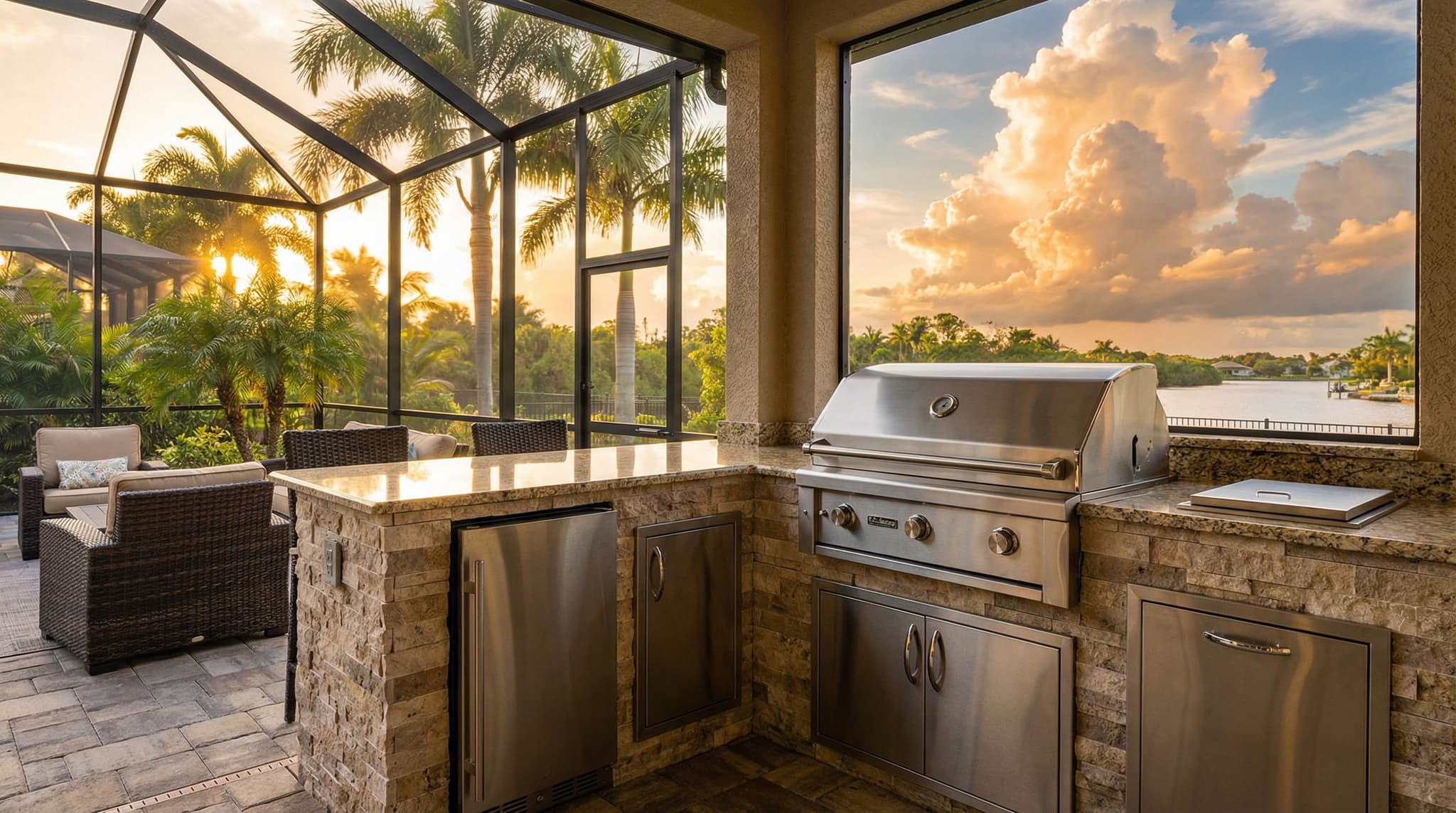
If you're building an outdoor kitchen within a few miles of the Gulf, specify 316 stainless appliances. The major grill manufacturers offering 316 grade or "coastal" lines include:
TrueFlame — HomeWorks is an authorized TrueFlame dealer. Their coastal and marine-grade stainless options are designed specifically for salt air environments. TrueFlame grills are built for the conditions you're dealing with in SW Florida, not retrofitted for coastal use as an afterthought.
Primo Grills — We're also an authorized Primo dealer. Primo's ceramic kamado-style grills are made from a ceramic compound that is inherently resistant to corrosion, rust, and weathering. There's no stainless exterior to corrode. The ceramic body is impervious to salt air, humidity, and UV. If you're serious about low-maintenance outdoor cooking in coastal Florida, a ceramic kamado (Primo or Big Green Egg) is worth serious consideration.
For other appliances (side burners, refrigerators, warming drawers), look for products that specifically state 316 stainless on coastal-rated product lines. Ask for the spec sheet — not just the marketing claim.
Hardware
All cabinet hinges, drawer slides, and latches in a coastal outdoor kitchen should be marine-grade with positive-latch closure. Positive-latch drawers and doors won't blow open in wind — a detail that matters when a storm front rolls through. Stainless steel hardware rated for marine environments is the baseline.
Hurricane-Resistant Construction
Anchoring to the Concrete Slab
An outdoor kitchen that isn't properly anchored to the concrete slab will fail in hurricane-force winds. A concrete block island can weigh 2,000-4,000 lbs and still move if it's not anchored.
Proper anchoring means:
- Concrete block walls keyed into the slab with rebar and grout fill
- Base plates for any steel frame components epoxy-anchored into the slab
- Verification that the slab itself is adequate (most FL pool decks and patios are 4" slab, which is fine — some older deck areas are thinner and need evaluation)
An unpermitted freestanding island — even a heavy one — can shift, tip, or become airborne in a major storm.
Wind Load Calculations
Lee and Collier County are in a high wind zone. Building codes require structures to be designed and built to handle specific wind loads (140 mph design wind speed in much of our service area, higher in some coastal zones).
For a covered outdoor kitchen with a pergola or permanent roof structure, this matters significantly. The roof structure must be engineered to the wind loads — which affects footing size, post sizing, beam connections, and attachment to the primary structure.
This is one reason permits are not optional for a covered outdoor kitchen. The permit process includes plan review that verifies the structure meets wind load requirements.
Covered vs. Uncovered: Structural Differences
Uncovered outdoor kitchen (island only, no overhead structure): Simpler from a structural standpoint. Primary concerns are the island itself being properly anchored and appliances being secured or brought inside before a storm.
Covered outdoor kitchen (pergola, solid roof, or roof extension): More complex. The cover is a sail in a hurricane. It must be engineered, permitted, and built to code — or it will come down and potentially take part of your house with it. Post-Ian, the number of unpermitted pergolas and shade structures that failed catastrophically is a significant dataset on what not to do.
Gas Line and Electrical
Gas line shut-off: Your outdoor kitchen should have a dedicated manual shut-off valve for the gas supply that is accessible and labeled. Before any storm, you shut the gas. This isn't just code-compliant — it's the difference between a close call and a fire during a hurricane.
Gas line installation for an outdoor kitchen requires a licensed plumber and a permit. This is not the place to DIY or hire unlicensed labor.
Weatherproof GFCI outlets: All outdoor electrical outlets must be weatherproof and GFCI-protected per NEC requirements. They should be in covered, in-use-rated covers, not just the standard weatherproof covers. Water intrusion into outdoor outlets during hurricane rain conditions is a real scenario.
Electrical panel: If you're adding significant electrical load (outdoor refrigerator, warming drawers, lighting, outlets), verify your panel has capacity. Adding a dedicated circuit for the outdoor kitchen is often the right approach.
Drainage for Florida Rain Volume
Southwest Florida can receive 3-6 inches of rain in an afternoon thunderstorm. Your outdoor kitchen needs drainage designed for this, not the 1 inch/hour that design standards in other states assume.
The countertop should have a slight pitch away from appliances to direct water off. The floor area around the kitchen should drain away from the structure. If your outdoor kitchen is in an enclosed patio or lanai, verify the existing drainage can handle the volume.
Standing water around a concrete block island is not a structural problem, but it accelerates mold growth on the stucco finish and degrades caulk joints faster.
Permits in Lee and Collier County
What Requires a Permit
Almost every meaningful outdoor kitchen project in Lee or Collier County requires permits:
- Building permit: Required for any permanent structure (including a concrete block island). Covers structural work, the island itself, and any roof addition.
- Electrical permit: Required for any wiring — outlets, lighting, appliance circuits. Pulled and finaled by a licensed electrical contractor.
- Plumbing permit: Required if adding a sink or any plumbing connection. Pulled by a licensed plumber.
- Gas permit: Required for any gas line work. Pulled by a licensed plumbing or gas contractor.
The permit fees themselves aren't the main cost — it's the inspection schedule and the requirement to use licensed subcontractors for trade work. Budget $500-$1,500 in permit fees, and build in 4-8 weeks for permit review in Lee County (Collier County timelines vary — can be longer during high-demand periods).
Why Skipping Permits Is a Terrible Idea
Post-Ian, this conversation has shifted significantly for a lot of homeowners who discovered the consequences firsthand:
Insurance. Homeowner's insurance policies in Florida typically include provisions that can limit or deny coverage for damage to unpermitted structures. An unpermitted outdoor kitchen that becomes debris and causes damage to a neighbor's property is a liability exposure that your insurance may not cover.
Resale. Unpermitted work is a disclosure obligation in Florida. Buyers' inspectors find unpermitted structures. Buyers either require removal (at your cost) or negotiate a price reduction larger than the cost of the original permits would have been.
Code compliance. Building codes for outdoor kitchens in SW Florida — especially wind loads for covered structures — exist because of what happens when they're not met. After every major storm, there are examples of unpermitted structures that failed in ways that caused injury and property damage.
The permit is not bureaucratic friction. It's the process that ensures someone with structural engineering training has reviewed your plans.
Cost in Southwest Florida (2026)
Entry-Level Grill Island: Around $15,000
A simple concrete block or polymer island, 6-8 linear feet, with a built-in grill (standard 304 stainless, inland spec), one or two side burners, and a concrete or basic tile countertop. No sink, no refrigerator, no roof structure.
This is the minimum for a permanent, permitted build. Anything significantly below this is either unpermitted, wood-framed, or a freestanding prefab unit — none of which we'd recommend for SW Florida.
Mid-Range Outdoor Kitchen: $15,000 – $30,000
Concrete block construction, 8-14 linear feet, granite or porcelain countertop, built-in grill (mid-grade, 316 stainless for coastal sites), under-counter refrigerator, side burner, sink with licensed plumbing connection, weatherproof electrical (outlets, lighting), permits and inspections.
This is the most common project scope in our service area. It builds a kitchen that's genuinely useful — not just a grill island — and that's built to last in the climate.
Full Custom with Hurricane-Rated Cover: $30,000 – $75,000
Engineered concrete block or CBS construction, full kitchen layout (grill, side burners, refrigerator, ice maker, sink, warming drawer), premium countertops (Dekton or porcelain slab), 316 stainless appliances throughout, built-in lighting, weatherproof entertainment setup, plus a permitted and engineered roof structure (solid or pergola) designed to Florida wind load requirements.
What pushes toward the top of that range: Large footprints (30+ linear feet), pizza ovens or specialty cooking equipment, complete outdoor bar setups, pool-side placement requiring longer utility runs, very high-end appliance packages.
TrueFlame and Primo note: As authorized dealers of both TrueFlame gas grills and Primo ceramic grills, we can source and install these appliances directly — no supply chain markup from a third-party distributor. If you're spec'ing a coastal-rated grill, this matters for both price and support.
Maintenance: What You Have to Do
Even a properly built outdoor kitchen needs maintenance in SW Florida. The goal of good construction is to minimize that burden — not eliminate it.
Cleaning Schedule for Salt Air
Monthly (coastal homes within 3 miles of Gulf):
- Wipe down all stainless surfaces with a stainless cleaner and a cloth in the direction of the grain
- Rinse appliance exteriors with fresh water to remove salt deposits
- Check drawer and door hardware for any early signs of surface rust (this should not happen with 316 stainless, but catch it early if it does)
Quarterly:
- Clean grill grates, burner covers, and drip trays
- Inspect caulk joints around countertop edges and sink for separation
- Check weatherproof outlet covers for debris accumulation
Annually:
- Re-seal natural stone countertops (if you used granite or quartzite)
- Inspect slab anchoring and look for any settlement cracks in the island structure
- Check gas line connections for proper sealing (this is an annual visual inspection — any concerns require a licensed plumber)
Pre-Hurricane Checklist
Before any named storm threatens:
- Shut off the gas supply at the dedicated outdoor kitchen shut-off valve
- Remove any loose items from countertops and storage areas
- If you have a portable Primo ceramic grill in addition to built-in appliances, secure it or bring it into the garage
- Close and latch all drawers and doors (positive-latch hardware matters here)
- Remove any fabric elements (umbrella, cushions) that aren't already stored
For a Category 2+ storm, the appliances in a properly built permanent outdoor kitchen should survive. The items that become projectiles are the loose accessories — cutting boards, trivets, grill tools — not the structure itself.
Post-Hurricane Inspection
After any significant storm (Tropical Storm or above):
- Walk the outdoor kitchen with fresh eyes and look for any structural movement
- Check that the gas line is intact before reopening the shut-off
- Inspect countertop edges and tile for impact damage
- Look for any debris from neighboring properties that may have damaged appliance faces or enclosures
- Check that drainage is clear and water isn't pooling around the base
Ready to Build?
An outdoor kitchen in Southwest Florida is one of the best investments you can make in your home — if it's built right. Done correctly, it extends your living space 8-9 months out of the year and adds genuine value to the property.
Done wrong, it's an expensive repair project in 5 years.
We build outdoor kitchens throughout Fort Myers, Naples, Estero, and Bonita Springs. Every one is engineered for this climate, permitted properly, and built to hold up through whatever the Gulf throws at it.
As authorized dealers of TrueFlame gas grills and Primo ceramic grills, we can source the right appliances for your site conditions and integrate them into a permanently installed build.
Call us at (239) 880-4700 or request a free quote. We'll come out, look at your space, talk through what makes sense for your site, and give you a real estimate — not a catalog price.
HomeWorks Construction and Design, LLC. License CBC 1261775. Serving Fort Myers, Naples, Estero, and Bonita Springs.