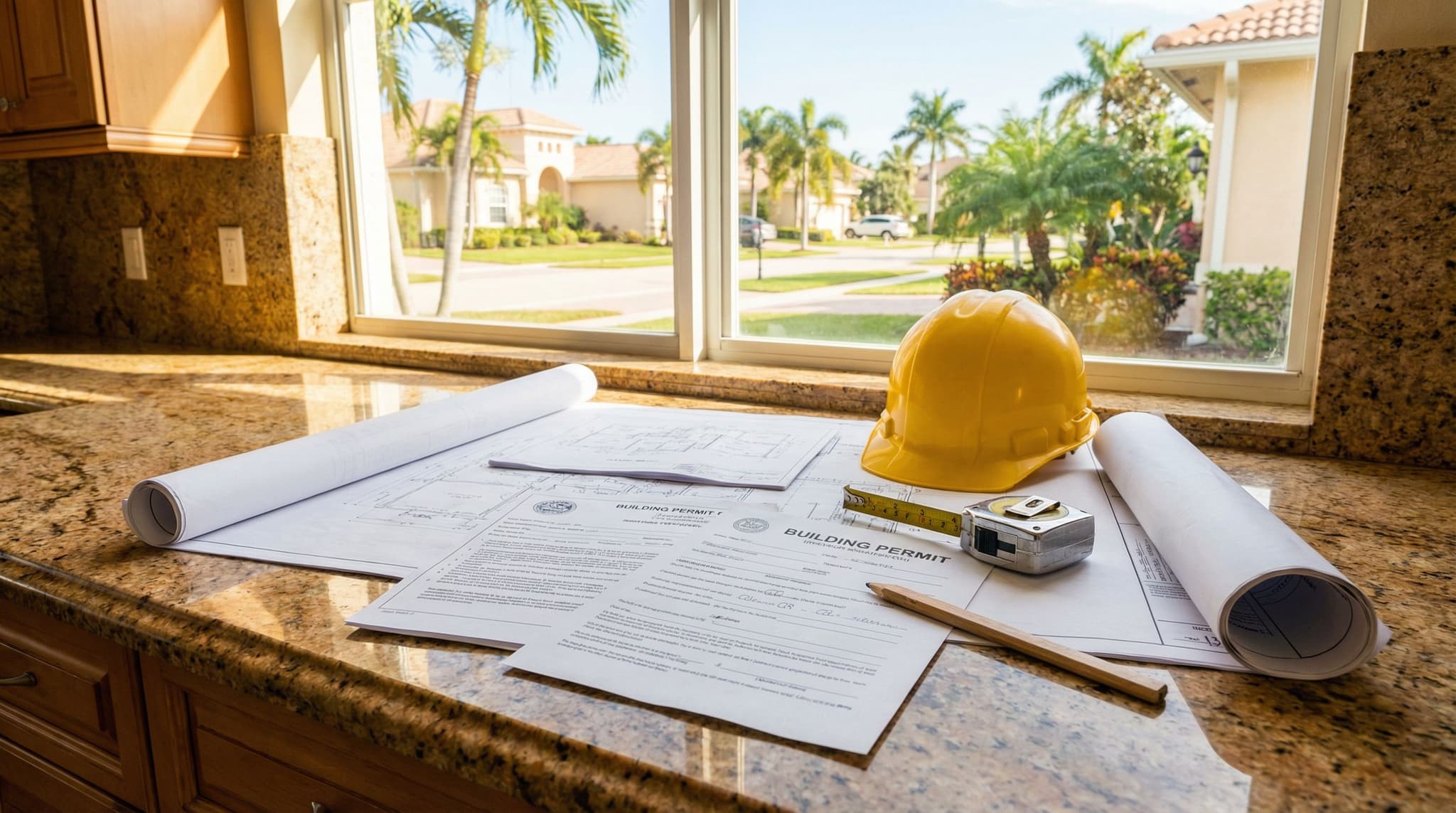
The most common question we get before a kitchen remodel is some version of: "Do we actually need a permit for this?"
The honest answer is: it depends on what you're doing. Here's the straightforward breakdown.
Do You Need a Permit for Your Kitchen Remodel?
Short answer: If you're moving plumbing, touching electrical, or removing or altering walls — yes, you need a permit. If you're doing purely cosmetic work without changing any systems, you probably don't.
What Requires a Permit in Lee and Collier County
- Moving or adding a sink (plumbing permit)
- Moving or adding a gas line for a range (plumbing/gas permit)
- Adding or modifying electrical circuits (electrical permit)
- Installing a new electrical panel or upgrading amperage (electrical permit)
- Moving or adding outlets, especially GFCI outlets near water (electrical permit)
- Removing or altering walls — load-bearing or not (building permit)
- Adding a window or changing window sizes (building permit)
- Installing a range hood that requires new duct penetration through the exterior (building permit)
- Any work in a home located in a flood zone that exceeds certain thresholds
What Typically Does Not Require a Permit
- Replacing countertops (same footprint, no plumbing moved)
- Painting cabinets or replacing cabinet doors (same cabinet boxes, no structural change)
- Replacing a faucet at the same location
- New flooring (unless subfloor structural work is involved)
- New lighting fixtures at existing locations (same circuit, no new wiring)
- New backsplash tile (cosmetic, no structural change)
- Replacing an appliance at the same location with the same utility connections
The Gray Areas
Cabinet replacement is the most common gray area. Replacing cabinet boxes in the same locations with no plumbing or electrical changes: generally no permit required. But if the project grows — adding an island that requires a new circuit, moving the sink to the island, adding a dishwasher where there wasn't one — permits are required for those elements.
If you're unsure: Call Lee County Development Services at (239) 533-8329 or Collier County Growth Management at (239) 252-2400. Tell them what you're planning. They'll tell you what's required. This call is free and takes 10 minutes.
Permit Types for Kitchen Remodels
Most kitchen remodels require more than one permit:
Building Permit: Covers structural work — wall changes, roof penetrations, window additions or modifications. Required whenever the physical structure changes.
Plumbing Permit: Required for any changes to water supply, drain lines, or gas lines. Moving a sink across the kitchen, adding a pot filler at the range, running a gas stub for a new range where there was an electric range previously — all require plumbing permits.
Electrical Permit: Required for new circuits, panel upgrades, adding outlets, moving outlets, or any electrical rough-in work. Modern kitchens require dedicated circuits for large appliances — refrigerator, dishwasher, microwave, range. If your kitchen doesn't have dedicated circuits and you're remodeling, your electrician will likely need to pull one.
Mechanical Permit: Required for changes to HVAC and ventilation. If your range hood exhausts outside (as it should), and you're adding a new duct penetration through the exterior wall or soffit, a mechanical permit is required.
In practice, most significant kitchen remodels require at least two of these permits, often all four.
Lee County Permit Process
Where to apply: Lee County Development Services, 1500 Monroe Street, Fort Myers, FL 33901. Online applications through LeeGov.com/business/permits.
The process:
- Contractor submits permit application with project drawings/plans
- Plans review (1-3 weeks for most residential kitchen projects)
- Permit issued — work can begin
- Inspections at designated project stages (rough-in before walls close, final inspection at completion)
- Permit closed out — this is the step many contractors skip, and it matters
Timeline: For a standard kitchen remodel, expect 2-4 weeks from application to permit in hand. More complex projects or those requiring structural engineering review take longer.
Permit costs (approximate):
- Building permit: $400-$1,200 depending on project value
- Plumbing permit: $150-$400
- Electrical permit: $150-$400
- Mechanical permit: $100-$300
Total permit costs for a typical kitchen: $600-$2,000. These are factored into your contractor's estimate.
Inspections: Lee County inspections are scheduled through the online portal or by phone. Your contractor coordinates all inspection scheduling. You don't need to be present for every inspection (though you can be), but someone must provide access.
Collier County Permit Process
Where to apply: Collier County Growth Management Department, 2800 N. Horseshoe Drive, Naples, FL 34104. Online applications through CityView portal at cvportal.colliercountyfl.gov.
How it differs from Lee County:
Collier County's permitting process is generally considered more rigorous than Lee County's. Plans review can take longer, especially for projects in flood zones (much of coastal Collier County falls in AE or VE flood zones). Factor in additional lead time.
Timeline: 3-5 weeks from application to permit for most residential kitchen projects. Projects in flood zones or requiring structural engineering may take 6-8 weeks.
Permit costs (approximate):
- Building permit: $500-$1,500
- Plumbing permit: $150-$500
- Electrical permit: $150-$500
- Mechanical permit: $100-$400
Total: $800-$2,500 for a typical kitchen.
Flood zone consideration: Homes in Collier County's coastal areas often fall in FEMA flood zones. Substantial improvements (generally, projects exceeding 50% of the structure's assessed value) in flood zones may trigger additional requirements — elevation certificates, flood-proofing measures, etc. Your contractor should flag this during the estimate process.
What Happens If You Skip Permits
The short version: nothing good.
Stop-Work Orders and Fines
If an inspector or code enforcement officer notices unpermitted work — a neighbor complaint, a routine drive-by, or an inspection for a different project — the county can issue a stop-work order and fines.
Fines in Lee and Collier County start at $500 and can reach several thousand dollars per day for continued violations. You'll also be required to apply for an after-the-fact permit, which costs more than a standard permit and may require opening walls to expose work that's already been completed.
Insurance Denial
Your homeowner's insurance policy almost certainly contains language excluding claims for damage related to unpermitted work. If a fire starts due to an unpermitted electrical installation, your insurer may deny the claim.
This isn't hypothetical. It happens.
Resale Problems
Florida requires seller disclosure of known material defects and unpermitted work. Unpermitted work shows up in title searches, and sophisticated buyers will have a home inspector who checks permit history.
At best, unpermitted work results in a price reduction or buyer demand for escrow for the cost of remediation. At worst, it kills the deal.
The Tear-Out Scenario
This is the worst-case outcome. A subsequent contractor, lender inspection, or insurance inspection identifies unpermitted work that's been concealed behind finished walls. You're required to open the walls, have the work inspected, and potentially have it redone if it doesn't meet current code.
The cost to demo and redo work that should have been permitted the first time is always higher than the cost to permit it correctly upfront.
Safety
Permits exist because inspections catch problems. Electrical wiring that was done incorrectly. A gas line that isn't properly supported. Plumbing that won't drain correctly. An inspector finding these during construction is dramatically cheaper than a fire, a flood, or a gas leak finding them after.
Pull the Permit Yourself vs. Contractor-Pulled
Florida law allows homeowners to pull their own permits for work on their primary residence (with some exceptions). So why have the contractor do it?
Contractor-pulled permits are better because:
- Your contractor is licensed and accountable for the work to the county. If something fails inspection, it's on them to fix it, not on you.
- The contractor handles all coordination with the building department, scheduling inspections, and closing out the permit. You don't make a single trip to a county office.
- Permit is in the contractor's license name, which is what the insurance and warranty structures are built around.
The red flag: A contractor who suggests you pull your own permit. This is sometimes framed as a way to "save money" or "simplify the process." What it actually does is remove their accountability. If the work fails inspection, you're the permit holder dealing with the county.
Require that your contractor pull all permits for work they're responsible for. It's standard practice for licensed contractors.
How HomeWorks Handles Permits
We pull every required permit. We schedule all inspections. We close out every permit at project completion so you have a clean permit history on your home.
You never visit the building department. You never coordinate with an inspector. You receive a copy of the closed permit at the end of the project.
When you go to sell your home, the permit history for your kitchen remodel is clean and documented. No surprises in the title search.
This is standard for licensed contractors — and it's something to specifically confirm with any contractor you're considering.
Questions Before You Start?
If you're planning a kitchen remodel in Lee or Collier County and want to understand what permits your project will require, give us a call at (239) 880-4700. We can walk you through what's required based on your specific project scope.
Or if you're ready to get started, request a free quote and we'll assess your kitchen in person.
HomeWorks Construction and Design, LLC. License CBC 1261775. Serving Fort Myers, Naples, Estero, Bonita Springs, and surrounding Southwest Florida communities.