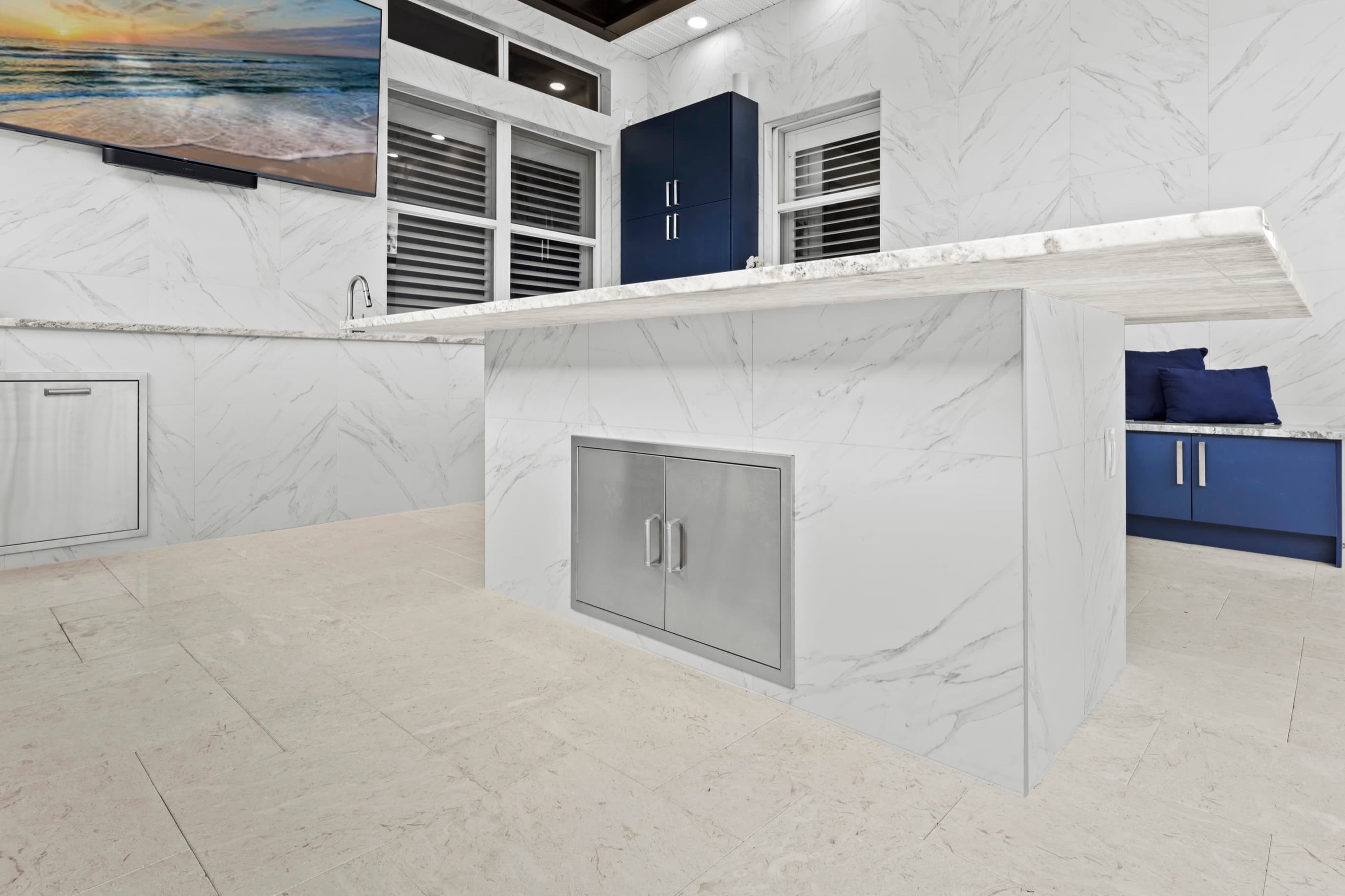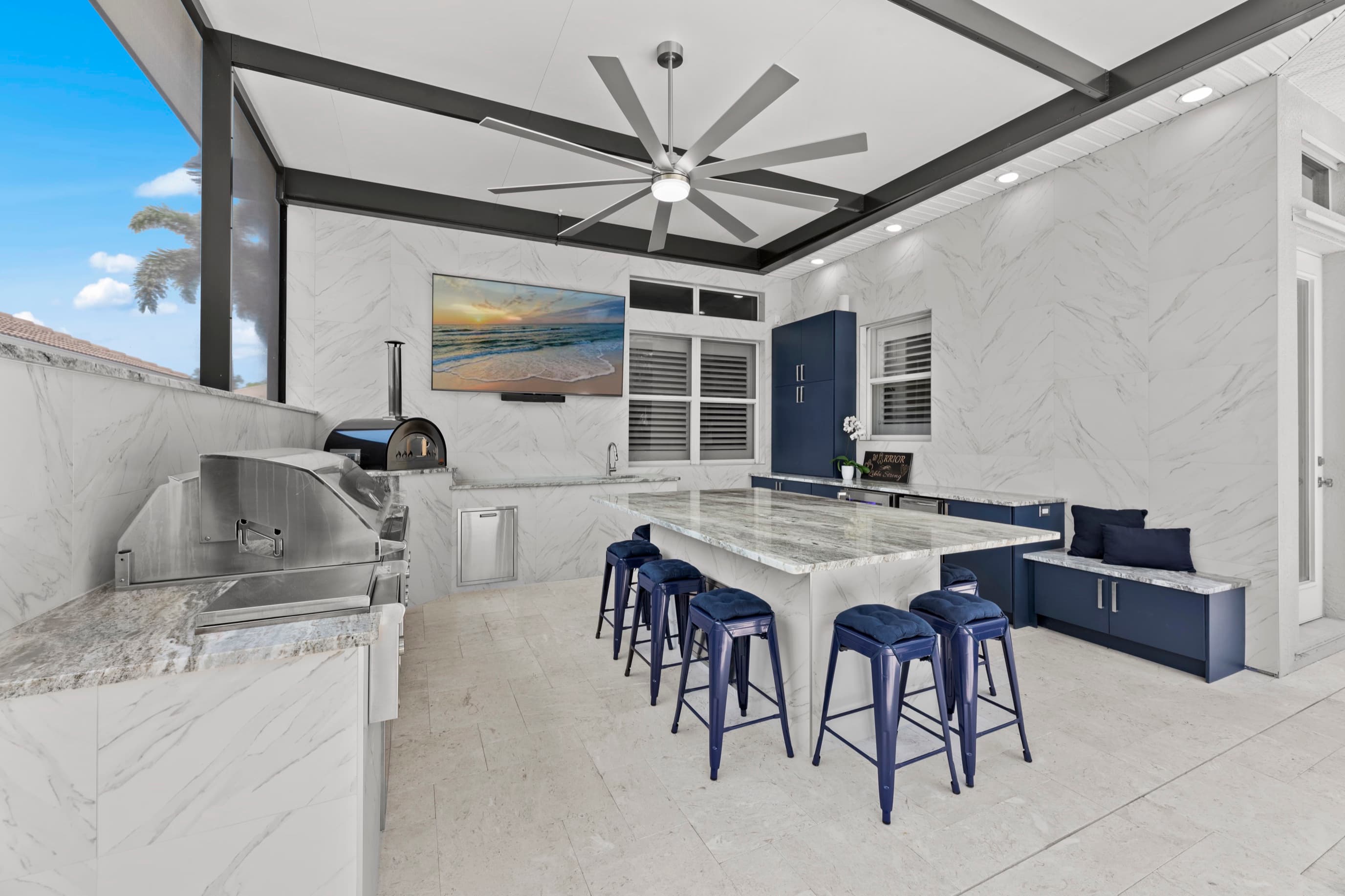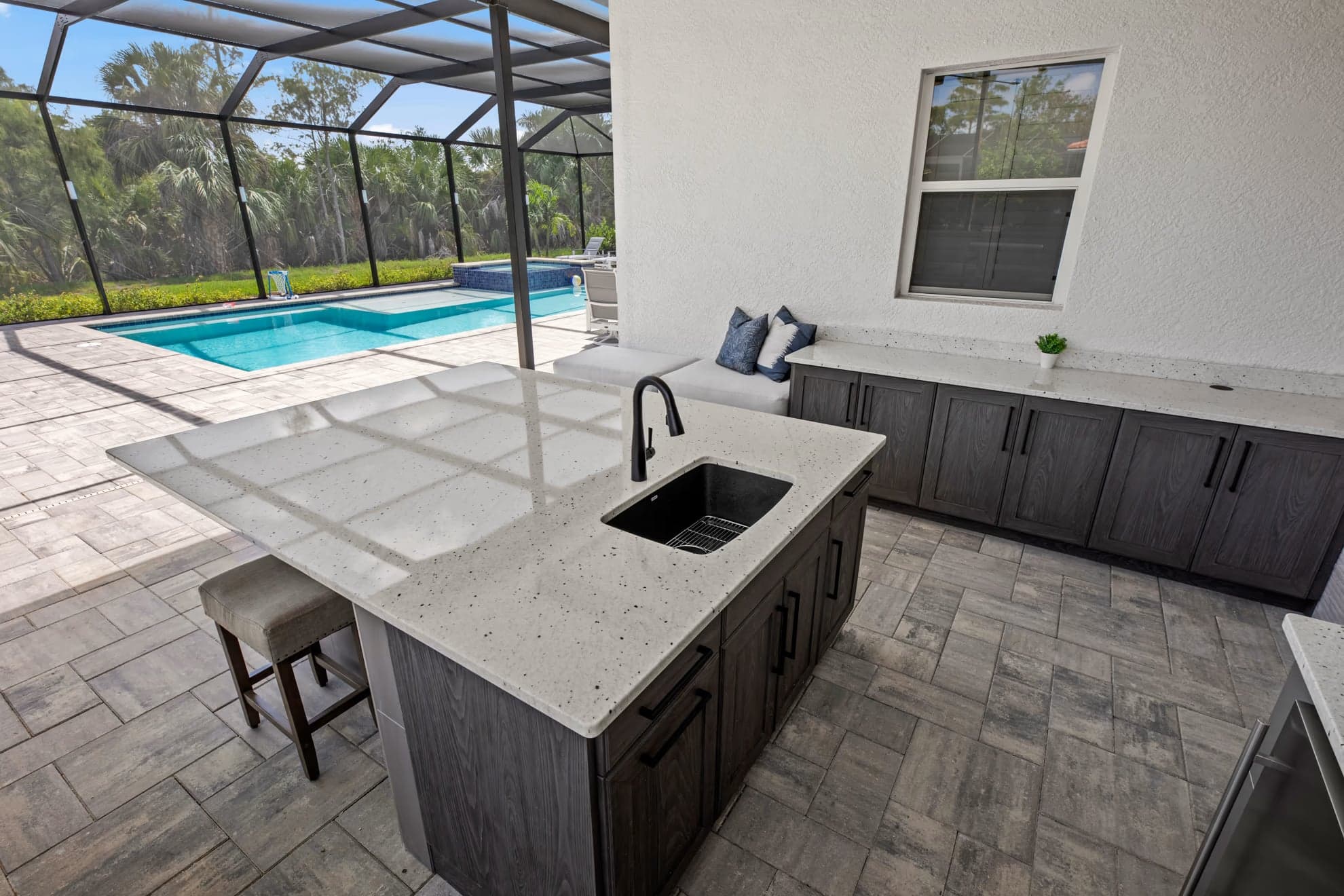
Stucco has a reputation problem. Homeowners hear it's the plain, builder-grade finish, or that it cracks the first time a real storm rolls through, and they assume it can't hold up on an outdoor kitchen the way it holds up on a house. It can. A stucco finish survives Southwest Florida's salt air and driving rain when it goes over concrete block the same way the house itself was built, to the same code, with the same detailing that keeps water moving instead of trapped.
This guide covers why that combination works, what actually causes stucco to crack (it is almost never the stucco itself), and what the finish honestly costs to build. For the full picture, see how HomeWorks builds outdoor kitchens in Southwest Florida.
What a Stucco Finish Actually Is (and Isn't)
"Stucco" gets used loosely. There are two very different products hiding under that one word.
Traditional stucco is a three-coat Portland cement plaster system, a scratch coat, a brown coat, and a finish coat, applied over metal lath. Its installation is governed by ASTM C926 and ASTM C1063, standards referenced directly in the International Building Code and, through it, the Florida Building Code (UpCodes, "R703.7 Exterior Plaster (Stucco)"). That is what most Florida homes are built with, and what we mean by "stucco" throughout this guide.
Synthetic stucco, known as EIFS, looks similar but is a foam-backed acrylic system with very different moisture behavior. The two get treated as interchangeable. They are not, and the difference matters more outside, exposed to full weather with no roof overhang to protect it.
Why Stucco on Concrete Block Survives Florida Rain
Built the Same Way the House Is
The reason stucco works on an outdoor kitchen here is the same reason it works on the house: it goes over concrete block (CBS), not a wood frame. CBS does not rot, and it gives stucco a rigid, stable substrate instead of one that swells and shrinks with every wet season, which is also why our guide to building an outdoor kitchen that survives Florida hurricanes treats CBS as the starting point for any permanent structure.
Code backs this up with a specific detail. A weep screed sits at the base of a stucco wall, at least 4 inches above grade or 2 inches above a paved surface. Its job is to let any moisture that gets behind the stucco drain back out (Inspectapedia). That is how traditional stucco performs: a water-managed system that expects some moisture and drains it, instead of acting as a perfect, unbroken barrier (Building Science Corporation). That is the opposite of fragile. Florida rain will find a way in. The system is built to give that water a way back out. That matters on homes near the water in Bonita Springs and Naples, where wind off the water drives rain into the wall.
The "Stucco Cracks in Heavy Rain" Objection, Addressed Honestly
Generic outdoor kitchen guides will tell you stucco can crack in heavy rain or humid climates, and it is worth answering directly instead of dodging it. According to a Florida engineering firm that has investigated coastal facade failures, most premature stucco cracking traces back to construction defects: missing or misplaced control joints, over-fastened lath that cannot move, the wrong cement-to-sand ratio, or inadequate curing, not to stucco as a material (Jeffrey B. Sellers, P.E., Construction Solutions, Inc., "Stucco and EIFS Facade Failures in Coastal Florida").
Code exists to prevent that. ASTM C1063 requires control joints so no single panel of stucco exceeds roughly 144 square feet, with joints no more than about 18 feet apart in either direction, so the material has room to move without cracking randomly (Stucco Champions, "Navigating Stucco Control Joint Codes"). An outdoor kitchen island is small enough that this rarely becomes an issue on its own, but the same care in lath fastening, mix ratio, and curing time still applies. Skip those details and any finish cracks. Follow them and stucco does what it has done on Florida homes for decades.
What Salt Air Actually Does to a Stucco Finish
Salt is the part most outdoor kitchen content skips. Salt-laden coastal air travels several miles inland, not just along the beachfront (Construction Solutions, Inc.). That reach covers Naples addresses close to the Gulf and homes several miles back from the water. The chloride it carries corrodes the galvanized metal lath behind a stucco finish. It breaks down the lath's protective coating, a process called depassivation. The lath then expands as it corrodes. That expansion is what pushes cracks out from behind the surface, rather than across it.
This is also why the finish is only one part of a durable build. Materials like the countertop, appliances, and hardware on a Southwest Florida outdoor kitchen face the same salt exposure in different ways, which we cover in our guide to remodeling for Florida's humidity.
How Long a Stucco Finish Actually Lasts
Properly installed and maintained, traditional cement stucco is a decades-long finish. InterNACHI, the home inspectors' association, lists stucco at 50-plus years on its standard life-expectancy chart, and lists exterior paint at 7 to 10 years on the same chart (InterNACHI, "Standard Estimated Life Expectancy Chart for Homes"). Those are two different clocks, and homeowners tend to conflate them. The substrate is the long one. The paint or color coat on top is the short one.
On the coatings side, that clock runs on exposure. The chart's 7 to 10 years is a national baseline. Southwest Florida painting contractor EFC puts coastal, high-sun walls at the short end of it and often below, closer to every 4 to 6 years, with average inland exposure at 5 to 8 years and shaded, well-protected walls stretching to the full 7 to 10 (EFC Contractors, "How Often to Repaint Stucco Exteriors in Southwest Florida"). Salt-driven wind pushes rain into the stucco face, especially on upper walls and corners, which is what shortens that window near the coast. Bonita Springs addresses near the beach sit in that coastal group, not the inland one. That is a maintenance and recoating question, not a sign the stucco itself is failing.
What a Stucco Outdoor Kitchen Finish Actually Costs
The Finish Itself
Stucco is typically the least expensive of the common island finishes. Manufactured stone veneer costs more, and natural stone veneer costs the most, several times the price of stucco, not a little more. An outdoor kitchen island is also a small footprint compared to a house wall, so the finish is priced as part of the build, not as a per-square-foot line you shop separately.
What It Adds to the Whole Build
On its own, that number is hard to weigh. Set it against everything else a full outdoor kitchen involves, the appliances, the plumbing, the electrical, and the permits, and the finish is one of the smaller line items in the build. That matters, because the finish is also the part taking the weather. Cutting costs here saves very little, and it risks the thing that decides how the kitchen looks in ten years.
What Actually Moves the Price
A few things move a stucco finish up or down within its range: the island's linear footage, how many corners and curves it has (more cuts and detail work), the texture and color coat you choose, and whether cracked or damaged substrate needs repair first. This is also why every HomeWorks proposal discloses a 15% contingency up front. The number that hurts is never the one you agreed to, it's the one nobody told you about.
Stucco vs. the Other Finishes You'll Be Shown
| Finish | Relative cost | Durability in SW Florida | Maintenance |
|---|---|---|---|
| Stucco on CBS | Least expensive of the four | Excellent when built to code, on concrete block, with proper control joints | Periodic recoating, roughly every 4 to 10 years depending on coastal exposure |
| HDPE polymer panel | Higher upfront | Excellent, marine-grade polymer made to live outdoors uncoated | Occasional wash, no sealing or recoating |
| Manufactured stone veneer | Mid-range | Very good with proper drainage behind it | Low, occasional cleaning |
| Natural stone veneer | The premium option | Very good | Low, occasional cleaning |
Cabinet materials inside the island (polymer, stainless, and the rest) are a separate decision from the exterior finish, and counters, framing, and other finish choices are their own decision too. Both deserve their own comparison rather than a couple of sentences here.
How HomeWorks Builds a Stucco Outdoor Kitchen Finish
Every project starts with a recorded site visit, so the scope is accurate and nothing gets missed. Our in-house designer produces Design Flex renderings included in the proposal, so what you approve is what gets built. HomeWorks holds permits in both Lee and Collier County, manages every subcontractor, and documents the whole job in JobTread: schedule, photos, and updates in one place.
You can see what a finished stucco outdoor kitchen actually looks like in our project galleries: an outdoor kitchen built by HomeWorks in Southwest Florida and a second finished outdoor kitchen build.
Frequently Asked Questions
Does stucco crack in Florida humidity?
Not on its own. Most premature cracking comes from how the stucco was applied, missing control joints, over-fastened lath, or the wrong mix, rather than from humidity acting on properly installed stucco. Built to code, with control joints spaced correctly, stucco handles Southwest Florida's humidity the same way it handles it on the house next to it.
How long does a stucco finish last on an outdoor kitchen in Southwest Florida?
The stucco substrate itself is a 50-plus year finish when properly installed and maintained, per the home inspectors' association's life-expectancy chart. The paint or color coat on top of it needs recoating far sooner: a 7 to 10 year national baseline that coastal, high-sun exposure in Southwest Florida pushes closer to every 4 to 6 years.
Is stucco cheaper than stone veneer for an outdoor kitchen?
Yes. Stucco is typically the least expensive of the common island finishes, manufactured stone veneer costs more, and natural stone veneer costs the most, several times the price of stucco. On an island-sized structure the finish is a small share of the total build, so the honest way to price it is as part of the whole project quote, not per square foot.
Does a stucco outdoor kitchen need a permit in Lee or Collier County?
Yes, a permanent outdoor kitchen structure needs a building permit, and HomeWorks holds permits in both Lee and Collier County and manages that process directly.
Stucco Isn't the Cheap Option, It's the Right One
Stucco on concrete block isn't a downgrade from stone veneer or a shortcut to get an outdoor kitchen built for less. It's the same finish, on the same substrate, built to the same code as the house it sits next to, and that is exactly why it holds up. Done wrong, on the wrong substrate or without the right detailing, any finish fails early. Done right, it's a decades-long answer, not a five-year one.
If your stucco exterior is due for a look regardless of whether you're building an outdoor kitchen, our guide to how often stucco exteriors need repainting in Florida is a useful next read.
HomeWorks is licensed (CBC 1261775), and Chad is personally on every project, with 81% of jobs finishing on schedule. Call (239) 880-4700 or request a free quote and we'll come look at your space and give you a real number, not a catalog price.