Here is the outcome nobody wants. The painters finish, the house looks great, and then a letter from the association arrives saying the color was never approved. Now the question is whether the house gets painted twice.
That is avoidable, and Florida law is more helpful here than most homeowners expect. A homeowners association can review the outside of your house only as far as its own recorded documents allow, it has to apply those rules the same way to everyone, and if it says no, it has to tell you in writing exactly why.
Below is what the statute says, where your community's HOA paint guidelines actually live, what to put in the request, and what to do if it comes back denied. This post is about homeowners associations, which cover houses and lots. If you live in a condominium, the rules come from a different chapter of Florida law, and our post on remodeling a condo in Southwest Florida covers them.
For the paint job itself, start with interior and exterior painting in Southwest Florida.
What Florida Law Lets Your HOA Review
Homeowners associations in Florida are governed by Chapter 720 of the Florida Statutes. The section that matters for HOA painting is Section 720.3035, on architectural control covenants.
It sets the limit first. An association's power to review the appearance of a structure, or to enforce standards for its external appearance, is permitted "only to the extent that the authority is specifically stated or reasonably inferred" in the declaration of covenants or in published guidelines and standards that the declaration authorizes.
In plain terms, the association's power over your paint comes from your community's own documents. If those documents give it a say over exterior appearance, it has one. The statute does not hand every association a statewide paint rule.
The same subsection adds a fairness requirement. The association "must reasonably and equitably apply and enforce on all parcel owners" the standards those documents authorize. The rules are supposed to be the same for you as for your neighbor.
Where Your HOA Paint Guidelines Actually Live
Because the authority comes from the documents, the documents are the first thing to read, before anyone picks a color.
Florida law defines the governing documents in Section 720.301(8) as the recorded declaration of covenants with its amendments, supplements and recorded exhibits, plus the association's articles of incorporation and bylaws. Paint rules, where a community has them, sit in the declaration or in architectural guidelines published under it.
You are entitled to see them. Section 720.303(4) lists the declaration of covenants with each amendment, and the current rules of the association, among the official records an association must keep.
Two more provisions in the same section help you get them:
- Larger communities post them online. An association with 100 or more parcels must post the declaration and each amendment, and the current rules, on its website or in a mobile app.
- Any owner can ask in writing. Under Section 720.303(5)(a), official records must be made available to a parcel owner for inspection or copying "within 10 business days after receipt by the board or its designee of a written request from the parcel owner." Put the request in writing and keep a copy.
When you have the documents, look for three things: whether exterior color is reviewed at all, whether there is a published list of approved colors or schemes, and whether there is an application form. Read the form before you choose colors, not after.
Choosing From the Options Your Community Publishes
Some communities publish a set of approved colors or combinations. Florida law protects the owner's right to pick from what the documents offer.
Section 720.3035(2) says that if the declaration or authorized guidelines provide options for the use of material, or for the size, design or location of a structure or improvement, "neither the association nor any architectural, construction improvement, or other such similar committee of the association shall restrict the right of a parcel owner to select from the options provided".
Paint color is not named in that list. Whether your community's palette counts as one of those options is a question your documents answer first, and a Florida attorney answers if it ever turns into a dispute. The practical takeaway is simpler: when your guidelines publish choices, choosing one of them is the strongest request you can make.
Section 720.3035(5) points the same way. It says the association may not enforce a policy or restriction that is inconsistent with the owner's rights in the declaration or the authorized guidelines, "whether uniformly applied or not." An unwritten preference is not a guideline.
What to Put in the Request So It Is Not Sent Back
Your community's form decides what is required, and every community's form is different. We will not describe any one association's process as the standard. What we can tell you is that a request answering these questions in writing leaves the reviewer less to ask about.
- Which surfaces are changing. The body of the house, the trim, the front door, the garage door and the shutters can each carry a different color. Name every one.
- The exact color for each surface. Use the name and number exactly as your guidelines list them, if they list them. If the form asks for physical samples or a color sheet, include them.
- Whether it matches what is there. Say plainly if this is a repaint in the existing approved colors or a change to new ones.
- A photo of the house today. It shows the reviewer what is being changed, side by side with what you are asking for.
- Anything else the form asks for. That can include contractor details or a timeline. Your form decides.
The practical rule is short. No paint is bought until the approval is in writing.
Shutters and Other Hurricane Protection
Painting the shutters raises one more provision. Section 720.3035(6) requires the board or architectural committee of every homeowners association in the state to adopt hurricane protection specifications for each structure or improvement on a parcel. Those specifications "may include the color and style of hurricane protection products".
The same subsection says the board or committee may not deny an application for installing, enhancing or replacing hurricane protection that conforms to those specifications. If your project touches shutters, ask the association for its hurricane protection specifications along with its paint guidelines, because the color of the shutters may be governed by the one rather than the other.
If the Request Comes Back Denied
This is where Florida law is most specific. Under Section 720.3035(4)(a), if the association or its committee denies an owner's request or application, it "must provide written notice to the parcel owner stating with specificity the rule or covenant on which the association or committee relied when denying the request or application and the specific aspect or part of the proposed improvement that does not conform to such rule or covenant."
So a denial is not supposed to be a vague no. It should name the rule and the part of your request that does not meet it. That tells you exactly what to change before you resubmit.
If you believe the association is applying a rule your documents do not contain, that is a question for a Florida attorney who handles homeowners association law. This post is a contractor's reading of the statute, not legal advice.
Interior Paint and Permits
Two more provisions in Section 720.3035(1) are worth knowing before you plan the job.
Interior paint. Under Section 720.3035(1)(b), an association may not enforce or adopt a covenant, rule or guideline that "Limits or places requirements on the interior of a structure that is not visible from" the parcel's frontage, an adjacent parcel, an adjacent common area or a community golf course.
Permits. If the paint is part of a larger exterior project that needs a building permit, Section 720.3035(1)(c) says the association "may not require a building permit to be issued by a governmental authority to a parcel owner as a prerequisite for review". The association's review and the permit are separate steps, and one does not have to wait on the other.
Frequently Asked Questions
Can a homeowners association control my paint colors?
Only as far as your community's documents give it that power. Section 720.3035(1)(a) limits an association's review of external appearance to what is specifically stated or reasonably inferred in the declaration of covenants or the guidelines it authorizes.
Where do I find my HOA paint guidelines?
In the declaration of covenants and any architectural guidelines published under it. An association with 100 or more parcels must post the declaration and its current rules on its website or app, and any owner can request the official records in writing.
Do I need HOA approval to paint the inside of my house?
Section 720.3035(1)(b) bars an association from placing requirements on the interior of a structure that is not visible from the frontage, an adjacent parcel, an adjacent common area or a community golf course. Check your documents for anything that applies to what can be seen from outside.
What happens if my paint request is denied?
The association must give you written notice naming the rule or covenant it relied on and the specific part of your request that does not conform. Use that notice to revise and resubmit.
Getting the Color Right Before the Paint Goes On
HomeWorks is a Florida certified building contractor, CBC-1261775, owned by Chad and Lyndee and working across Lee and Collier County. Chad is on every project. We run 81 percent on schedule and carry 4.8 stars across 60 Google reviews.
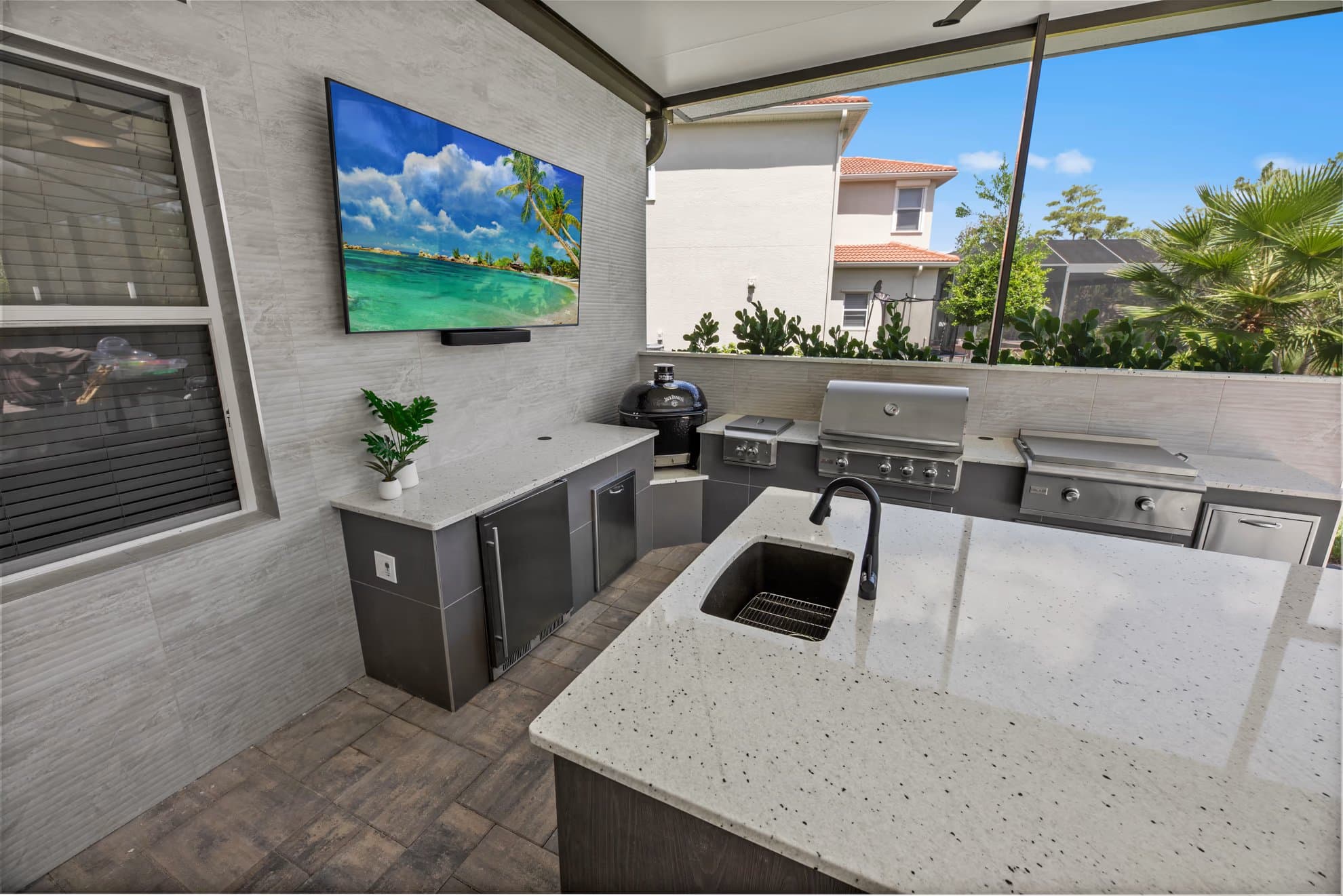
The covered outdoor kitchen in the photo at the top of this post is part of an outdoor kitchen built by HomeWorks in Southwest Florida. The house beyond the screen belongs to a neighbor and is not HomeWorks work.
On a painting job, the scope is set at a recorded site visit and written into the proposal before any paint is bought, with a 15 percent contingency disclosed up front. How often a Florida house needs repainting is a separate question, and our post on how often to repaint a house in Florida covers it.
If your association's approval is the next step, request a quote and tell us what your guidelines ask for.