Every few months, we get a call from a homeowner who remodeled their Florida home using a contractor from up north. Or who followed advice from a design blog written in Seattle. Or who picked materials because they looked great in a showroom that was air-conditioned to 68 degrees.
The conversation is always some version of: "It's only been two years. Why is this already failing?"
Southwest Florida isn't like other places. Our humidity averages 75% year-round. Higher in summer. We have salt air near the coast, afternoon thunderstorms almost daily for half the year, and homes that sit closed up for months while owners are elsewhere. Materials that perform beautifully in Colorado or Connecticut can fall apart here in ways that seem impossible.
This guide is about what actually lasts—and what doesn't—when you're remodeling in Lee or Collier County. Not theory. Not manufacturer claims. What we've seen hold up over 25 years of building in this climate.
Why Florida Is Different
Before we get into specific materials, it helps to understand what we're dealing with.
Humidity doesn't stay outside. Even in air-conditioned homes, moisture moves through walls, through gaps around windows and doors, through every opening. Your interior never reaches the bone-dry levels of a heated Northern home in winter. Materials that need low humidity to stay stable don't get it here.
Temperature swings stress materials. Not hot-to-cold like up north, but a different kind of stress. Air conditioning creates a 20-30 degree difference between inside and outside. Materials expand and contract. Condensation forms on cold surfaces. This happens every day, all year.
Salt air accelerates everything. Within a few miles of the Gulf, salt in the air corrodes metal, degrades finishes, and attacks materials that would last decades elsewhere. If you can smell the ocean from your house, your material choices need to account for it.
Homes sit empty. Many Southwest Florida homes are seasonal. When owners leave for the summer, the AC runs on a higher setting to save money—or sometimes fails entirely. Humidity climbs. Mold finds opportunities. Materials that need consistent conditions suffer.
Understanding this changes how you think about every material choice.
Flooring: The Biggest Decision
Flooring covers more square footage than any other material in your home. Get it wrong, and you're living with the mistake—or replacing it—for years.
What Fails Here
Solid hardwood is the biggest casualty of Florida humidity. Wood absorbs moisture from the air. In our climate, that means expansion. Boards cup (edges lift higher than the center). Gaps open and close with the seasons. Finishes fail as the wood moves underneath them.
We've seen gorgeous hardwood floors—properly installed, properly finished—start showing problems within 18 months in Southwest Florida. Not because of bad installation. Because wood and humidity don't coexist peacefully.
Can hardwood work here? In limited applications, with engineered products, with realistic expectations about movement and maintenance. But as a whole-home flooring choice? We recommend against it.
Standard laminate fails differently. The core is usually MDF or HDF—compressed wood fibers. When moisture gets in (and in Florida, it eventually does), the core swells. Edges lift. Seams separate. The click-lock connections fail. Once this starts, it doesn't stop.
The failures usually begin in bathrooms, kitchens, or near exterior doors—anywhere moisture is higher. But they spread.
Carpet in most applications. Beyond the obvious issues (mold, mildew, allergens), carpet in Florida holds moisture you can't see. The pad underneath is worse. In a home that sits closed up for months, carpet becomes a humidity reservoir.
What Works
Luxury Vinyl Plank (LVP) has become our default recommendation for whole-home flooring in Southwest Florida. Not because it's cheap—quality LVP isn't—but because it handles our climate without complaint.
LVP is 100% waterproof. Not water-resistant—waterproof. You can flood it, dry it out, and it's fine. It doesn't expand or contract meaningfully with humidity. It doesn't require acclimation like wood. It installs over concrete without moisture concerns.
And modern LVP looks remarkably like wood. The printing and texturing technology has improved dramatically. From normal viewing distance, many products are indistinguishable from hardwood.
What to look for in LVP:
- Rigid core (SPC or WPC) rather than flexible vinyl
- Wear layer of 20 mil or higher for residential use
- Attached underlayment or quality separate underlayment
- Realistic texture, not just printed pattern
Budget: Quality LVP runs $4-$10 per square foot for materials, plus $4-$6 for installation. Total: $8-$16 per square foot installed.
Porcelain and ceramic tile remain the gold standard for Florida durability. Zero moisture absorption. Won't expand, contract, warp, or degrade. Handles flooding, humidity spikes, decades of use.
The drawbacks are comfort (hard, cold underfoot—though radiant heating helps) and installation cost. Tile is more labor-intensive than LVP, and underlayment preparation matters more.
Where we recommend tile: Bathrooms, kitchens, laundry rooms, entryways, and whole-home for owners who prefer it. Especially in seasonal homes that sit empty.
Polished concrete works for modern aesthetics. It's indestructible by moisture, easy to maintain, and surprisingly comfortable with radiant heating. Not for everyone visually, but bulletproof practically.
Cabinets: Where Humidity Hides
Kitchen and bathroom cabinets face constant humidity exposure—steam from cooking and showering, moisture from sinks, ambient humidity that never fully dissipates.
What Fails Here
Solid wood cabinets from Northern suppliers often struggle. Wood moves with humidity. Doors warp. Drawers stick in summer and rattle in winter (when AC runs less). Finishes crack as the wood underneath expands and contracts.
This doesn't mean wood cabinets can't work in Florida—they can—but construction and finish matter enormously.
Particleboard and MDF construction in areas near water is asking for trouble. These materials absorb moisture and swell. Under a sink, near a dishwasher, in a bathroom—particleboard cores eventually fail.
Thermofoil finishes (vinyl wrapped over MDF) can delaminate in high humidity. The adhesive softens, the vinyl lifts at the edges, and the look goes from "clean" to "peeling" surprisingly fast.
What Works
Plywood cabinet boxes over particleboard. Plywood is more dimensionally stable—it moves less with humidity changes. It also handles occasional water exposure better. Most quality cabinet lines use plywood construction; budget lines use particleboard. The upcharge is worth it.
Proper finishes. Catalyzed lacquers, conversion varnishes, or factory-applied UV-cured finishes resist humidity better than standard lacquers. These finishes create a harder barrier against moisture penetration.
Wood species matters. Some woods handle humidity better than others. Maple and cherry are relatively stable. Oak moves more. Alder is problematic in high humidity. If you want wood cabinets in Florida, ask specifically about the species and its behavior in humid climates.
Painted MDF doors can work well if the MDF is properly sealed—all six sides, including edges—before painting. The paint acts as a moisture barrier. But if any edge is left raw (common in cheap cabinets), moisture enters and the MDF swells.
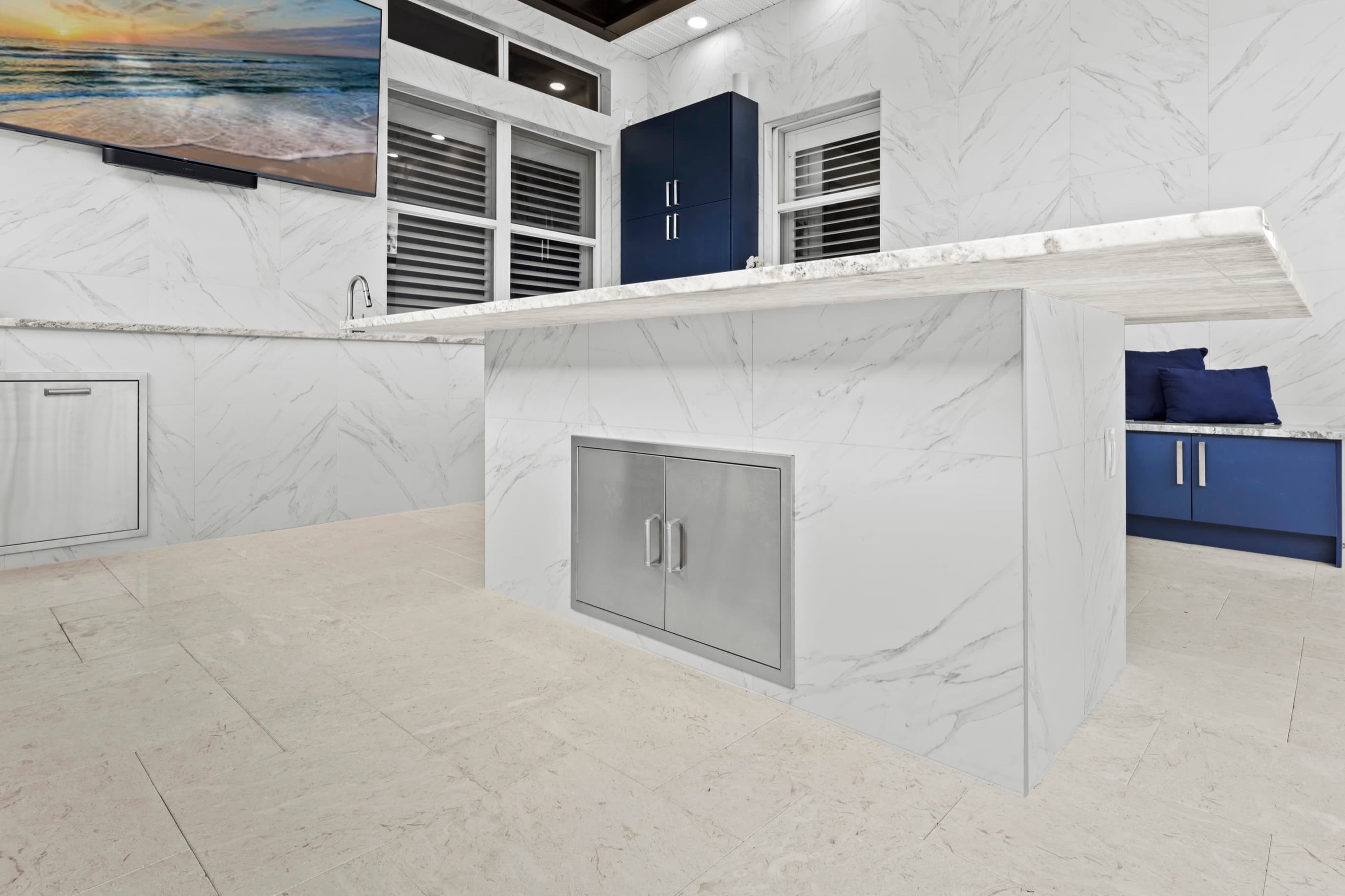
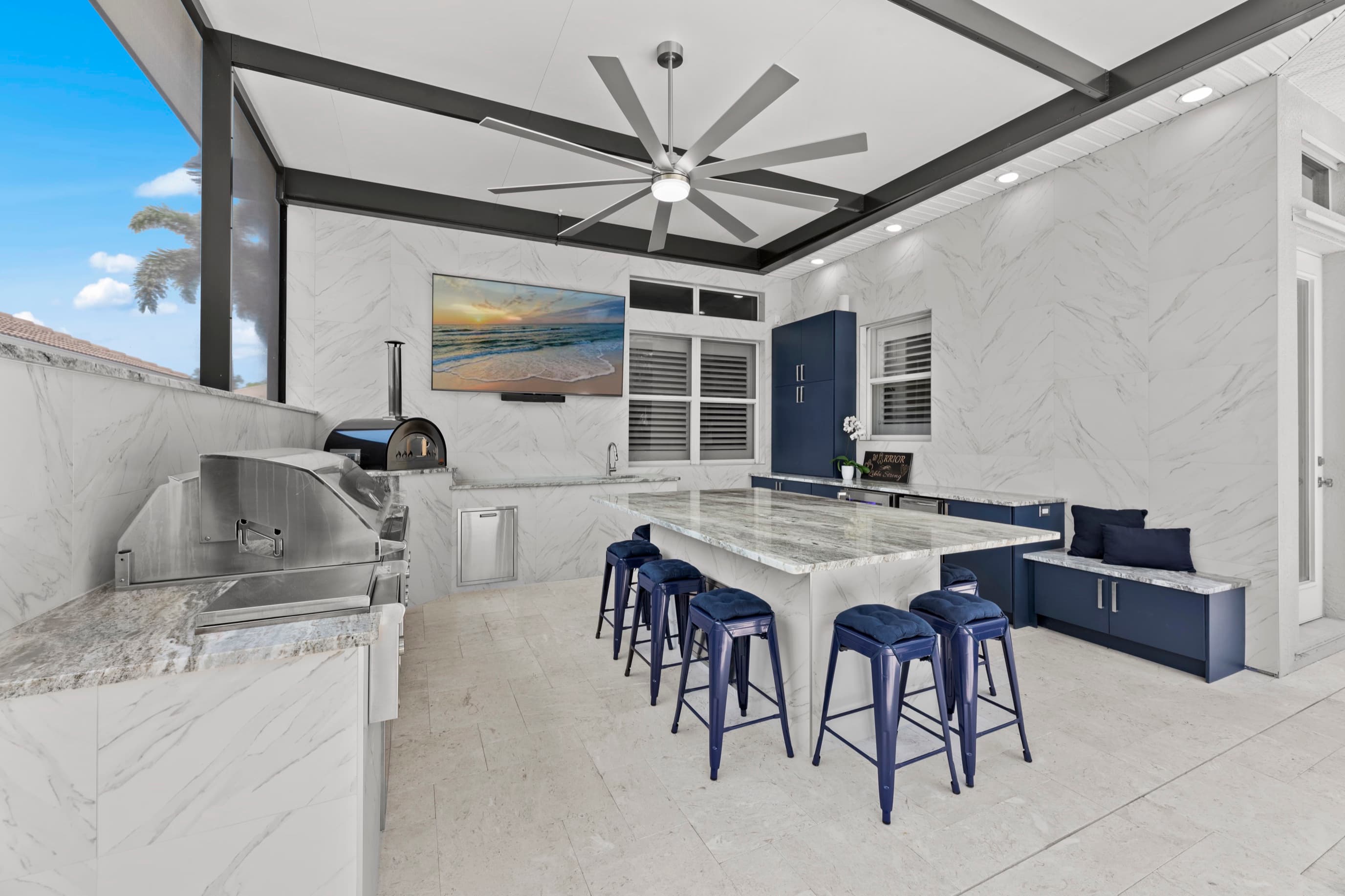
Marine-grade or exterior-rated cabinets for outdoor kitchens and any indoor area with significant moisture exposure. These use materials and construction methods designed for moisture. They cost 2-3x what standard cabinets cost. In outdoor applications, they're non-negotiable.
Countertops: Mostly Good News
Countertops are actually one of the easier material choices in Florida. Most common options handle humidity well.
What Works (Almost Everything)
Quartz is effectively impervious to humidity. The resin binder creates a non-porous surface. No sealing required. No moisture absorption. No staining from humidity-related issues. But you can’t put any quartz that has any white in it outdoors – the resin will yellow quickly
Granite, quartzite, and most natural stones handle Florida humidity fine with proper sealing. The sealing needs to be maintained (annually for most stones), but that's true anywhere. Humidity itself doesn't damage them.
Porcelain is extremely durable, non-porous, and weather-resistant. It won’t absorb water, stain, fade in the sun, or crack easily from heat or freezing temperatures, making it low-maintenance and long-lasting outdoors. The challenge comes in finding a fabricator for large scale slabs. Smaller sizes are more easily installed, but they have grout lines which can hold bacteria.
The Minor Concerns
Marble requires more attention in humid climates. It's porous enough that humidity can affect the finish over time, especially in bathrooms. It also etches from acidic substances (which we covered in the bathroom post). Not a deal-breaker, but requires commitment to maintenance.
Butcher block and wood countertops need more care in Florida. They require regular oiling, can't sit wet, and may move seasonally. In a kitchen that sees heavy use and good maintenance, they can work. In a seasonal home that sits empty, they're risky.
Concrete countertops require proper sealing and can develop hairline cracks from the expansion/contraction cycle that Florida's AC-to-outdoor transitions create. Workable, but not maintenance-free.
Bathrooms: Where Humidity Is the Point
Bathrooms are the highest-humidity rooms in your home. Everything in them needs to handle constant moisture exposure.
Waterproofing Matters More Than Materials
The most important thing in a Florida bathroom isn't the tile you choose—it's what's behind it.
Cement board backing (Durock, HardieBacker, or similar) rather than drywall or green board in any wet area. Cement boards won't absorb moisture, won't grow mold, and won't degrade over time.
Waterproof membrane systems in showers and around tubs. Not water-resistant—waterproof. Schluter KERDI, Laticrete Hydro Ban, RedGard—products designed to create a continuous waterproof barrier. Applied to walls and floors, over seams and corners, creating an envelope that contains water.
The tile is just decoration. The waterproofing is what protects your house.
Surface Materials
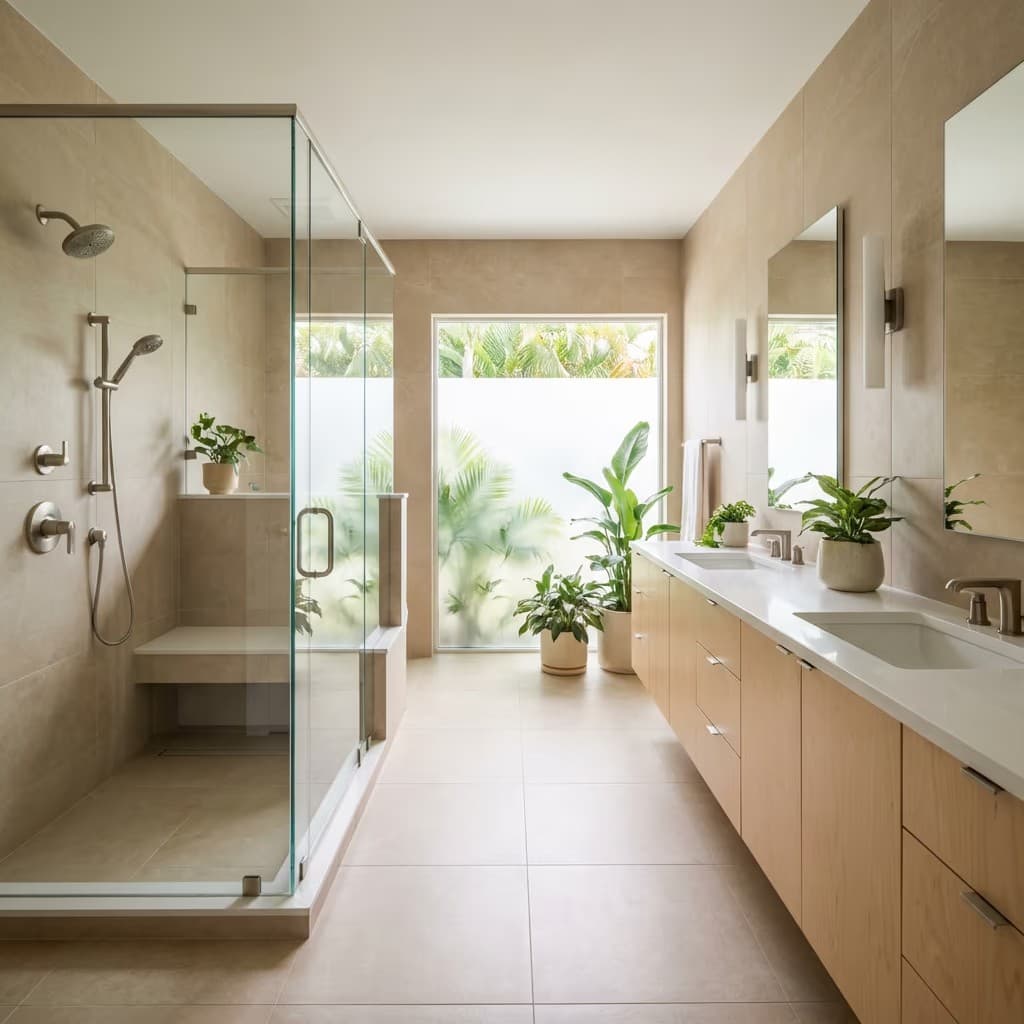
Porcelain tile is the default for good reason. Zero water absorption. Won't support mold growth. Handles decades of daily showers without degrading.
Natural stone works with commitment to sealing and maintenance. Travertine and limestone is popular in Southwest Florida and holds up well. Marble requires more attention.
Grout is the weak point in any tile installation. In Florida, use epoxy grout or at minimum, high-quality polymer-modified grout. Standard sanded grout absorbs moisture, stains, and eventually supports mold growth. The upcharge for better grout is minimal; the difference in longevity is significant.
Caulk fails faster here than anywhere. Silicone caulk is mandatory in wet areas—not acrylic latex, which breaks down in constant moisture. And it needs replacement more frequently than you'd expect—every 1-2 years in heavy-use showers.
Fixtures and Hardware
Finish selection affects maintenance. Polished chrome shows water spots from our mineral-heavy water. Brushed finishes hide spots better. Oil-rubbed bronze can show wear patterns in humid bathrooms.
Quality matters for longevity. Cheap faucets and showerheads corrode faster in Florida's water and humidity. This is where spending more upfront saves replacement costs later. Delta, Kohler, Moen—the established brands—hold up better than off-brand alternatives. More so, the big brands can use cheap plastic parts vs. metal so they can break down and leak sooner too.
Paint and Finishes
Every painted surface in your Florida home faces humidity that paint in other climates doesn't see.
What Works
100% acrylic latex paint for interior walls. It breathes better than oil-based paints, flexes with humidity-driven movement, and resists mildew better. It’s also easier to paint over down the road. Look for paints labeled for high-humidity environments or containing mildewcides.
Semi-gloss or satin finishes in bathrooms, kitchens, and laundry rooms. Higher sheen paints are more washable and resist moisture penetration better than flat finishes.
Exterior-grade paint for interior trim in high-humidity areas makes sense. It's formulated to handle moisture better.
The Problems We See
Flat or matte ceiling paint in bathrooms attracts and holds moisture stains. Use a satin or semi-gloss on bathroom ceilings.
Cheap paint fails faster in Florida. The mildewcide and moisture-resistance additives in premium paints (Benjamin Moore, Sherwin-Williams, etc.) genuinely perform better here. This isn't marketing—it's chemistry.
Insufficient prep. Paint doesn't adhere well to surfaces with moisture trapped underneath. In Florida, timing matters—don't paint during the most humid parts of summer days. Run AC before, during, and after painting to reduce ambient humidity.
Second Homes and Seasonal Properties
If you're not in your Southwest Florida home year-round, material choices become even more critical.
The Empty-House Problem
When you leave for the summer and set the AC to 80 to save money, indoor humidity climbs. When the AC fails entirely (and eventually, every AC fails), humidity can exceed outdoor levels. Condensation forms. Mold finds opportunities.
Homes with robust materials ride this out. Homes with humidity-sensitive materials come back to problems.
Specific Recommendations for Seasonal Homes
Flooring: LVP or tile throughout. No hardwood, no laminate, no carpet except possibly bedrooms with low-pile, synthetic carpet that can be replaced if needed.
Cabinets: Plywood construction with catalyzed finishes. Consider wood door styles with stains over paints—they handle humidity swings better and won’t readily show cracks.
Bathrooms: Premium waterproofing behind every wet surface. Porcelain tile. Epoxy grout. Materials that can handle months of elevated humidity without degradation.
HVAC: A dehumidifier or smart thermostat that maintains humidity levels regardless of temperature setting. This protects every material in your home.
Mold prevention: Consider mold-resistant drywall in high-risk areas. Address any potential water intrusion points before leaving for the season.
What "Florida-Proof" Actually Means
There's no single product that solves Florida humidity. It's a system of choices:
Right materials — Products designed for high humidity, not products that tolerate it grudgingly.
Right installation — Proper underlayment, proper waterproofing, proper sealing. Florida-experienced contractors know where corners get cut elsewhere and can't be cut here.
Proper maintenance — Sealing schedules kept. Caulk replaced when needed. HVAC maintained so humidity stays controlled.
Realistic expectations — Some maintenance is unavoidable. Some materials need more attention here than elsewhere. Accepting this upfront leads to better long-term decisions.
When we say we build bathrooms and kitchens "to last decades, not just pass inspection," this is what we mean. Materials and methods chosen for how they'll perform in year 15, not just how they'll look on installation day.
Questions to Ask Your Contractor
If you're planning a remodel in Southwest Florida, these questions reveal whether your contractor understands our climate:
"What flooring would you recommend for a home that sits empty three months a year?"
The right answer involves LVP or tile. The wrong answer involves hardwood.
"What's behind the tile in this shower?"
The right answer names specific waterproofing products. The wrong answer is vague or mentions "moisture-resistant drywall."
"What type of cabinet construction are you using?"
The right answer is plywood boxes. If they say particleboard, ask why.
"How do you handle grout in wet areas?"
The right answer involves epoxy or high-quality polymer-modified grout. Standard grout is a red flag.
These aren't trick questions. They're basics that any Florida-experienced contractor knows. The answers tell you quickly whether someone understands what they're building into.
Built to Last Here
Southwest Florida is worth the material considerations. The climate that makes this place beautiful is the same climate that challenges your home. Understanding that—and building with it in mind rather than against it—is the difference between a remodel you enjoy for decades and one you're redoing in five years.
If you're planning a project and want to talk through material options for your specific situation, we're happy to help. We've been building in this climate for 20+ years. We know what holds up and what doesn't.
Give us a call at 239-219-0828 or fill out the contact form.
HomeWorks Construction serves Fort Myers, Estero, Bonita Springs, Naples, and surrounding Southwest Florida communities. We specialize in remodeling that's built to last in Florida's climate—not just pass inspection.