Most people compare LVP and hardwood on looks and budget. In Southwest Florida, the better first question is about moisture.
The worry is a familiar one. A new floor goes in, and a few months later the boards cup, gaps open along the seams, or something starts to lift near the slider. Nobody can say whether it was the product, the install, or the house.
Here is the short answer. For a Southwest Florida home on a concrete slab, HomeWorks recommends LVP or engineered hardwood, and we advise against solid hardwood. Hardwood is wood, and wood trades moisture with the air around it, so any wood floor here has to be installed at the right moisture content for a damp, warm coastal climate and kept in conditioned air. Vinyl plank is not wood, so the wood moisture rules do not apply to it. Either way, if your home sits on a concrete slab, the slab gets tested for moisture before any floor goes down.
Below is what the federal Wood Handbook, the Florida Building Code and ASTM say about each piece of that. For the full project, start with flooring installation in Southwest Florida.
Why Humidity Is a Wood Question
The Wood Handbook, published by the USDA Forest Products Laboratory, opens its chapter on moisture with this sentence: "Wood, like many natural materials, is hygroscopic; it takes on moisture from the surrounding environment."
A wood floor is always adjusting to the air in the room. The handbook's chapter on moisture control puts it plainly: "Wood in service is always undergoing slight changes in moisture content." The handbook adds that daily changes are usually small and seasonal ones are of more concern.
A finish does not change that. The same chapter says: "Protective coatings can retard dimensional changes in wood but do not prevent them."
How a board is cut matters too. The handbook notes that "Tangential shrinkage is about twice as great as radial." It tells readers to use the tangential figure when estimating width shrinkage of plainsawn boards and the radial figure for quartersawn boards. In plain terms, a quartersawn board moves less across its width than a plainsawn board of the same wood. When you compare hardwood floors vs LVP, ask how the hardwood was cut, because it changes how much the floor will move.
What the Wood Handbook Recommends for a Florida Floor
The handbook does not leave the target to guesswork. Table 13-2 lists the recommended moisture content for wood at the time it is installed, and it splits the country into three areas.
| Area in the Wood Handbook | Interior flooring, average | Individual pieces |
|---|---|---|
| Most areas of the United States | 8 percent | 6 to 10 percent |
| Dry southwestern area | 6 percent | 4 to 9 percent |
| Damp, warm coastal area | 11 percent | 8 to 13 percent |
The handbook's map of those areas, Figure 13-1, places all of Florida inside the 11 percent zone. So a wood floor bound for a Southwest Florida home should arrive close to 11 percent, and a floor dried for a drier part of the country starts out of step with the house.
The reason is stated in the same chapter: "In general, no significant dimensional changes will occur if wood is fabricated or installed at a moisture content corresponding to the average atmospheric conditions to which it will be exposed." On flooring specifically, it says flooring is dried to the moisture content expected in service "so that shrinking and swelling are minimized and buckling or large gaps between boards do not occur."
The outdoor air is wetter still. Table 13-1 lists the moisture content wood settles at outdoors in several cities, using climate data from before 1997. For Miami, the only Florida city in the table, it runs from 12.3 percent in April to 14.5 percent in September. A floor inside a conditioned home sits drier than that, which is why the air conditioning is part of the floor system here. If the house will sit closed for part of the year, tell whoever installs the floor, because the floor will live in whatever air the house holds.
The handbook also lists the checks that keep flooring from cracking later. Two of them are simple to ask for:
- "Measure random pieces of flooring using a non-penetrating meter to ensure moisture content is correct upon arrival and prior to installation."
- "Break open flooring bundles and expose all sides of flooring to the atmosphere inside the structure."
Its note on testing adds that to get a realistic average, you test at least 10 percent of each item.
What Changes With Vinyl Plank
Vinyl plank is a different material, written up in different standards. ASTM F3261 covers resilient flooring in tile or plank format that is "surface decorated or printed and protected by a clear wear layer," and it says this type of floor "utilizes a polymeric rigid core as part of the product structure."
In other words, the wood look on a vinyl plank is a printed layer under a clear wear layer, over a core that is not wood. The Wood Handbook's moisture tables describe wood. They say nothing about a polymer core, so the 11 percent target and the meter check above are wood steps, not vinyl steps.
That is the real difference in the vinyl flooring vs hardwood question: hardwood's moisture behavior is a matter of published federal data, while a vinyl plank's limits are set by its maker. If a product is sold as waterproof, that is the manufacturer's claim about its own product. Its installation instructions and warranty are where you read what that claim covers, and what it does not.
The Slab Gets Tested Either Way
This is where LVP flooring vs hardwood stops being a contest, because both floors sit on whatever is under them.
For a new concrete slab, the Florida Building Code, Residential, 8th Edition (2023), Section R506.2.3 says: "A 6-mil (0.006 inch; 152 µm) polyethylene or approved vapor retarder with joints lapped not less than 6 inches (152 mm) shall be placed between the concrete floor slab and the base course or the prepared subgrade where no base course exists." The same section lists exceptions, including one "Where approved by the building official, based on local site conditions."
That rule tells you what goes under a slab when it is poured. It cannot tell you the condition of the slab under a house that was built years ago. That is what testing is for.
ASTM F710, the Standard Practice for Preparing Concrete Floors to Receive Resilient Flooring, is direct about it: "All concrete slabs should be tested for moisture regardless of age or grade level while all concrete floors should be tested for pH before installing resilient flooring." It also says concrete floors for resilient flooring "should be permanently dry, clean, smooth, structurally sound, and free of substances that may prevent adhesive bonding."
F710 is written for resilient flooring, which includes vinyl plank. It is not written for wood, but its scope says its procedures "may be useful for preparing concrete floors to receive such finishes," and it names wood flooring among them. One common method is ASTM F2170, which "covers the quantitative determination of percent relative humidity in concrete slabs for field or laboratory tests."
F710 also says it "does not supersede in any manner the resilient flooring or adhesive manufacturer's written instructions." So the test result gets compared against the limits the flooring maker publishes for that product, whichever floor you choose.
One more point from the Wood Handbook matters during a remodel. In a building under construction, it says, "average relative humidity will be greater than that in an occupied house because of the moisture that evaporates from wet concrete, brickwork, plaster, and even the structural wood members." Its flooring guidance is to have flooring delivered after masonry and plastering "are completed and fully dry." Fresh patching or leveling work on a slab is part of that sequence.
LVP vs Hardwood, Side by Side
| Question | Hardwood | Vinyl plank |
|---|---|---|
| Does the material take on moisture from the air? | Yes. Wood is hygroscopic. | It is not wood, so the Wood Handbook figures do not apply. |
| What moisture should it arrive at here? | About 11 percent average, 8 to 13 percent per piece | Not a wood measure. Follow the maker's instructions. |
| Is the flooring checked before it goes down? | Yes, random pieces with a non-penetrating meter | Per the maker's installation instructions |
| Is the slab tested for moisture? | Yes | Yes. ASTM F710 says all slabs. |
| Where are its limits written? | Federal data in the Wood Handbook | The maker's instructions and warranty |
For a Southwest Florida home on a concrete slab, HomeWorks recommends LVP or engineered hardwood, and we advise against solid hardwood. That is the same advice on our flooring service page. If you want real wood, engineered hardwood is the option we recommend, and it still goes in at the right moisture content over a slab that tests dry. If the house will sit closed for long stretches, or the floor runs into a laundry room or a bath, read what each vinyl vs hardwood option's instructions and warranty say about moisture before you decide, because that is where the difference is written down.
Questions to Ask Before Either Floor Goes Down
- Will the slab be tested for moisture, by what method, and what limit will the result be compared against?
- For a wood floor, what moisture content will the flooring arrive at, and will random pieces be checked with a meter on arrival and before installation?
- For a wood floor, is the wood plainsawn or quartersawn?
- For vinyl plank, what do the maker's instructions and warranty say about moisture, heat and the slab?
- Will the house be conditioned year round, or will it sit closed for part of the year?
- Is any patching or leveling planned on the slab, and when will it be dry enough for the floor?
For the questions that apply to any remodeling contractor, see how to choose a remodeling contractor in Southwest Florida.
Frequently Asked Questions
Is LVP affected by humidity?
Vinyl plank is not wood, so the wood moisture figures in this post do not apply to it. How a given product handles moisture and heat is set out in its maker's installation instructions and warranty, and the slab under it still gets tested.
What moisture content should hardwood flooring be in Florida?
The Wood Handbook recommends an average of 11 percent for interior flooring in the damp, warm coastal area, with individual pieces between 8 and 13 percent. Its map places all of Florida in that area.
Getting the Floor Right Before It Goes Down
HomeWorks is a Florida certified building contractor, CBC 1261775, owned by Chad and Lyndee and working across Lee and Collier County. Chad is on every project. We run 81 percent on schedule and carry 4.8 stars across 60 Google reviews.
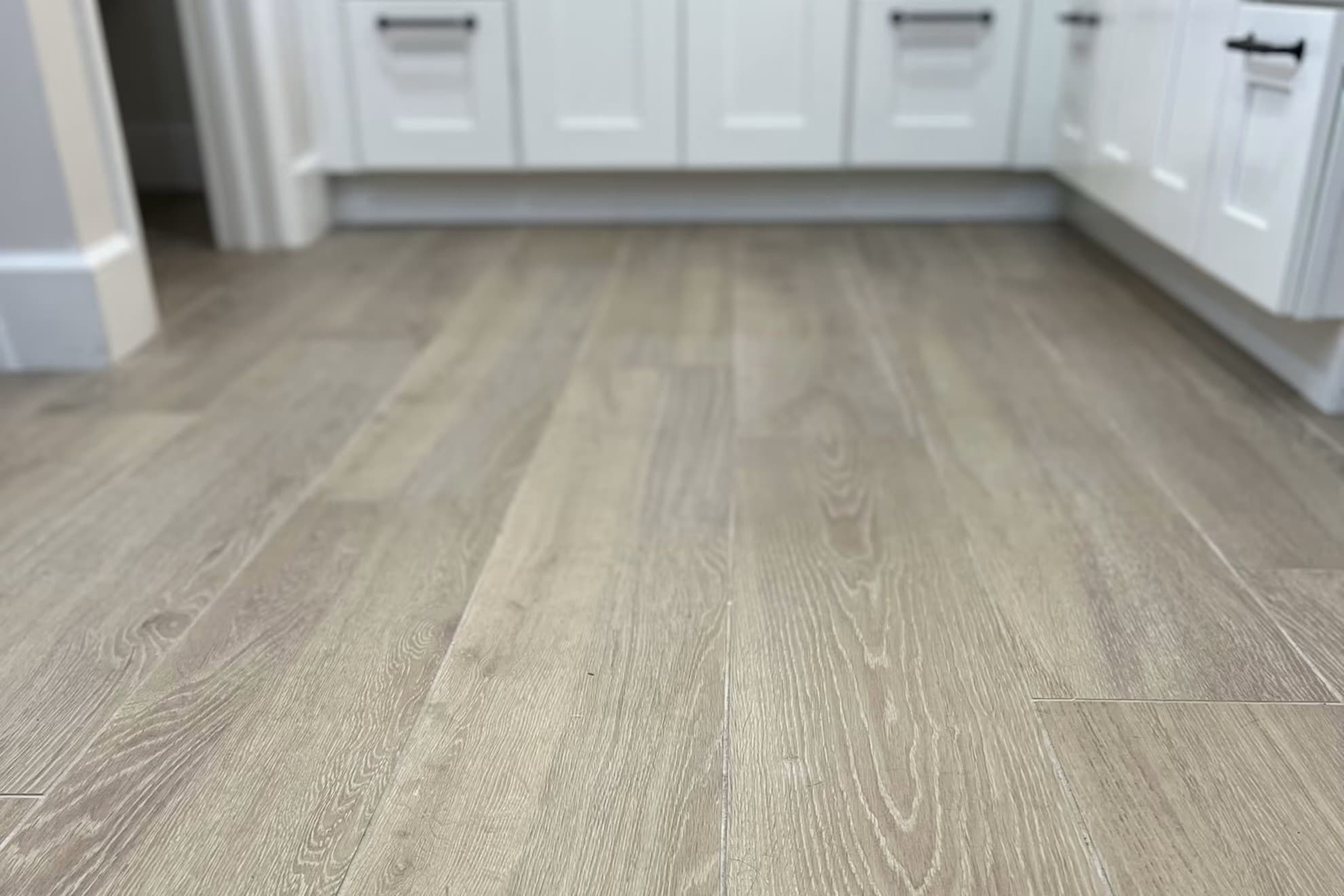
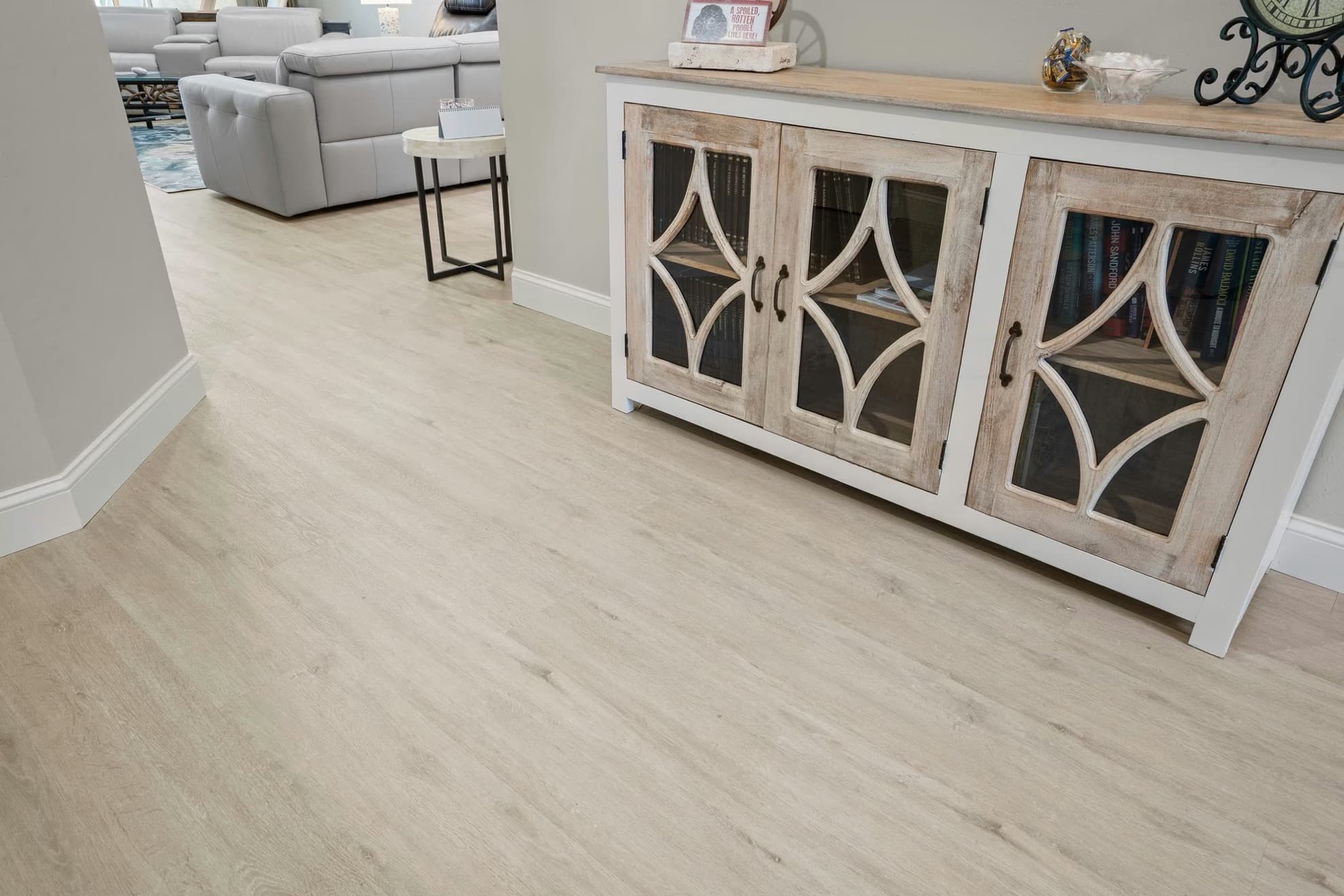
The floor in the photo at the top of this post is from one of our renovation projects. The slab, the moisture checks and the product's own limits get settled at a recorded site visit and written into the proposal, before the old floor comes up. The price comes with a 15 percent contingency disclosed up front.
See a kitchen renovation by HomeWorks in Southwest Florida, or request a quote and tell us which floor you are weighing.