The rule of thumb in most of the country — repaint your home exterior every 10-15 years — does not apply in Southwest Florida.
We get 260+ sunny days per year. Humidity runs 70-90% year-round. Salt air off the Gulf attacks surfaces within a few miles of the coast. And from June through September, we get driving afternoon thunderstorms almost daily. That combination destroys paint faster than virtually any other climate in the continental US.
Here's what actually holds up, when you need to repaint, and what happens when you wait too long.
Interior vs. Exterior: Different Timelines
Interior Repaint: Every 7-10 Years
Interior paint in a Florida home lasts about as long as it does anywhere else. Protected from UV and moisture (assuming your HVAC is working and you're not dealing with a chronic leak), interior paint holds up well.
Exceptions that shorten the timeline:
- High-traffic areas (hallways, kids' rooms, kitchen walls) — closer to 5-7 years
- Bathrooms and laundry rooms — humidity and steam degrade paint faster; budget for 5-7 years
- Homes that sit closed in summer — when AC is off or set high, humidity spikes, and paint on bathroom and kitchen walls can mildew earlier
Exterior Repaint: Every 5-7 Years in SW Florida
This is the number that surprises most people moving from northern climates.
In Minnesota or Pennsylvania, 10-12 years on an exterior paint job is reasonable. In Fort Myers or Naples, 5-7 years is the realistic cycle — and coastal homes within 2 miles of the Gulf often need fresh paint every 4-5 years.
The same paint, same product, same application quality — it just doesn't last as long here because of the conditions it's fighting.
Signs It's Time to Repaint
Exterior Warning Signs
Chalking. Run your hand along an exterior wall. If it comes away with white powder, the paint is breaking down — the binder has degraded and the pigment is chalking off. This is the most reliable indicator on stucco homes.
Fading. This is obvious when you compare the paint color to something shaded. If your covered patio wall is still the original color and your south-facing wall looks bleached out, the paint is failing.
Peeling or flaking. Usually indicates a moisture issue underneath or a failed paint bond. Common on wood trim, fascia, and older homes with multiple paint layers. Don't just repaint over peeling paint — the new coat won't bond and will fail the same way.
Cracking or checking. Fine hairline cracks in stucco that didn't exist before are normal as a home ages. But when existing cracks are filled with old paint that's cracking along with the stucco, you have a maintenance problem that fresh paint alone won't fix.
Mildew staining. Black or green streaks on the north-facing walls or areas without much sun. Mildew grows on paint and in paint that doesn't have adequate mildewcides. It won't wash off with a hose — it needs treatment before repainting.
Color is changing. If your light gray house is starting to look beige, or your white trim looks yellow, the paint is breaking down from UV exposure.
Interior Warning Signs
- Scuffs, marks, and stains that won't clean off
- Yellowing (common in rooms that had a smoker or years of cooking grease)
- Paint finish has gone flat and dull (more noticeable in satin and semi-gloss areas)
- Visible water stains (address the leak first, then paint)
Why Florida Destroys Paint
Understanding this helps you make better material decisions — and explains why the 10-year timeline from up north doesn't work here.
UV Radiation
Southwest Florida averages over 260 sunny days per year. UV radiation breaks down paint's binder — the component that holds pigment to the surface and gives paint its film strength. Once the binder degrades, you get chalking, fading, and eventually cracking.
South-facing and west-facing walls take the worst UV damage. If your house faces west (common in planned communities where homes face a road running east-west), your front elevation will need repainting sooner than your back.
Humidity (70-90% Year-Round)
Humidity doesn't just make you uncomfortable — it forces moisture into every gap, crack, and paint pore. Paint on wood trim absorbs and releases moisture constantly as humidity fluctuates. This expansion and contraction causes adhesion failure and peeling over time.
High humidity also enables mold and mildew growth directly on and in paint film. Without paint specifically formulated with mildewcides, exterior surfaces in SW Florida will develop mildew in 2-3 years regardless of paint quality.
Salt Air
Within 2-3 miles of the Gulf, which includes Fort Myers Beach, Sanibel, Naples Park, and the beach communities, salt deposits on surfaces constantly. Salt is hygroscopic (it attracts moisture) and corrosive. It attacks paint film, metal fasteners, trim, and any unsealed surface.
Homes in this zone need more frequent repainting (4-5 year cycle), more thorough prep (pressure washing, salt removal before painting), and products with higher salt-tolerance.
Afternoon Thunderstorms
From June through October, we get near-daily afternoon thunderstorms — often with driving rain and wind. This isn't like a drizzle. The impact of heavy rain at an angle forces water into any gap in the paint or caulk. Even high-quality paint fails faster when it's wet for significant portions of every year.
Mold and Mildew Growth
All the factors above — humidity, warmth, rain — create ideal conditions for mold and mildew. Florida homes need exterior paint with active mildewcides. Without it, you're not just looking at an aesthetic problem — you're dealing with surface degradation that shortens paint life and can get into the substrate.
Best Exterior Paint Types for Florida
100% Acrylic Latex: The Gold Standard
For exterior paint in SW Florida, 100% acrylic latex is the correct answer. It's flexible (expands and contracts with temperature swings without cracking), breathable (allows moisture vapor to escape without trapping it), UV-resistant, and mildew-resistant when properly formulated.
Do not use oil-based exterior paint in Florida. Oil-based paint dries to a rigid film that cracks with Florida's thermal cycling and doesn't breathe — it traps moisture, which causes paint failure and can cause rot in wood substrates.
Elastomeric Coatings for Stucco
Most Southwest Florida homes have stucco exteriors. Elastomeric coatings — thick, rubber-like paint systems applied at 10-20 mils dry film thickness — are excellent for stucco because they bridge hairline cracks and are highly flexible.
Elastomeric costs more ($35-$60/gallon vs. $25-$40 for premium acrylic) and requires two coats minimum. But on an older stucco home with fine surface cracking, an elastomeric coating can seal and protect in ways standard paint can't.
One caveat: Elastomeric coatings are difficult to remove if you ever want to change the finish, and they trap moisture if applied over damp or problem surfaces. They need to be applied correctly by someone who knows the product.
Best Paint Brands for SW Florida
Not all paint is equal. In this climate, premium brands genuinely perform better — the UV packages, mildewcide concentrations, and resin quality make a real difference.
Sherwin-Williams Duration: One of the best-performing exterior paints in hot, humid climates. Lifetime warranty from SW. Strong mildewcide package and UV resistance. This is what we specify frequently for SW Florida exteriors.
Sherwin-Williams SuperPaint: A step below Duration in the SW lineup but still very capable. Strong acrylic formula, good mildewcide. Solid choice for value-oriented exterior projects.
Benjamin Moore Aura Exterior: Excellent UV resistance and color retention. BM's premium color technology (ColorLock) is genuinely better at resisting fading. Strong mildewcide package.
PPG Manor Hall: Reliable performer, particularly in the mid-Atlantic and Southeast. Good acrylic formula with solid mildewcide. Often priced competitively relative to SW and BM premium lines.
What to avoid: Contractor-grade "house paint" from big-box stores. Low-cost exterior paints have lower resin content, weaker UV packages, and minimal mildewcide. In Florida, they'll fail in 2-3 years. The price difference between a gallon of premium acrylic and cheap paint is $10-$15. Over the life of the job, it's not worth the savings.
Color Considerations for Florida Homes
Darker Colors Fade Faster
Dark colors absorb more UV radiation, which accelerates paint breakdown. A deep charcoal or dark navy exterior will visually fade noticeably in 2-3 years in SW Florida sun, even with a quality paint. Lighter colors hold their tone longer.
This doesn't mean you can't use dark colors — just understand you're accepting a shorter cycle before the color looks tired.
Lighter Colors Show Mildew More
Here's the tradeoff: lighter colors (whites, light grays, creams) are more UV-stable but show mildew growth earlier. A light gray wall with any north-facing exposure will develop visible dark streaks in 2-3 years without proper mildewcide in the paint.
The Sweet Spot: Earth Tones and Medium Shades
Medium-value earth tones — warm tans, medium grays, sage greens, soft blues — tend to perform best visually in SW Florida:
- Enough lightness to resist UV breakdown
- Enough depth to hide minor mildew between repaints
- Appropriate for the Florida coastal aesthetic
- Age gracefully as the color shifts slightly over time
This is why you see a lot of these tones throughout Fort Myers, Estero, and Naples neighborhoods.
Prep Is 80% of the Job
The most common reason paint fails early — in Florida or anywhere — is inadequate surface prep. Premium paint applied over a poorly prepped surface will fail. Basic paint applied over a properly prepped surface will outlast premium paint over bad prep every time.
What Proper Prep Looks Like
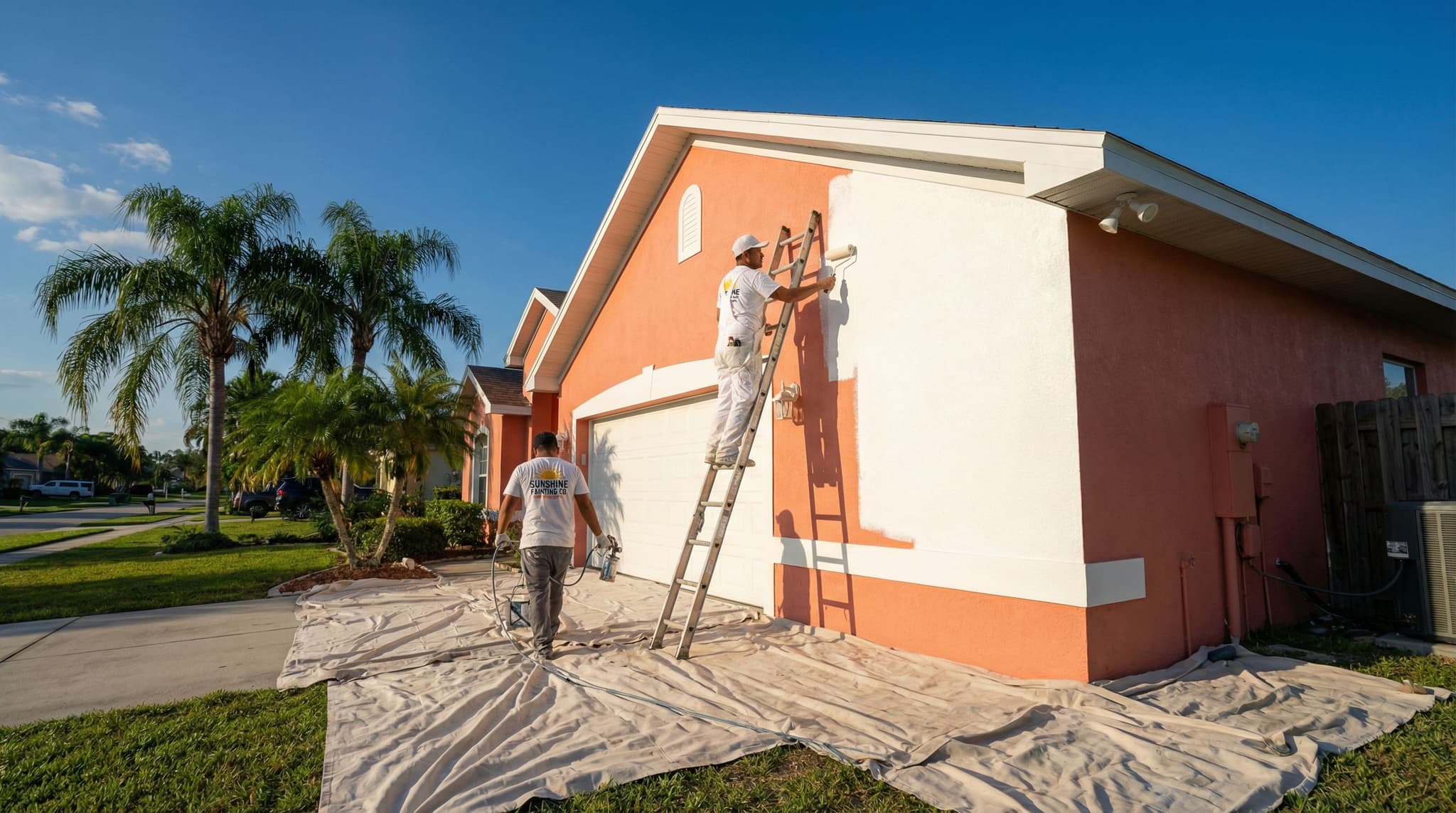
Pressure washing: Every exterior paint job in SW Florida should start with pressure washing to remove salt deposits, mildew, loose paint, and dirt. Allow 24-48 hours of dry time before painting.
Mildew treatment: If mildew is present, it needs to be killed before painting — not painted over. A diluted bleach solution or commercial mildewcide treatment, allowed to dwell and then rinsed, kills the mildew. Painting over active mildew just traps it and it bleeds through.
Scraping and sanding: Any peeling or flaking paint must be scraped back to a solid surface. You can't feather a new coat of paint over loose existing paint and expect it to hold.
Caulking: All gaps around windows, doors, trim, and penetrations need to be properly caulked before painting. Uncaulked gaps allow water intrusion that destroys the paint from behind. Use a paintable exterior caulk rated for Florida conditions.
Priming: New or repaired stucco needs primer. Bare wood needs primer. Any area with staining or bleed-through issues needs a sealing primer. Skipping primer is another way to shorten the life of a paint job.
Proper prep adds time and cost to a paint job. A crew that gets in and out in a day is almost certainly skipping prep steps. A quality exterior repaint on a typical SW Florida home (2,000-2,500 sq ft) should take 2-4 days including prep.
Proper prep is what makes paint last 6-7 years instead of 3.
Coastal vs. Inland: A Real Difference
Homes within 2 miles of the Gulf coast, including Fort Myers Beach, Sanibel, Naples Park, and Vanderbilt Beach, need more frequent repainting and more intensive prep than inland homes.
The difference in practice:
- Inland Fort Myers or Estero home: 6-7 year exterior repaint cycle with quality products
- Fort Myers Beach or Sanibel home: 4-5 year cycle, sometimes shorter on west-facing elevations directly exposed to Gulf breezes
Salt deposits need to be removed more aggressively before repainting. Metal hardware (hinges, shutters, light fixtures) should be inspected for corrosion. Some homeowners in these locations use an annual pressure wash as maintenance to extend the repaint cycle.
Getting the Job Done Right
The difference between a paint job that looks good for a year and one that holds up for 6+ years comes down to prep, product quality, and application.
We handle interior and exterior painting throughout Fort Myers, Naples, Estero, and Bonita Springs. Our painting is owner-led from design through build. We're on-site to oversee prep, material selection, and application quality, not just sending a crew with a sprayer.
Call us at (239) 880-4700 or reach out through our contact page to talk through your project. We can assess your current paint condition and give you an honest read on what it needs.
And if you're ready to schedule, request a free quote — we'll come out and look at the actual surface conditions before giving you a number.
HomeWorks Construction and Design, LLC. License CBC 1261775. Serving Fort Myers, Naples, Estero, and Bonita Springs.