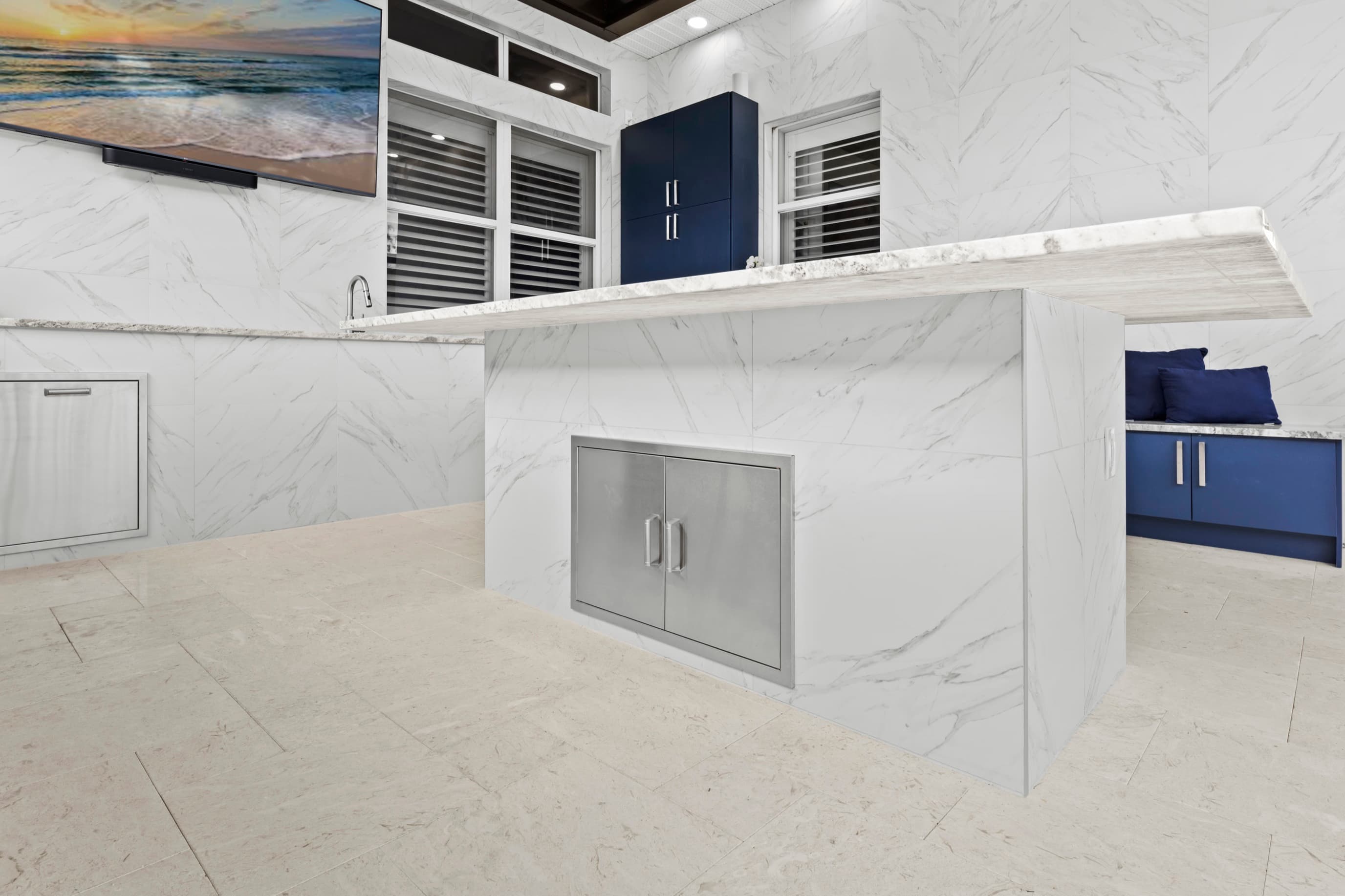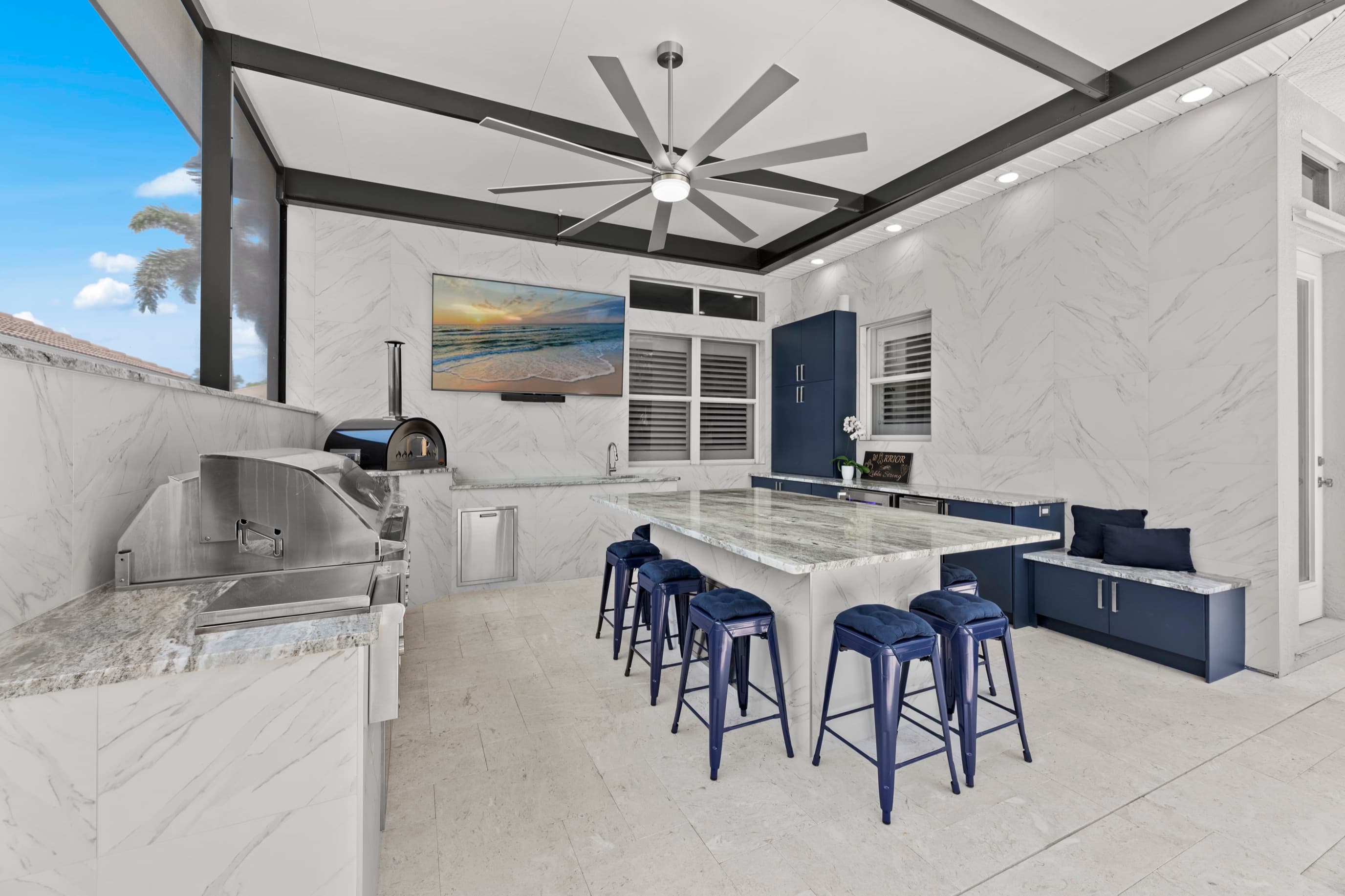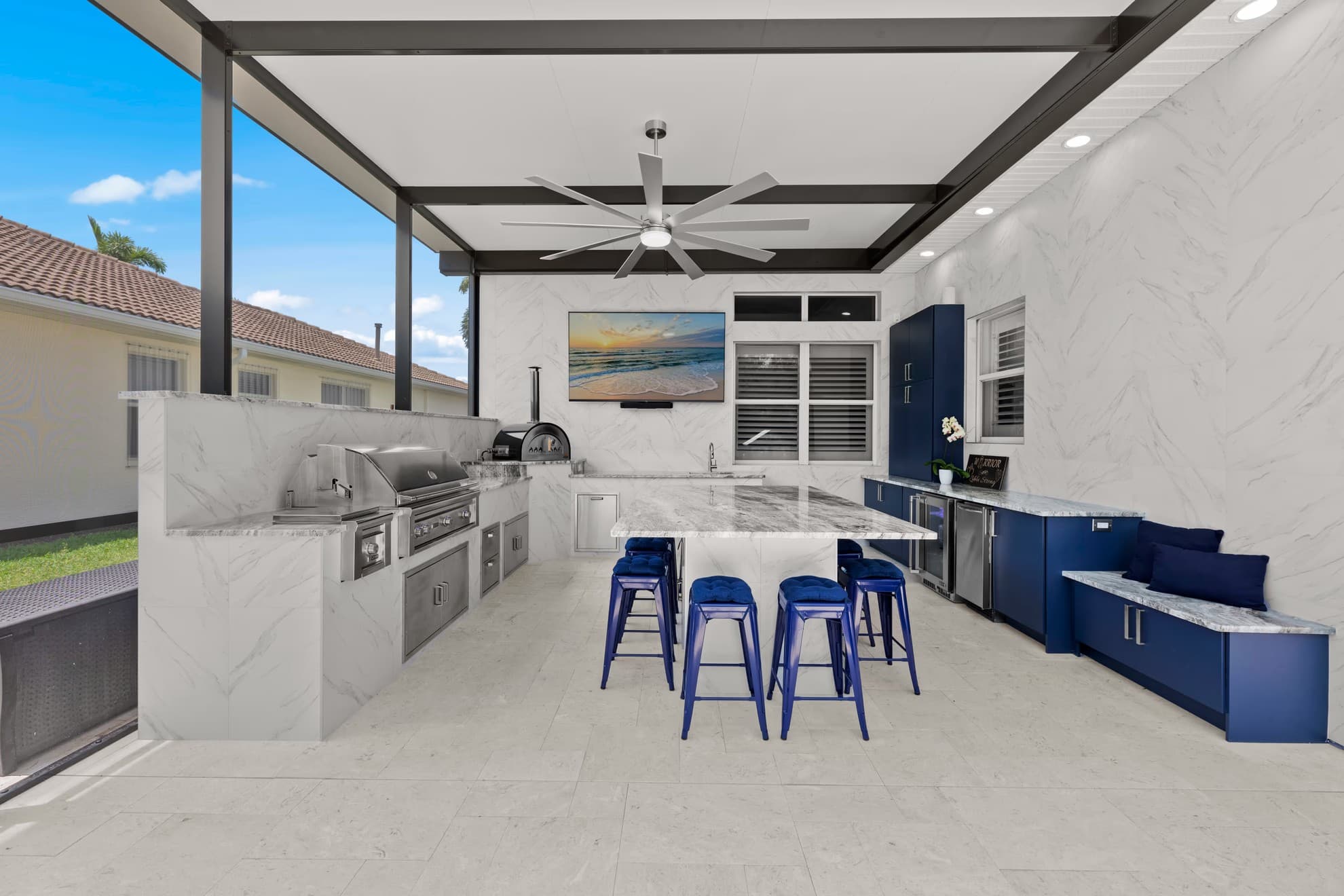
The island looked solid the day it was finished: tight seams, a countertop with no scratch on it yet, a finish that photographed well. Two summers of Southwest Florida salt air and humidity later, a soft spot shows up where the frame meets the slab, a ring won't come out of the countertop, or the exterior finish starts cracking where nobody can see the water sitting behind it. The best materials for an outdoor kitchen here aren't automatically the ones that look best on delivery day.
For Southwest Florida, that means concrete block or steel framing instead of wood, a countertop that's either non-porous or properly sealed on a real schedule, and an exterior finish with somewhere for water to go once it gets behind the surface. This post covers three decisions: framing, countertops and sealing, then finishes other than stucco, which our guide to why stucco outdoor kitchens hold up here already covers in full. Cabinet material, the box itself, is its own decision too. This post is about everything else.
Framing: The Decision That Determines Whether the Rest Survives
Whatever countertop or finish goes on top of it, an outdoor kitchen is only as good as what's underneath. Get the frame wrong and the best countertop in the world is sitting on a structure that's already failing.
Why Wood Framing Isn't a Long-Term Fix
Wood decay fungi need three things to establish themselves: moisture, oxygen, and a mild temperature range, according to the Forest Products Laboratory's own Wood Handbook (USDA Forest Service, Forest Products Laboratory). That's a large part of why the lab's own research program studies moisture management as a defense against decay in wood construction (USDA Forest Service, Forest Products Laboratory). An outdoor kitchen frame in Southwest Florida gets wet repeatedly, from rain, from dew, from sustained humidity that never fully dries out between wet spells. Those are exactly the conditions decay fungi need, supplied over and over, for as long as the structure stands. A conditioned interior wall rarely sees that combination. An outdoor kitchen frame sees it every season.
We didn't find a credible, independently sourced number for how many years that takes on a wood-framed outdoor kitchen specifically, and we're not going to make one up. What we can say plainly is that the mechanism is well established: repeated wetting is the input decay needs, and an uncovered outdoor structure supplies it far more reliably than anything built indoors.
Concrete Block (CMU): The Same Material the House Is Already Built On
Concrete masonry is inorganic. It isn't a food source for the fungi described above, and its own industry association describes concrete masonry construction as able to withstand extreme events, including hurricanes, with minimal wear over time (Concrete Masonry & Hardscapes Association). It's also the same construction method the house itself is likely built with, which is exactly the reasoning our guide to building an outdoor kitchen that survives Florida hurricanes uses when it comes to anchoring and load, worth reading if you want the structural detail this post doesn't repeat.
Steel Stud: The Second Structural Option
Properly coated steel framing is the other real option. The Steel Framing Industry Association states that steel is inorganic and won't support mold growth or warp in moist environments the way wood does, and that it resists termite damage in nearly all climates (Steel Framing Industry Association). Coating performance for cold-formed steel framing is governed by ASTM A1003, tested for corrosion resistance under the ASTM B117 salt-fog standard, which matters specifically in a salt-air environment. That salt-fog rating is the spec worth asking about on a coastal lot. That's an industry association making its own case for its own material, so take the framing as directional rather than neutral, but the underlying point, that steel doesn't rot the way wood does, holds regardless of who's saying it.
Countertops: What Needs Sealing, and What Doesn't Need It at All
Every countertop material below will look good the day it's installed. What separates them is what a Southwest Florida wet season does to whichever one you picked, and whether it needed you to do anything about it in between.
| Material | Sealing Required | UV / Sun Exposure | What Fails First |
|---|---|---|---|
| Porcelain Slab / Sintered Stone | None | Manufacturer-rated for direct exterior exposure | Rarely fails outright; the highest upfront cost is the tradeoff |
| Sealed Granite or Quartzite | Penetrating sealer, roughly every 10 to 15 years for a quality product | Good, UV-stable as a natural stone | Staining and moisture absorption if sealing lapses |
| Engineered Quartz | None required, but not built for this use | Standard indoor quartz is not warrantied for direct sun | Resin binder discoloration and warranty voided outdoors |
| Concrete | Yes, a UV-stable exterior-rated sealer | Sealer quality determines UV performance | Sealer yellowing or degrading, then thermal cracking |
Porcelain Slab and Sintered Stone
Large-format porcelain and sintered stone products such as Dekton are manufactured to be functionally non-porous and engineered for exterior UV and thermal exposure, per the manufacturer's own technical documentation (Cosentino, Dekton technical datasheet). That's a manufacturer spec sheet, not an independent lab, so treat the marketing language with the same skepticism you'd apply to any spec sheet, but the underlying category, a fired, dense mineral surface with essentially no open pores to absorb water, is a real and well-established one. It's the lowest-maintenance option on this list because there's nothing to seal and nothing to schedule.
Sealed Granite and Quartzite
If you'd rather have natural stone, the maintenance commitment is smaller than you may have been told. The Natural Stone Institute's own consumer guidance states that a quality penetrating sealer, sometimes called an impregnator, should have a life expectancy of 10 to 15 years, and that most granite countertops don't strictly need to be sealed at all, since sealing mainly provides further reduction of moisture migration into a surface that's already fairly moisture-resistant (Natural Stone Institute). If you've heard that natural stone needs resealing every year or two, that's not what the industry's own consumer guidance says. Use a penetrating sealer, not a topical one, and you're looking at a once-a-decade task, not an annual one. That's a schedule an owner can keep, even on a lanai in coastal Naples.
Engineered Quartz: Built for a Kitchen, Not a Lanai
Engineered quartz is a legitimate indoor countertop material that most manufacturers do not build or warranty for direct sun exposure. Caesarstone, one of the larger quartz manufacturers, sells a dedicated Outdoor Collection developed and tested specifically for weather and UV resistance, with its own separate warranty documentation apart from its standard indoor product line (Caesarstone, Outdoor Collection; Caesarstone, Warranty). That product split is the evidence: if standard quartz worked fine outdoors, there'd be no reason to engineer and warranty a separate line for it. If you want the quartz look on an outdoor kitchen, specify the outdoor-rated product, not the same material you'd use inside.
Concrete Countertops
Concrete countertop cracking is mostly a shrinkage response as the mix cools, and it's manageable with fiber reinforcement, proper curing, and a low-shrinkage mix design (Concrete Countertop Institute). Outdoors specifically, the sealer is the part that matters most: many sealers yellow or degrade in direct sunlight within months, so an outdoor concrete countertop needs a UV-stable, exterior-rated sealer, not whatever sealed the last indoor project (Concrete Countertop Institute). That source also sells its own sealer products, so treat the specific brand recommendations as a vendor's, but the underlying UV point, that not all sealers are built for direct sun, is worth asking about regardless of which one your contractor uses.
Finishes Beyond Stucco: Why Veneer Needs Somewhere for the Water to Go
Stucco on concrete block is its own well-covered decision, including what it costs and how long it lasts here. The finish worth a closer look is stone veneer, manufactured or natural, because two outdoor kitchens finished in what looks like the same veneer can perform completely differently depending on one thing you can't see once it's built: what's behind it.
A rainscreen, a drainage plane between the veneer and the wall behind it, is standard building-science practice for manufactured stone veneer, and industry guidance calls for a drainage screed set a specific minimum distance above grade and above paved or walking surfaces so water has somewhere to exit (IIBEC). Skip that drainage plane, or install it wrong, and moisture that gets behind the veneer has nowhere to go. It sits there, and it causes the substrate underneath to swell, crack, and eventually pop the veneer off the wall. The veneer itself usually isn't what failed. What failed is what was, or wasn't, behind it. That's a build-quality question to ask your contractor directly, not something you can judge from a finished photo. If you're looking at veneer on Bonita Springs homes near Estero Bay, ask what's going behind it before you settle on the stone.
Cabinets Are a Different Decision
Framing, countertop, and finish are the structure and the surfaces. The cabinet box inside the island, polymer, PVC, composite, or stainless, is a separate material decision with its own failure modes. Our comparison of outdoor kitchen cabinet materials covers that decision in full.
Frequently Asked Questions
Does a concrete block or steel-framed outdoor kitchen need a permit in Lee or Collier County?
Yes. A permanent structure like this requires a permit in both counties. Our walkthrough of the outdoor kitchen installation process covers the site prep, permitting, and framing stage in more detail than a materials comparison can.
Can I mix materials, like a porcelain countertop with a stone veneer finish, on a concrete block frame?
Yes. Framing material, countertop material, and exterior finish are three independent decisions. They don't have to match or come from the same product line, which is exactly why this post treats them as three separate sections rather than one bundled spec.
Ready to Build It Right the First Time?
Framing, countertops, and finish are the three decisions that determine whether an outdoor kitchen holds up over time or starts showing problems early. HomeWorks specifies coastal-appropriate materials for all three as a matter of course, the same way we approach outdoor kitchens across the rest of the build. You can see what that looks like finished in an outdoor kitchen built by HomeWorks in Southwest Florida.
If you're planning an outdoor kitchen and want a straight answer on which materials make sense for your site, request a free quote.