"Custom" is doing two completely different jobs in one word, and cabinet shopping is where that gets expensive.
Sometimes it means made to fit your kitchen. Sometimes it is being used to mean better. Those are not the same claim, and only one of them can be checked.
Here is what actually separates stock, semi-custom and custom cabinets, what KCMA's performance standard will and will not tell you, and where paying for custom genuinely buys something in a Southwest Florida kitchen. For the whole project, see our kitchen remodeling service.
What These Cabinet Labels Tell You
Start with the uncomfortable part. KCMA A161.1-2022 does not define stock, semi-custom or custom. Ask the supplier what its label includes.
In general use, stock means a line built in fixed sizes and finishes, made ahead and pulled from inventory. Semi-custom means that same line with a wider set of sizes, door styles, finishes and interior fittings you select from a list. Custom means built to order for your specific room, where the sizes are whatever the drawing says.
Those descriptions are useful, but the label alone does not tell you how the cabinet is built. A manufacturer can call a line semi-custom because it offers more finishes than the line below it. That is a marketing distinction inside one company's catalog, not a construction one.
So when a quote says "custom", the only honest response is to ask what it is describing: the sizes, the options, or the way the box is built.
What the KCMA Standard Does and Does Not Say
There is a real standard for kitchen cabinets. It is KCMA A161.1-2022, the Performance and Construction Standard for Kitchen and Vanity Cabinets, published by the Kitchen Cabinet Manufacturers Association.
The most useful sentence in it is the one that says what it is not. Section 1.2 reads: "This is a performance and construction standard only. It is not intended to specify cabinet design (mechanics or appearance) or materials. This standard is intended to be used to evaluate and measure how well a factory assembled cabinet can be expected to perform when properly installed in accordance with manufacturer's instructions, normally used, and maintained."
The industry's own standard does not specify materials.
It carries all the way through the construction section. Section 2.6.1 requires only that "all materials shall be of sufficient gauge or thickness to insure rigidity in compliance with this performance standard." Section 2.6.2 says face frames, where used, "shall be of thickness necessary to provide rigid construction to meet physical performance tests." Section 2.6.3 says the same thing about the sides, tops, bottoms and backs of frameless cabinets.
The standard names no species, sets no numeric panel thickness and gives no plywood-versus-particleboard verdict. The standard does not care what the box is made of. It cares whether the box passes the tests.
That is the answer to most of what you will be told in a cabinet conversation. A materials argument is being used to answer a performance question, and the industry itself declined to make that argument.
What the Standard Does Test
The tests are specific, and they are the questions worth asking about.
Section 5.1 loads every shelf and cabinet bottom uniformly at 15 pounds per square foot and leaves the load there for seven days. At the end, there can be no visible joint separation or failure anywhere in the cabinet or the mounting system, and the loaded shelves cannot deflect more than 0.0625 inch per lineal foot between supports, with a maximum of 0.25 inch between any two supports.
Section 5.2.3 is the one that matters most in a real kitchen. A mounted wall cabinet or wall hung base cabinet up to 36 inches wide "shall accept the net loading of 272 kg (600 pounds) without any visible sign of failure in the cabinet or the mounting system." For wall hung base cabinets between 36 and 60 inches wide, the test load is 800 pounds. For wall hung base cabinets over 60 inches wide, it is 20 pounds per inch of width.
The test puts 600 pounds on a three foot wall cabinet without allowing visible failure. That is the number to hold in your head the next time somebody explains that thicker boxes are what keeps cabinets on the wall.
Section 5.4 drops a 3 pound steel ball from 6 inches above the shelves, the cabinet bottoms and the drawer bottoms. Section 5.5 uses a 10 pound sandbag dropped 12 inches to test the base cabinet door and its connections against impacts such as a child falling against the cabinet.
A cabinet either passes these or it does not, and that has nothing to do with whether it is called custom.
Where Custom Actually Earns the Money
None of the above means custom is a waste. It means custom buys fit, and fit is worth real money in specific situations.
The first is a room that is not square. Older Southwest Florida houses, additions, and anything that has been remodeled once already tend to have walls that run out over a long cabinet run. A stock line handles that with filler strips. A custom run handles it by being the right size in the first place.
The second is height. A lot of houses here have tall ceilings and a soffit or a bulkhead sitting in the middle of that height. Whether the cabinets stop at a standard height, run to the ceiling, or get built around what is up there is a dimension question, and the tallest wall cabinet in a stock catalog is a fixed number.
The third is appliances. Panel-ready refrigerators, wide ranges, and anything integrated has an opening it needs. Getting that opening exactly right without an ugly filler is where made-to-order stops being a preference.
And the fourth is interiors. That includes pull-outs, drawer banks instead of doors on the base cabinets, and places for the trash and spices. Ask which interior fittings are available in the specific semi-custom line you are considering.
If none of those four applies, compare the specified dimensions and features before deciding whether custom adds anything you need.
What Actually Changes Between the Three
| Stock | Semi-custom | Custom | |
|---|---|---|---|
| Sizes | Fixed increments, gaps closed with fillers | Fixed increments plus modifications | Whatever the drawing says |
| Doors and finishes | A short list | A long list | Anything the shop can make |
| Interior fittings | Limited | Most of what you would want | Anything |
| Lead time | Confirm the selected line's delivery date | Confirm the selected line's delivery date | Confirm the selected shop's delivery date |
| Construction quality | Not determined by the tier | Not determined by the tier | Not determined by the tier |
That last row is the whole point of this post. Quality is a property of the cabinet, not of the tier, and it is measurable.
The Questions That Get You a Real Answer
- Is the line certified to KCMA A161.1? It is a yes or no question with a published answer, and it provides an independent performance check.
- What is the box made of, and how thick? There is no single required answer, but the supplier should be able to explain the spec sheet.
- Framed or frameless? This changes the opening size, the hinge, and how the doors sit next to each other. It is a real difference and it is not a quality ranking.
- Who measures, and when? Ask whether the field measure happens before or after demolition. On an existing kitchen with plaster or a furred wall, that single answer explains more schedule risk than the cabinet tier does.
- What is the lead time, and what happens if a box arrives wrong? Every tier gets something wrong occasionally. The difference between suppliers is what week the replacement shows up.
Frequently Asked Questions
What do custom built kitchen cabinets actually mean?
It means the cabinets are made to order at the dimensions your kitchen needs, rather than selected from fixed catalog sizes. It is a statement about fit and lead time. The label alone does not establish a performance certification or tell you how the cabinet is built.
Are custom cabinets better quality than stock cabinets?
Custom cabinets are not automatically better quality. The industry standard for cabinet performance, KCMA A161.1-2022, tests loading, impact, door and drawer operation and finish durability, and it explicitly does not specify materials or design. A well-built stock cabinet can pass tests a poorly-built custom one fails. Ask whether the specific line is certified rather than which tier it belongs to.
When is it worth paying for custom kitchen cabinets?
Custom is worth considering when the room needs it: walls that are out of square, awkward ceiling or soffit heights, exact appliance openings, or runs where filler strips would be visible. If your kitchen is a rectangle with standard appliances, compare a semi-custom quote with the custom quote, including dimensions, features and delivery dates.
Getting the Cabinets Right for the Room You Have
HomeWorks is a Florida Certified Building Contractor, CBC-1261775, owned by Chad and Lyndee and working across Lee and Collier County. Chad is on every project. We run 81 percent on schedule and carry 4.8 stars across 60 Google reviews.
We do not build cabinets ourselves, and when a less expensive tier gets you the same result, we will tell you so. We have an in-house designer, the room gets measured before anything is ordered, and the tier that fits your walls and your timeline is the one we specify. Then the price and the 15 percent contingency go on the table before work starts.
If permits are the next thing on your mind, what a kitchen remodel permit involves in Lee and Collier County covers that end of it.
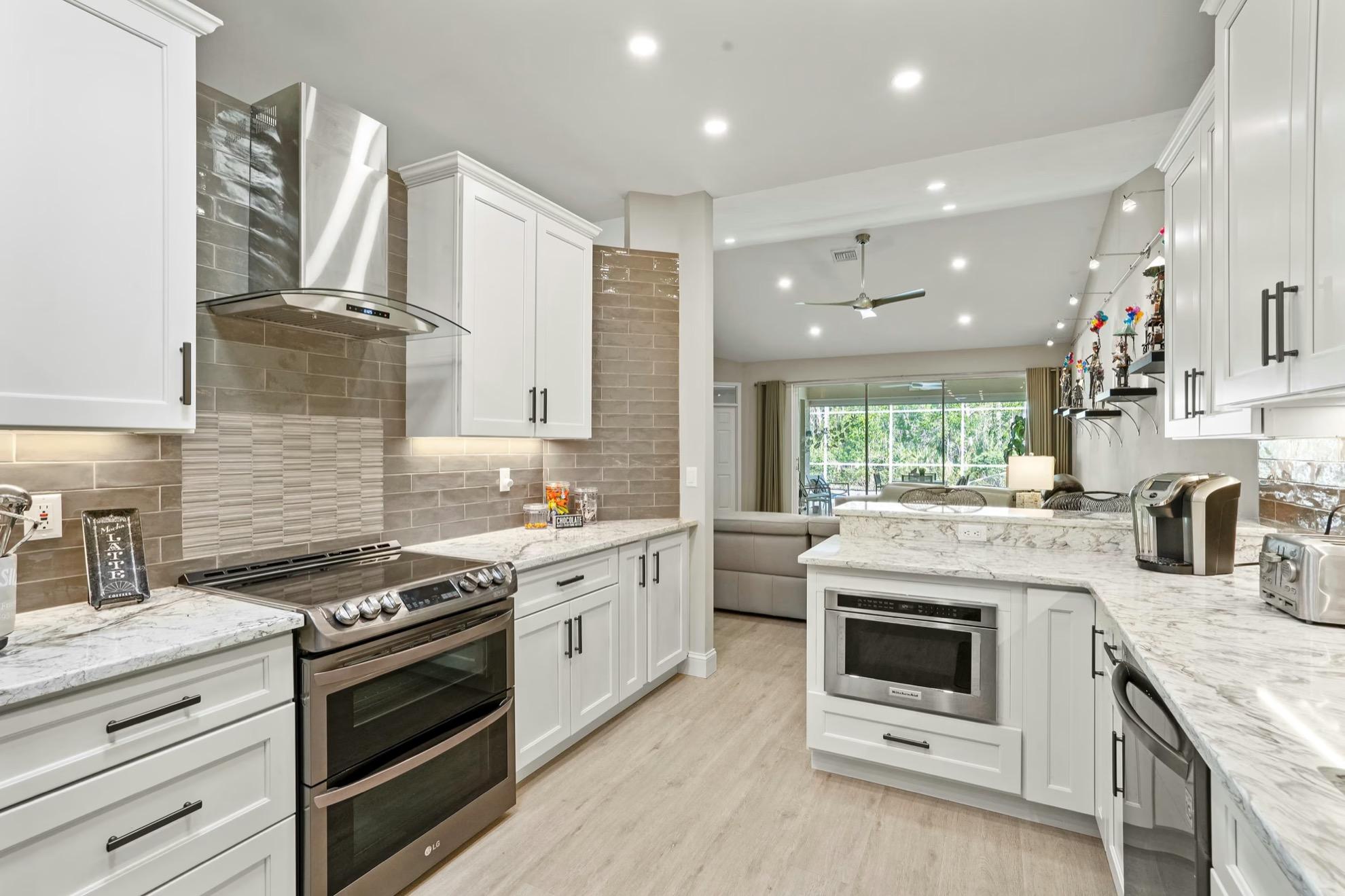
Have a look at a kitchen remodeled by HomeWorks in Southwest Florida, or request a quote and we will start by measuring the room.