"Who makes the best outdoor kitchens?" is the question everyone types into a search bar. It is the wrong question. The right one is harder and a lot more useful: who is accountable for the whole thing when the gas line comes in over, the inspector flags the framing, and the counter is already set?
Three kinds of businesses build outdoor kitchens in Southwest Florida. Prefab and retail sellers hand you a finished island. Outdoor kitchen specialists design and assemble the cooking run. Licensed general contractors carry the structure, the gas, the electrical, the plumbing, the permits, and the schedule as one job.
All three are the right answer for somebody. This guide says plainly which is which, including the cases where a prefab island beats anything we would build for you. It comes from the outdoor kitchens we build in Fort Myers, Estero, Bonita Springs, and Naples.
The Three Kinds of Outdoor Kitchen Builders
Prefab and Retail Islands
A prefab island arrives built. It is a finished unit with a grill cutout, doors, and a counter, delivered on a pallet or wheeled off a showroom floor and set on an existing slab.
What it is good at: speed, a fixed price, and no design process. You pick a model, it shows up, you cook on it. Nobody draws anything and nobody waits on a county.
What it does not include: a gas line, a sink, power beyond a cord, a roof, or anyone pulling a permit. The unit is a product. Everything that connects it to the house is a separate job, and it stays your job.
Outdoor Kitchen Specialists
These companies do outdoor kitchens and little else. They know appliances, they know layouts, and they build a lot of cooking runs every year.
What they are good at: appliance knowledge, showroom selection, and a design shaped around the way you actually cook.
Where the seam shows is the trades and the permit. A specialist who does not hold a contractor license has to hire out the gas, the electrical, the plumbing, and any structure, or hand those pieces back to you. When the schedule slips between two companies, nobody's name is on both halves of it.
Licensed General Contractors
A general contractor holds a state license, pulls the permit, and carries the whole scope. The island, the slab, the gas, the power, the drain, the roof, the inspections, and the cleanup all sit under one contract with one company.
What they are good at: the parts nobody photographs. Structure, code, coordination between trades, and a single warranty on the finished thing.
Where they look expensive: a general contractor prices the buried work honestly, so the number lands higher than a quote that leaves the gas line out and calls it later.
When a Prefab Island Is the Right Answer
We tell homeowners to buy the prefab island in four situations. This is not a setup for a pitch. In these cases it is the better buy.
You want a freestanding propane grill island on an existing slab, with no gas line, no sink, no roof, and no power beyond a cord. Nothing there crosses into permitted work, and paying a contractor to place a finished unit is money you do not need to spend.
Your budget stops at the grill station tier. If $8,000 to $15,000 is the ceiling and you would rather put it into appliances than into construction, a prefab island puts more grill in your yard than a built kitchen at the same number.
You are in a rental, or in a house you plan to sell soon. A prefab island can move with you or be replaced cheaply. A block-built kitchen is part of the house from the day it goes in.
You want it this month. Design, permitting, and construction take weeks. A delivered island takes days.
Buy the island in those cases, and keep it on the safe side of the permit line: no hard gas connection, no new circuit, no drain, no roof built over it. Our comparison of a BBQ island and a full outdoor kitchen walks through where that line sits in practice.
What Changes the Moment Gas, Water, or a Roof Is Involved
Add any one of those three and the project stops being a purchase and becomes construction.
Florida's permit exemption for smaller single-family work excludes any electrical, plumbing, structural, mechanical, or gas work, excludes property in a flood hazard area, and does not allow a project to be broken into pieces to get under it (Florida Statute 553.79, s. 553.79(1)(g)). An outdoor kitchen with a grill line, an outlet, and a sink is excluded several times over. Our guide to outdoor kitchen permits in Lee and Collier County covers what triggers the permit, what the inspections look at, and how each county handles it.
Then come the trades. A gas line has to be sized, run, and pressure tested before anything connects to it. We install weather-rated, GFCI-protected outlets on circuits sized for what actually gets plugged in. A sink needs a supply line and a legal path for the drain. Each of those is licensed work with its own inspection.
Then comes the structure. An island carries a stone counter, and a roof or pergola carries wind load, so both get engineered and inspected as structures. Take an Estero build inside a screen enclosure: the clearances at the screen frame, the ventilation, and the enclosure's own engineering all have to line up before anyone sets a block.
That is three trades, one structure, and a county building department, all on one schedule. The only question that matters is who is holding it.
What a Licensed General Contractor Owns
Florida defines a building contractor as one whose services cover commercial and residential buildings up to three stories and accessory structures, or the remodeling, repair, or improvement of a building of any size where the work does not affect structural members (s. 489.105(3)(b)). That is the license HomeWorks builds outdoor kitchens and their covered structures under.
In practice the license means the permit is pulled in the contractor's name, not yours. That is the part homeowners miss until it matters. When you pull an owner-builder permit for someone else's work, the county's questions become your questions and the liability follows the paperwork.
The trades run under that permit. Licensed electricians, plumbers, and gas fitters do their own work, and the contractor schedules it, coordinates it, and meets the inspector. LP gas businesses are licensed separately in Florida, where it is unlawful to engage in LP gas business activities without a license from the department (s. 527.02(1)).
One job, one schedule, one warranty, one number to call. That is the accountability our crews carry when we are working in Fort Myers, and it is what "a licensed contractor, not a handyman with a truck" actually means on a quote.
How to Check Any Builder in Five Minutes
Do this before you compare prices. It takes less time than reading one proposal.
Look up the license. Every Florida contractor license is public and searchable at the DBPR license search. Type in the company name or the license number and read the status and the class yourself.
Know what unlicensed actually means. In Florida it is unlawful to engage in the business or act in the capacity of a contractor, or to advertise as one, without being registered or certified (s. 489.127(1)(f)). A contract entered into by an unlicensed contractor is unenforceable in law or in equity by that contractor (s. 489.128(1)). The cheapest bid in the pile can leave you holding a contract that is worth nothing on the day you need it.
Ask who pulls the permit and in whose name. If the answer is you, ask why.
Ask for the itemized quote. The structure, the materials named by grade, the gas, the electrical, the plumbing, the appliances by model, the permits on their own line, and the contingency. A lump sum hides what got left out, which is the whole reason lump sums exist.
Ask what happens when the gas line comes in over. The honest answer is a contingency you can see. Every HomeWorks quote puts the 15 percent contingency on the table before work starts, so nobody has a money conversation in the middle of your project.
Ask what the design deliverable is and when you see it. Our outdoor kitchen design and service checklist lists what a real proposal contains and what a recorded site visit turns up.
What "Best for the Money" Means Here
Cheapest is easy to measure. Best for the money is what you end up paying, divided by the years the kitchen lasts.
The cheap quote grows in three predictable places: the permit that was never in it, the gas line left for later, and the wood frame that has to come back out from under a stone counter. By the time those land, your yard is torn up and saying no costs more than saying yes. That is the contractor horror story, and it starts at signing, not at the end.
Outdoor kitchens here run $8,000 to $80,000, with the gas, electrical, permits, and construction inside every one of those numbers. A grill station is $8,000 to $15,000. A mid-range kitchen with a sink, a refrigerator, and bar seating is $20,000 to $40,000. A full outdoor living space with a covered structure is $40,000 to $80,000 and up. What an outdoor kitchen costs in Southwest Florida breaks down what moves the number inside each tier.
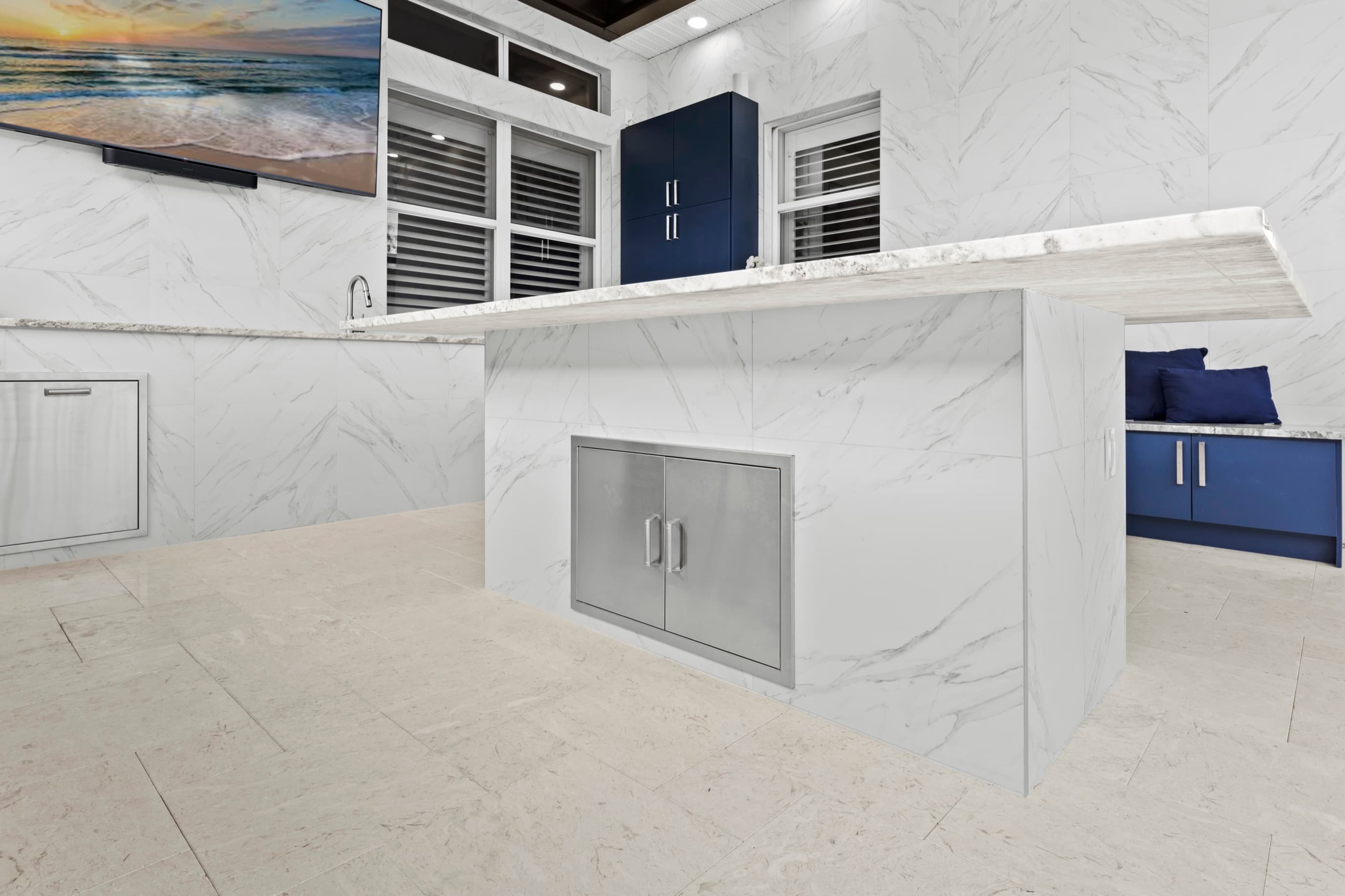
Then build it for the address, because the address decides the spec. We use 316 stainless on coastal lots in Bonita Springs and Naples, and 304 inland, since salt air finds the cheaper grade first. Block or welded steel under the counters, never wood. Full-body porcelain or sealed stone on top of it.
Best for the money is the quote that names all of that, in writing, with the contingency showing.
Frequently Asked Questions
Who makes the best outdoor kitchens?
No single brand or business. The best outdoor kitchen is the one built for your address by whoever owns the entire job: the structure, the gas, the electrical, the plumbing, the permit, the inspections, and the schedule. Judge builders on who is accountable when something goes sideways, not on who has the nicest showroom.
Is a prefab outdoor kitchen island worth it?
Yes, in the four cases above. An existing slab with no gas, no sink, no roof, and no new circuit. A budget that stops at the grill station tier. A rental or a house you are selling soon. A deadline measured in weeks instead of months. Outside those cases you are buying an appliance holder and keeping every connection problem for yourself.
Do outdoor kitchen builders need a license in Florida?
The contractor does, and so do the trades. Selling a prefab island off a showroom floor is retail. Connecting one to a gas line, a new circuit, or a drain is licensed work, and so is building the structure that holds it up. Check any company's status yourself in the state license search linked above before you sign anything.
Ready to Compare Real Quotes?
Get three quotes. Line them up on scope instead of on the bottom number, and ask every one of them who pulls the permit.
Chad and Lyndee started HomeWorks in 2017 with more than 25 years in the trade behind them. The company has run 100+ projects since, at 4.8 stars across 60 reviews, with 81 percent finishing on schedule. We handle the design, the permits, the gas, the electrical, the construction, and the cleanup. We are not done until you're 100% satisfied.
Call (239) 880-4700 or request a quote for a free, no-pressure consultation. You get an itemized number with the permits and the trades already in it, and the 15 percent contingency on the table before anyone touches your yard. Done right, on time, on budget, no excuses.
HomeWorks Construction and Design, LLC. License CBC-1261775. Serving Fort Myers, Estero, Bonita Springs, and Naples.