Most homeowners are not shopping for a construction project. They want the tub gone.
It is usually the same story. The tub is a builder unit nobody has sat in since the kids moved out, the grout lines have gone chalky, and stepping over a wall first thing in the morning stopped feeling casual a while ago. Then the wall opens up and the number changes. That last part is what people are actually afraid of.
Here is the short answer. A tub to shower conversion is plumbing work, then waterproofing work, then tile work, in that order. The tub comes out, the drain moves, a new waterproof system goes in behind the tile, and the space you get back is usually about double the code minimum. It is permitted work in Lee and Collier County because it touches potable water. And it is not always the right call, which is the second half of this post.
Below is what happens between demolition and the final inspection, what the Florida Building Code requires, and the four situations where keeping a tub beats converting it. Swapping one tub for another is a different job with a different sequence and is not what this covers. For the wider picture, start with bathroom remodeling in Southwest Florida.
What Happens Between the Tub Coming Out and the Tile Going On
Demolition tells you what you actually bought
The tub itself comes out fast. What is behind it decides the rest of the schedule.
In this market the common find is tile set directly on drywall with no waterproof membrane behind it. Our bathroom remodel cost guide covers what correcting that adds, because it is the most frequent surprise in a Southwest Florida bath job. The second find is a soft bottom plate or a wet stud where the tub flange met the wall and water has been wicking for years.
Neither of those is a change order game. They were already in your house. What matters is whether the contractor put a contingency in the number before demolition, or discovers the rot and hands you a bill.
The drain moves, and that is the permitted part
A tub drain sits at one end of the tub. A shower drain sits near the middle of the shower floor. Those are rarely the same spot, so the drain gets relocated and the trap gets reset.
If the house is slab on grade, and most here are, relocating that drain means cutting and patching concrete. Over a crawl space the same work happens from below. Same job, very different day.
Waterproofing is the whole job
This is where shortcuts fail, and the code is specific about it.
The 2023 Florida Building Code, Residential, 8th Edition, Section P2709.2 requires that on site built up shower receptors be lined. The approved materials are sheet lead, sheet copper, a plastic liner meeting ASTM D4068 or ASTM D4551, hot mopping, or a sheet applied bonded waterproof membrane meeting ANSI A118.10. That lining has to extend at least 2 inches beyond the rough jambs and above the finished threshold.
Section P2709.1 sets the shape. The finished floor slopes toward the drain at 2 to 4 percent, and a finished curb threshold runs between 2 and 9 inches deep, measured to the top of the drain.
That is the difference between a shower that lasts and one that quietly rots framing for six years. Tile is not waterproof. Grout is not waterproof. The system behind the tile keeps water inside the shower, and it is the part you never see again once the tile goes on.
Will a Shower Actually Fit Where the Tub Was
Almost always, with room left over.
Section P2708.1 of the same code requires a shower compartment to have at least 900 square inches of interior cross sectional area, and to measure at least 30 inches in its smallest dimension. That is measured at the finished interior surface, and it excludes the valve, the shower head, the soap dish, and any grab bars. The 900 square inches has to hold from the top of the threshold up to 70 inches above the drain.
If your alcove is the common 60 inch by 30 inch size, converting it gives you about 1,800 square inches, roughly double the minimum, with the 30 inch requirement met in the shallow direction.
The code also allows a narrower compartment, down to 25 inches, when the cross sectional area is at least 1,300 square inches. That matters in older guest baths where the alcove is short.
So the size question is rarely whether a shower fits. It is whether the glass stops at the old alcove line or the shower takes more of the room, which is a layout decision, not a code one.
Curbed or Curbless, and Why Florida Slabs Change the Answer
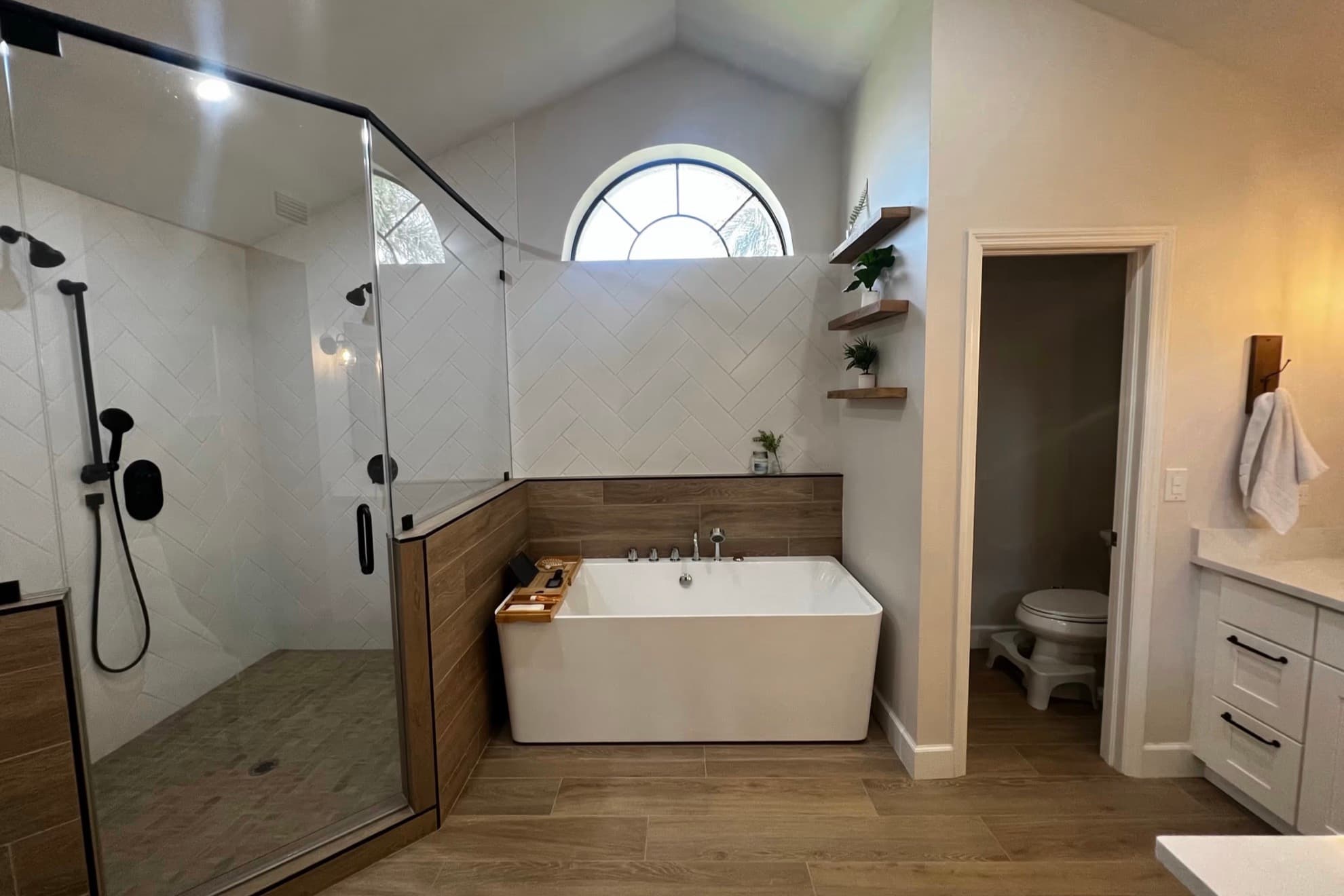
A curbless shower is the one in the photo you saved. It is also the one where the shower floor sits lower than the rest of the bathroom, so the slope to the drain has somewhere to go.
Over a wood framed floor that means dropping or sistering joists. Over a slab it means cutting a recess into the concrete. That is real structural work, and it is the honest reason a curbless quote and a curbed quote are nowhere near each other.
A curb of 2 to 9 inches is code compliant and far simpler. It is also, for some people, the wrong answer for the next twenty years. If the reason for converting is that stepping over a tub wall got hard, a curb that is still there in 2046 has not solved much. Our guide to aging in place bathroom design covers that wider question.
One thing worth deciding while the wall is still open: blocking for grab bars. Plywood between the studs costs almost nothing during framing and costs a demolition to add later. Put it in even if you do not want bars yet.
Permitting, and Which Office Actually Issues It
A conversion touches potable water and drainage, so it is permitted work. We pull the permit and schedule the inspections. That is not a favor, it is what a licensed contractor is for.
The part homeowners get wrong is who issues it. Permitting authority here is per jurisdiction, not per county. The City of Fort Myers, the Village of Estero, the City of Sanibel, the Town of Fort Myers Beach, Collier County, and Lee County for unincorporated Lee each run their own review. A rule you read about one of them is not automatically the rule for yours, so confirm with the office that covers your address. We work across both counties, including Fort Myers and Naples.
The practical consequence is scheduling. Tile does not go on until the rough plumbing passes inspection. Anyone who gives you a tile date without mentioning the inspection is giving you a number, not a schedule.
When Replacing the Tub Is the Better Spend
Four situations where we will tell you to keep a tub.
It is the only tub in the house. Once it is gone there is nowhere to bathe a toddler, wash a dog, or soak a bad back. That is a daily cost, not a resale abstraction.
Small children live there or visit often. A walk in shower and a two year old are a difficult combination for a few years.
The tub is sound and only the surround failed. If the problem is the tile and the waterproofing behind it, you can fix that without changing the fixture. Smaller job, smaller number.
You are moving soon. A conversion done properly involves permits and inspections, so starting one weeks before listing rarely ends well.
We are not going to hand you a resale statistic. There is no sourced number we trust for what removing a house's last tub does to a sale price here, and the figures online are usually national and usually published by someone selling a bathroom product. This is a judgment call about who buys your house next, and your agent is a better source on it than your contractor.
What to Ask Any Company You Find
Search for a shower conversion near you and you get three kinds of results: national one day refit companies, independent tile setters, and licensed general contractors. All three can produce good work. They carry very different risk. Four questions sort them out quickly.
- Who pulls the permit, and is the license number on the contract? Ours is CBC 1261775.
- What waterproofing goes behind the tile, and does it meet ANSI A118.10 or another lining the code names?
- What happens if a stud is rotten when the wall opens? Is a contingency already in the number I am signing, or is that a change order?
- Who is on site the day the tile is set, and who do I call if something is wrong?
The best tub to shower conversion companies near you will answer all four without pausing. The ones that get vague on question three are the ones that produce the stories you have heard.
Frequently Asked Questions
Can I keep the tub and add a shower?
Two versions of that question. If you mean a tub with a shower head over it, that is the combination shower and bath most Florida homes already have, and converting removes it. If you mean a separate soaking tub plus a separate walk in shower in the same room, yes, when the room has the space. That is two wet zones, two drains, and two waterproofing details, so it costs more than converting the alcove.
How long does a tub to shower conversion take?
We will not give you a day count before we have seen the room, and you should be wary of anyone who does. The sequence is fixed: demolition, plumbing rough, inspection, waterproofing, tile, glass, final. The inspection is the step nobody controls, and tile does not start until it passes. You get the schedule in writing at the walkthrough, along with the price and a 15 percent contingency, before anything is signed.
Do I need a permit for a conversion?
Yes. The work touches potable water and drainage. Which office issues that permit depends on the jurisdiction your address sits in, not on the county alone.
What about the one day conversions I keep seeing?
A one day product is generally a liner or an acrylic surround fitted over what is already there. It changes what you see, not what is behind it, which is where the failures are. If the wall behind your tub is genuinely sound, that can be a reasonable choice. If it is not, the problem is covered rather than fixed.
Getting a Straight Answer About Your Bathroom
HomeWorks is a Florida certified building contractor, CBC 1261775, owned by Chad and Lyndee and working across Lee and Collier County. Chad is on every project. We run 81 percent on schedule and carry 4.8 stars across 60 Google reviews.
On a conversion, what that buys you is the boring version. The price and the 15 percent contingency are on the table before demolition. One team owns the job from the first walkthrough to the final cleanup. Nobody hands you a new number because a stud turned out to be wet.
Have a look at a bathroom remodeled by HomeWorks in Southwest Florida, or request a quote and we will come look at the room.