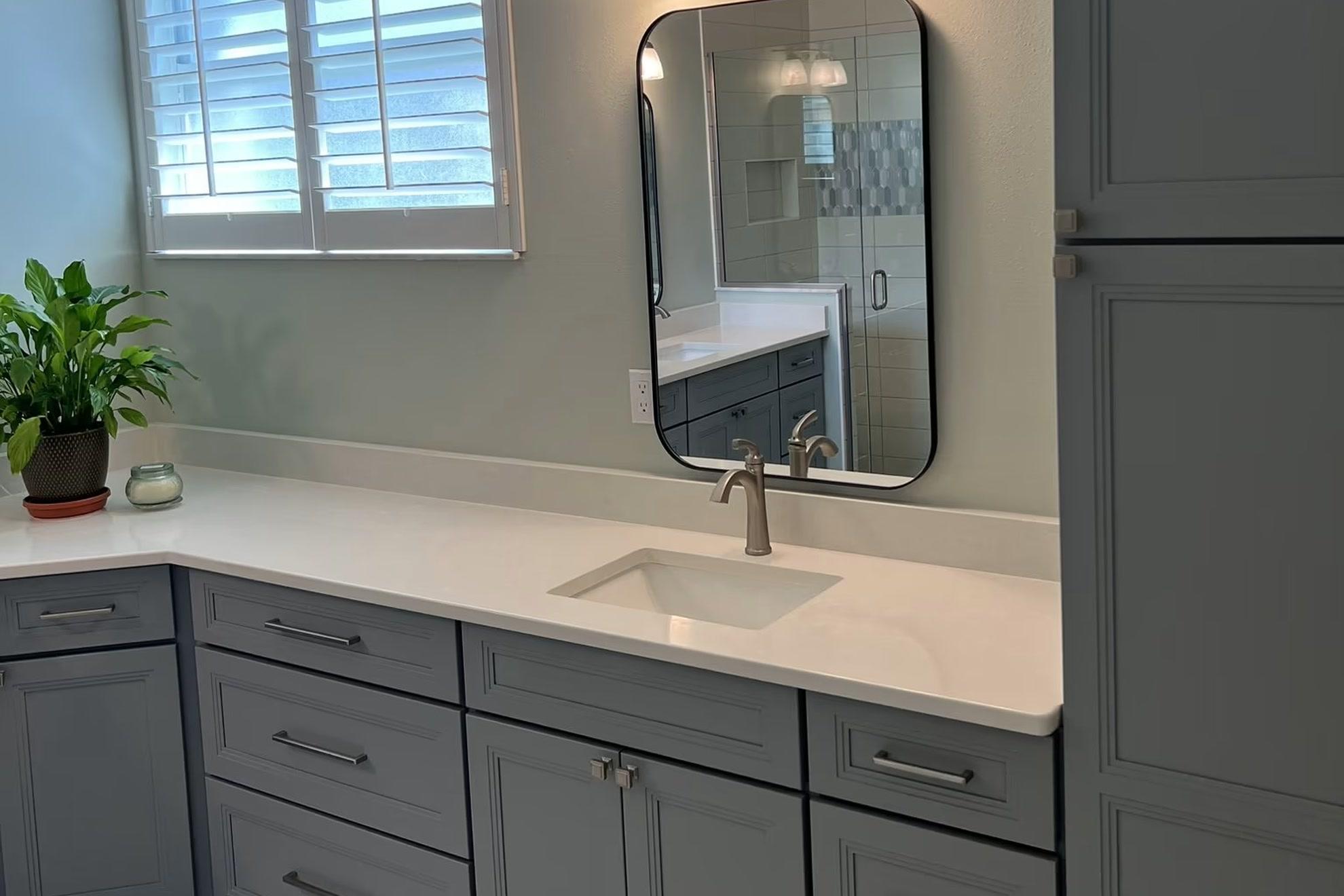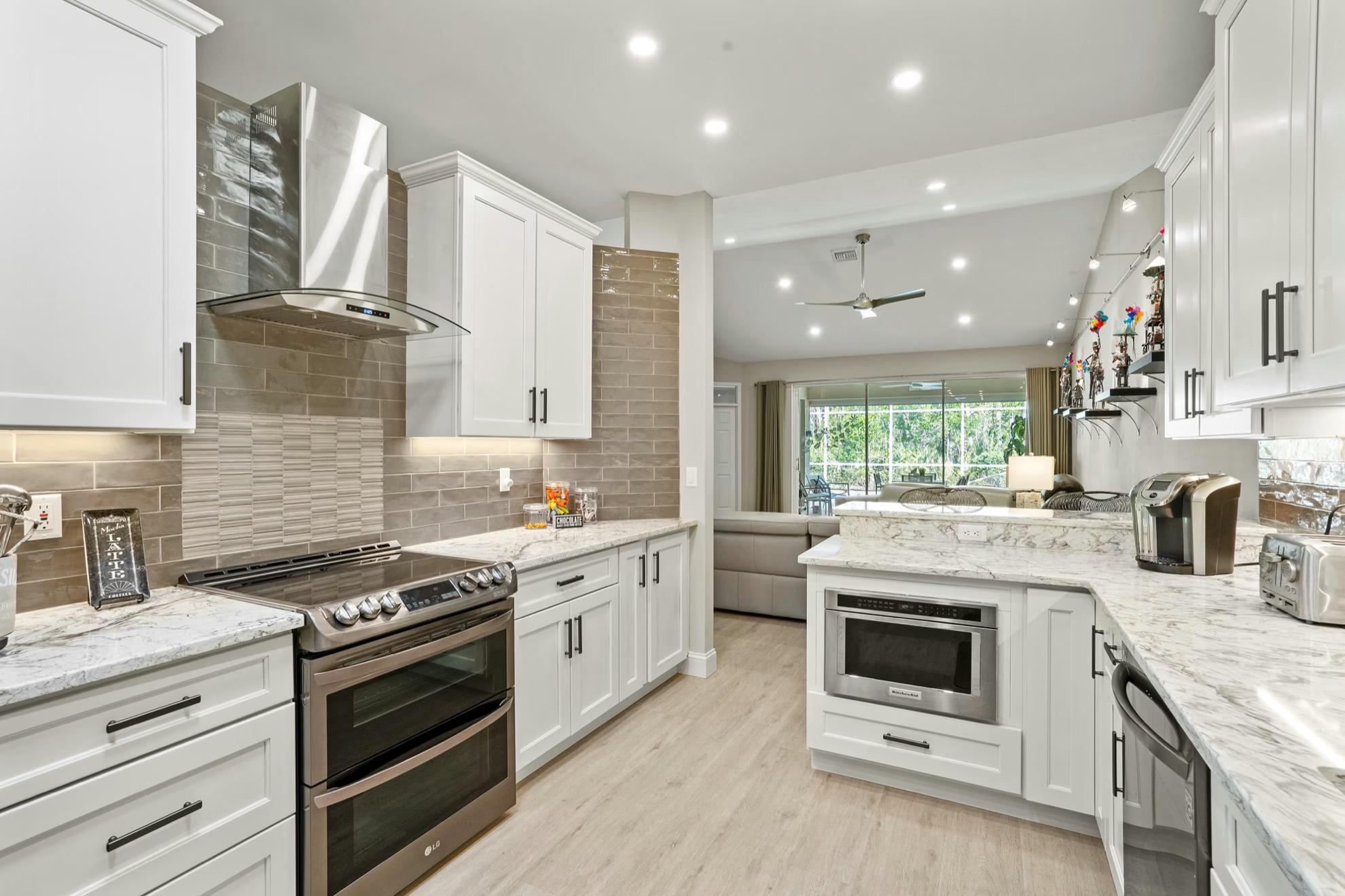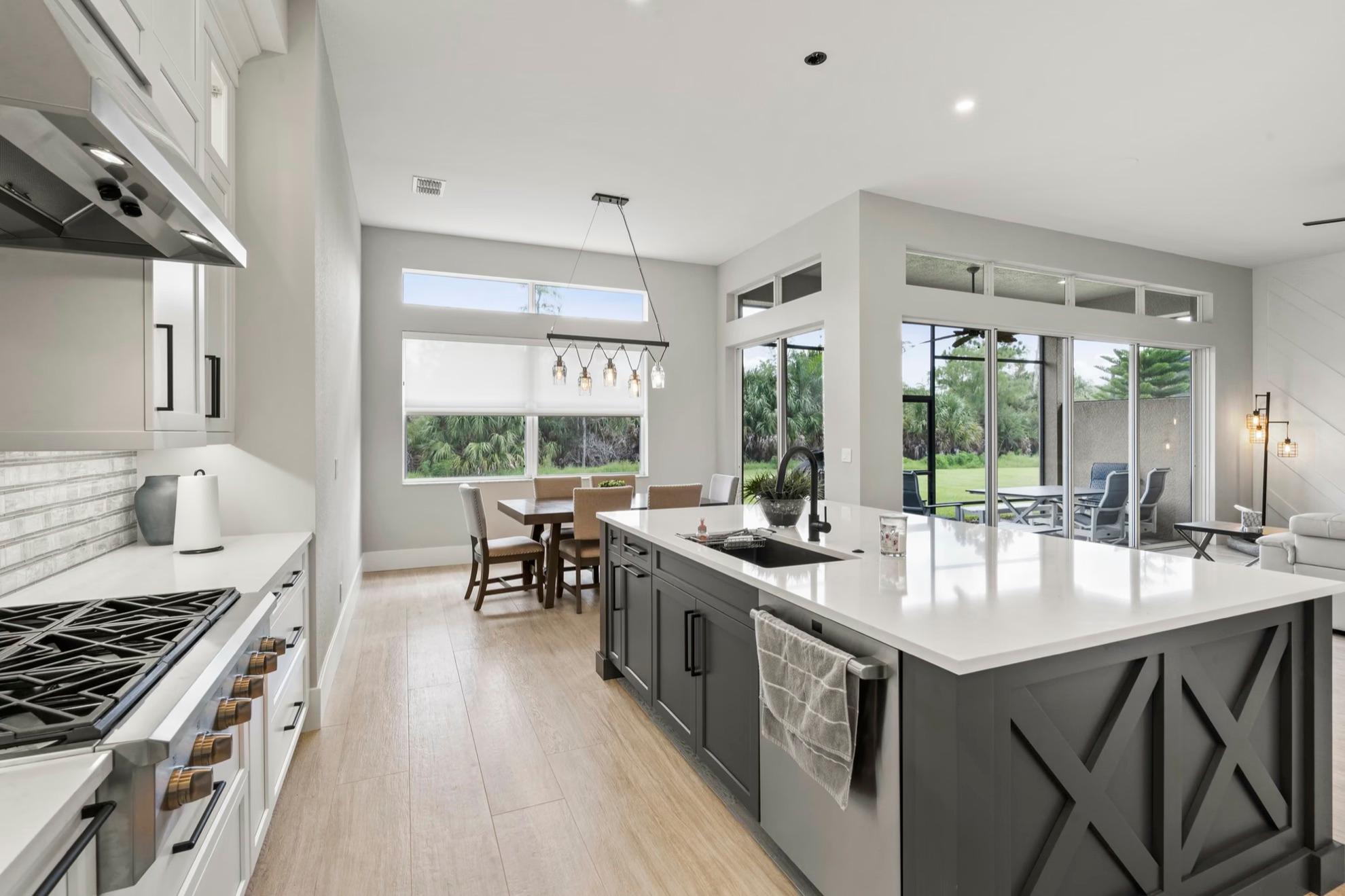
Most countertop advice written for Florida is written for somewhere else, then given a palm tree.
Heat and humidity do change the answer here. They just do not change it the way the sales conversation usually implies, and for two of the three materials in this post they barely change it at all.
Here is what granite, engineered quartz and wood countertops actually are, which of the three responds to a Southwest Florida house and by how much, and the questions that get a straight answer out of whoever is selling you a slab. Kitchen remodeling tends to stall at this decision more than any other.
Start With What You Are Actually Buying
These three words describe three genuinely different things, and one of them is not what most people think.
Granite is rock. It is quarried, cut into slabs and polished, and what you install is the same material that came out of the ground.
Engineered quartz is not. According to the NIOSH science bulletin on engineered stone countertops, published by the federal agency that studies workplace hazards, "a new engineered stone countertop product known as 'quartz surfacing,' was created in the late 1980s by combining quartz aggregate with resins to create a product for use in home building and home improvement." In plain terms, it is crushed stone held together by a polymer.
The same bulletin puts numbers on the difference. Quartz surfacing materials "may contain up to 93% crystalline silica", while "the percent of crystalline silica in a slab of granite is less than 45%, darker color granite has a lower percentage."
Wood is wood. A butcher block top is strips of lumber glued into a slab, and it is a living material in a way the other two are not.
That is the whole framework: one rock, one composite with a binder in it, and one piece of a tree. Almost every real difference in a Florida kitchen comes out of those three facts.
Heat Is a Question About the Binder
A hot pan is the most common way a kitchen countertop gets damaged, and the three materials fail differently because of what holds them together.
Granite has no polymer binder holding it together. The stone itself is quarried rock rather than crushed aggregate bound in resin, though sealers or surface fills can still be affected by direct heat.
Engineered quartz has a binder, and the binder is a resin. That is the federal description quoted above, not a competitor's characterization. Resin is a polymer, and a polymer is the part of any assembly that responds to heat first.
Here is what we are not going to tell you: a number. We could not find an independent standard that publishes a temperature limit for engineered quartz, and the only parties publishing one are the companies selling the slabs. So the honest instruction is to ask for the manufacturer's own written care and use sheet for the specific line you are buying, before you buy it, and read what it says about direct heat. It is their product, so their own document is the best evidence that exists about it, and any fabricator who cannot produce it in a day has told you something too.
Wood scorches. Everyone already knows this and nobody is surprised by it.
Use a trivet on all three and this section stops mattering.
Humidity Only Has an Opinion About One of Them
This is where Florida advice usually goes wrong. Humidity is treated as a countertop problem in general, when it is a countertop problem for exactly one of these three.
Stone does not change dimension with the weather in your kitchen. Neither does a quartz composite. Whatever else you weigh between those two, seasonal humidity is not on the list.
Wood is different, and the size of the difference is published by the federal government.
The Wood Handbook, from the USDA Forest Products Laboratory, includes a table of the moisture content wood settles at for a given temperature and relative humidity. At 80 degrees Fahrenheit, wood in equilibrium with 50 percent relative humidity holds 9.1 percent moisture. At the same temperature and 80 percent relative humidity, it holds 15.7 percent.
That is the number that matters in a Southwest Florida house. An air conditioned kitchen and the same room after a long summer with the air off, in a second home or after a storm takes the power out, are two different environments for a wood countertop, and the wood is moving toward each of them.
How Much It Moves, With the Arithmetic Shown
The same handbook lists shrinkage values by species. Sugar maple, a common butcher block wood, shrinks 9.9 percent tangentially and 4.8 percent radially going all the way from green to ovendry. Northern red oak is 8.6 and 4.0. Black walnut is 7.8 and 5.5.
The handbook also states that shrinkage begins near the fiber saturation point, about 30 percent moisture content, and continues in a fairly linear manner below it.
So run it. A swing from 9.1 percent to 15.7 percent is 6.6 points, which is roughly a fifth of that 30 point range. A fifth of sugar maple's numbers is about 1.1 to 2.2 percent of the width, depending on how the strips were cut. On a countertop 25 inches deep, that is somewhere between a quarter of an inch and half an inch of movement, across the grain, in one direction.
That is a calculation from the handbook's own figures, not a quotation from it, and it is worth checking rather than taking on faith. A finish slows the exchange down. It does not stop it, and it does not change where the wood is heading.
None of this makes wood a bad countertop. It makes wood a countertop that has to be fastened in a way that lets it move, kept in a house that stays conditioned, and maintained. Around a sink, in a rental, or in a home that sits empty half the year, it is the wrong material and the reason is arithmetic rather than taste.
What Actually Separates the Two Stone Options Here
Once humidity is off the table, the granite versus quartz decision comes down to things that have nothing to do with the climate.
Granite slabs are natural, so each one is different and the slab you approve is the slab you get. Quartz is manufactured, so the pattern is consistent and what you see in the sample is what shows up in the kitchen. Neither of those is better. They are different kinds of certainty, and people have strong preferences.
Seams are the practical one. A big island in an open plan house may need one, and where it lands is a decision somebody is going to make with or without you. Ask to see the seam layout on the actual slab drawing before fabrication starts.
The sink is the other. An undermount sink hangs from the underside of the countertop, so the support under it is part of the countertop job, not the plumbing job. Ask who is building it.
Questions That Get You a Real Answer
- For quartz, can I see the manufacturer's written care and use sheet for this exact line? Ask for the document from the company whose name is on the slab, not the fabricator's summary of it.
- Can I see the seam layout on the slab drawing? Ask to see it before fabrication, not after.
- Who supports the undermount sink, and with what? The answer should be specific.
- When does the template happen? Templating usually cannot happen until the cabinets are set, which is a schedule fact worth knowing at the start rather than discovering in week three.
- For wood, how is it being fastened, and does it get finished on all six faces? The bottom and the ends are the ones that get skipped, and they are the faces doing the moisture exchange you cannot see.
Frequently Asked Questions
Do granite countertops hold up in Southwest Florida humidity?
Yes. Granite is quarried rock, and it does not change dimension with the relative humidity in your kitchen. Humidity is a real material question in a Florida house for wood and for anything with an unsealed particle core, which is why it comes up so often for cabinets and flooring. For a stone countertop it is not the deciding factor, and any comparison that leads with it is answering a different question.
Is quartz or granite better for a Florida kitchen?
Neither is better because of the climate. They are made differently: granite is a single natural material, while engineered quartz is crushed stone bound with resin, per the NIOSH description above. That difference shows up in pattern consistency, in how each one is fabricated, and in what the manufacturer says about direct heat. It does not show up as one of them failing in Florida weather.
Can you use a wood countertop in a Florida kitchen?
Yes, in a house that stays conditioned, away from the sink, fastened so it can move and finished on every face. The Forest Products Laboratory numbers above show wood settling at 9.1 percent moisture at 50 percent relative humidity and 15.7 percent at 80 percent, both at 80 degrees Fahrenheit. In a second home that sits closed up through the summer, that swing is a reason to put wood on an island as an accent, or to skip it.
Specifying the Countertop for the House You Actually Have
HomeWorks is a Florida certified building contractor, CBC-1261775, owned by Chad and Lyndee and working across Lee and Collier County. Chad is on every project. We run 81 percent on schedule and carry 4.8 stars across 60 Google reviews.
We handle design, permits, construction, and cleanup with one accountable team. We have an in-house designer, the room gets measured during a recorded site visit, and the proposal includes Design Flex renderings. The price and the 15 percent contingency go on the table before work starts.
If you want the whole house version of the materials question, remodeling for Florida's humidity covers flooring, cabinets and finishes. If you are still working out the look, 2026 kitchen trends for Southwest Florida homes is the design end of it.
Have a look at a kitchen remodeled by HomeWorks in Southwest Florida, or request a quote and we will start by measuring the room.