"Aging-in-place" gets a bad reputation.
The phrase conjures grab bars that look like they belong in a hospital, shower chairs from a medical supply catalog, and design choices that announce to every visitor that someone in this house is getting older.
That's not what we build.
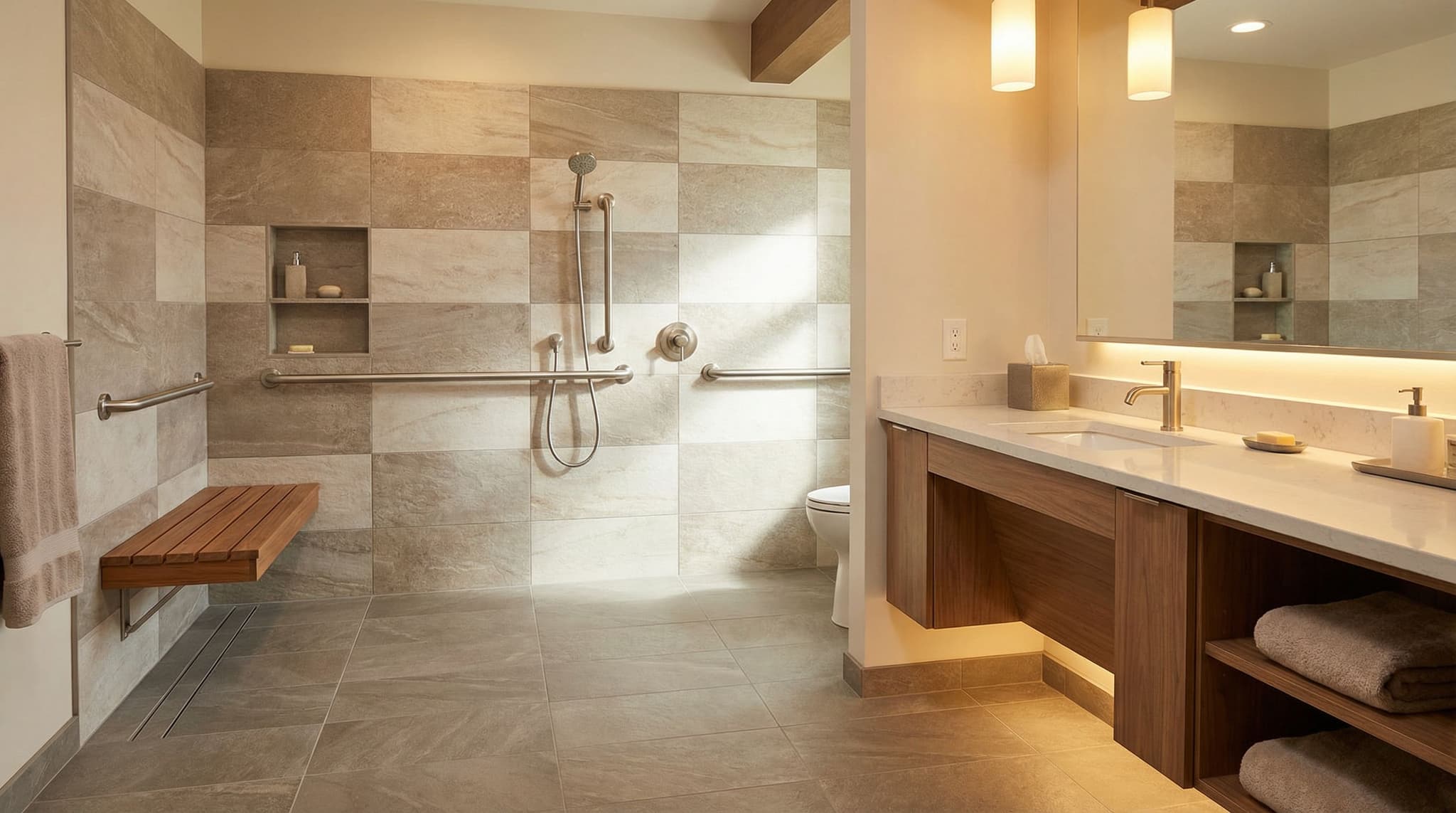
The bathroom remodeling projects we do for 55+ homeowners across Fort Myers, Naples, Estero, and Bonita Springs look like luxury bathrooms. Curbless showers with linear drains and large-format porcelain. Brushed gold hardware that doubles as grab bars. Comfort-height fixtures that feel right for any adult. Heated floors. Layered lighting with motion-activated night strips.
Safe and beautiful aren't in conflict. A well-designed accessible bathroom is better than a standard bathroom — at any age.
Why This Matters Specifically in Southwest Florida
Southwest Florida has one of the highest concentrations of 55+ communities in the country. The numbers aren't close.
The Brooks, Pelican Bay, Bonita Bay, Spanish Wells, Pelican Landing, Grandezza, Shadow Wood, Tidewater, Pelican Preserve — these communities span tens of thousands of homes, most of them owned by people who plan to stay put for decades. Not moving to assisted living. Not selling and downsizing. Staying.
The homes in these communities were largely built between 1995 and 2010. Their bathrooms reflect that era: builders-grade tile, step-over shower curbs, standard-height everything, chrome fixtures from the Clinton administration. The bathrooms work. They're just not designed for the long term.
Most bathroom falls happen in homes people plan to stay in. The bathtub is the most dangerous spot in the house — not the staircase, not the pool deck. The everyday routine.
A thoughtful bathroom renovation is not about accommodating decline. It's about designing a bathroom that works better right now and keeps working for decades without requiring another expensive renovation when circumstances change.
Curbless (Zero-Entry) Showers
The single most requested feature in the aging-in-place renovations we do is the curbless shower — no step, no threshold, no curb to navigate.
A curbless shower keeps water contained not with a raised barrier but with a sloped subfloor that pitches toward the drain. A linear drain along one wall handles the flow efficiently and creates a clean, modern look. Done correctly, water stays where it's supposed to.
This design requirement happens to align perfectly with the current luxury shower trend. Curbless showers are in every high-end design publication right now — not because of accessibility, but because they look better. Larger. More spa-like. The shower you want in a hotel.
Material choices for curbless showers:
- Large-format porcelain tile (24x24 or larger) — fewer grout lines means less surface variation underfoot, better slip-resistance, and dramatically easier cleaning. A shower with 4x4 tile has 15-20x more grout lines than one with 24x24 tile.
- Non-slip rated tile — porcelain tile has a Coefficient of Friction (COF) rating. For shower floors, you want a wet COF of 0.60 or higher. This doesn't mean a textured tile that collects grime — modern matte and honed finishes achieve proper slip resistance while looking clean.
- Built-in bench seating — teak slat or porcelain-topped. Useful during the shower, doubles as a surface for products, and looks intentional rather than medical.
- Recessed niches — tiled and lit, keep product bottles off the floor.
Cost context: A curbless shower conversion or new-build runs $10,000–$25,000 depending on size, tile selection, and whether we're reconfiguring the existing shower footprint or rebuilding from scratch.
Grab Bars as Design Elements
The chrome grab bar bolted to bare drywall is a thing of the past. Modern grab bars are designed to be indistinguishable from other bathroom hardware — or to serve dual purposes as part of the bathroom's design.
Finish options: Brushed nickel, matte black, brushed gold, oil-rubbed bronze, polished chrome. Whatever finishes your faucets, shower system, and towel bars use, grab bars can match.
Design formats:
- Towel bar grab bars — these look exactly like a standard towel bar. They hold towels. They also hold up to 250 lbs of lateral force.
- Shelf grab bars — a small corner shelf with a bar along the front edge. Holds products, functions as a grab bar.
- Integrated shower grab systems — bars built into the shower niche or along the shower wall as part of the overall design.
Placement that matters:
- Near the toilet — vertical bar on the side wall for lowering and rising. Most important placement in the bathroom.
- At the shower entry — something to hold when stepping into the shower (or stepping over a curb, if you're not going curbless).
- Inside the shower — lateral bar along the wall at hip height.
The critical construction note: Grab bars must be mounted to blocking in the wall — wood framing or a continuous backer board installed during the renovation. A bar screwed into drywall or tile alone will fail under load. This blocking must be planned and installed during the renovation, not added after the fact.
The smart move: Install the blocking during any bathroom renovation, even if you don't install bars now. Blocking costs almost nothing when the walls are already open. Retroactively installing blocking after tile is up costs $800–$1,500 per location. We install blocking in every bathroom we remodel.
Comfort-Height Fixtures
Standard bathroom fixtures are surprisingly uncomfortable for most adults.
Standard toilet height: 15 inches from floor to seat. Standard vanity height: 30–32 inches. Both of these measurements were established when average heights were lower and when the population was younger.
Comfort-height toilets sit at 17–19 inches — roughly the same height as a standard chair. The difference is noticeable from the first use and significant for anyone with knee or hip concerns. This is now the default specification in every bathroom we remodel.
Raised vanity heights at 34–36 inches eliminate the forward lean that puts strain on the lower back. This is particularly relevant for primary bathrooms where the vanity gets used twice daily. Taller homeowners often prefer 36 inches. Most adults are more comfortable at 34 inches than at 30 inches.
Neither of these changes reads as accessible. A comfort-height toilet looks like a toilet. A taller vanity looks like a taller vanity. These are ergonomic improvements that happen to also reduce fall risk.
Non-Slip Flooring
The bathroom floor takes more falls than any other surface in the home. The combination of wet surfaces, bare feet, and transitions between dry and wet areas creates consistent risk.
What to look for in bathroom flooring:
- COF rating of 0.60 or higher (wet) — the Coefficient of Friction rating for wet surfaces. This is a measurable specification, not a vague claim.
- Matte or honed finishes — not polished, not glazed-smooth. A matte porcelain with proper COF rating provides meaningful slip resistance without looking industrial.
- Large-format tile — fewer grout lines reduce tripping hazards and uneven surfaces underfoot.
- Textured natural stone — travertine, slate, and honed limestone all have inherent texture that provides grip.
What to avoid:
- Polished marble — looks spectacular, wet COF often below 0.40. A liability.
- Glass mosaic tile — individual tiles create a surface that can shift underfoot; grout lines collect bacteria in a bathroom environment.
- High-gloss porcelain — beautiful and easy to clean until it's wet.
- Smooth porcelain large-format tile without texture treatment — same issue.
Heated floors as a practical bonus: Radiant floor heating systems (electric mat under tile) add $1,500–$3,000 to a bathroom renovation. The accessibility benefit is real: warm floors improve circulation, reduce the shock of cold tile on bare feet, and make the bathroom more inviting to use — which reduces the tendency to rush, which reduces fall risk. They're also simply a luxury that pays off every morning.
Wider Doorways and Clear Floor Space
Standard bathroom doorways are 28–30 inches of clear opening. That's adequate for a healthy adult moving normally. It's insufficient for anyone using a walker, a cane, or a wheelchair — even temporarily, after a surgery or injury.
Door width recommendations:
- 32-inch clear opening — minimum for comfortable walker use
- 36-inch clear opening — recommended for long-term flexibility, accommodates most wheelchairs
- Pocket doors — eliminate the door swing entirely, which is the bigger issue in tight bathrooms. A pocket door saves 6–8 square feet of floor space that a swinging door requires for clearance. They're also easier to use with one hand, relevant for anyone carrying anything.
Clear floor space: The ADA standard for wheelchair turning radius is 60 inches. That's not necessary for most residential bathrooms. What matters practically is having 36–42 inches of clear space in front of the toilet, vanity, and shower entry — enough to move with a walker, assist another person, or maneuver if balance is an issue.
On ADA vs. Universal Design: ADA compliance applies to public buildings. Private residences don't have a legal obligation to meet ADA standards. What you want in a home bathroom is Universal Design — designing for the widest range of human abilities, conditions, and ages. A universally designed bathroom typically exceeds ADA minimums in comfort while looking better than most code-minimum ADA implementations. The best accessible bathrooms don't look accessible. They just look thoughtful.
Lighting for Safety
The most overlooked element in aging-in-place design is lighting — and it costs a fraction of structural or fixture work.
Layered lighting approach:
- General lighting — recessed LED, properly sized for the bathroom square footage. Many bathrooms are underlit because they were built with a single ceiling fixture and never updated.
- Task lighting — wall-mounted sconces flanking the mirror, at face height. Overhead lighting alone casts downward shadows on the face; sconces eliminate them. This is also better for grooming at any age.
- Accent lighting — LED strips in toe kicks, under floating vanities, inside shower niches. Creates visual depth and serves as ambient light.
- Night lighting — motion-activated LED strip lights, typically installed under the vanity toe kick or along the base of a wall. These activate at low light levels, illuminating the floor without requiring the overhead lights to come on. The middle-of-the-night bathroom trip is one of the highest-risk moments for falls. Motion-activated night lights eliminate fumbling for switches.
Dimmable controls on everything. Bright for morning grooming, soft for evening use. Smart switches (Lutron Caseta integrates with most smart home systems) allow dimmers to be controlled from the bed — which means lights can be set before getting up.
All of this — the sconces, the toe-kick strips, the dimmers — is what a well-designed luxury bathroom looks like. The fall-prevention benefit is secondary to the aesthetic improvement.
What This Costs in Southwest Florida
We get asked for budget ranges constantly, so here are real numbers from our SW Florida projects.
Basic Accessibility Upgrades to Existing Bathroom: $8,000–$15,000
Keeping the existing layout, tile, and fixtures. Adding comfort-height toilet, grab bars (with proper blocking installation), improved lighting, and non-slip floor treatment or floor tile replacement. This is the minimum effective intervention — not a full renovation, but meaningful safety improvements.
Mid-Range Renovation with Curbless Shower: $25,000–$45,000
The most common scope we see in 55+ communities. Complete gut renovation of a primary bathroom: curbless shower with linear drain and large-format tile, comfort-height toilet, new vanity at 34–36 inches, updated lighting with night strips, grab bars in matte black or brushed gold matching the fixture set. The result is a current, attractive primary bathroom that requires no future modifications.
Full Luxury Accessible Bathroom: $45,000–$75,000+
Large primary bathrooms with premium materials, heated floors, custom vanity cabinetry, premium shower systems (rain head, body sprays, handheld), and high-end tile selections. These projects are common in Naples communities like Pelican Bay and Grey Oaks, where the baseline expectation is premium finishes.
The realistic number for most 55+ community homeowners: $30,000–$50,000. This range covers a complete primary bathroom renovation with a curbless shower, properly installed grab bars, comfort-height fixtures, updated lighting, and non-slip flooring. Done right, this bathroom needs no further renovation for 20+ years.
Southwest Florida Communities: What We See on the Ground
The planned communities throughout Lee and Collier counties share common characteristics. Most homes were built between 1995 and 2012. Many have never had a significant bathroom renovation. The original tile, original fixtures, and original layouts from the builder are still in place.
We've completed aging-in-place renovations in communities across The Brooks, Pelican Landing, Bonita Bay, Shadow Wood, and throughout the Estero corridor. The patterns are consistent: original builder-grade showers with step-over curbs, standard-height toilets, a single ceiling fixture over the vanity, and chrome hardware that's 15-20 years old.
A note on HOA considerations: many of these communities require an architectural review for exterior changes, but interior renovations are generally owner-controlled. Still worth checking your community's requirements before starting. We've worked through the process in most communities in our service area and can help navigate it.
The Right Time to Do This
The worst time to renovate for aging-in-place is after an event — an injury, a fall, a diagnosis — when the renovation needs to happen quickly and the options narrow.
The right time is during a planned renovation, when the walls are already open, blocking can be installed without additional demo cost, the shower is already being rebuilt anyway, and the project budget is driven by what you want rather than what you need urgently.
If you're planning any bathroom renovation and you plan to stay in your home for more than five years, design the bathroom to work for the next 20-30 years. The incremental cost over a standard renovation is modest. A curbless shower instead of a curbed shower adds $2,000–$5,000 to a project that's already $30,000. Blocking in the walls for future grab bars adds $200–$400 per location. Comfort-height toilet over standard: $100.
These are not expensive upgrades. They're just decisions that need to be made while the walls are open.
We do free estimates for bathroom remodeling throughout Fort Myers, Naples, Estero, and Bonita Springs. If you're in a 55+ community and thinking about a bathroom renovation, we're familiar with the communities, the typical existing conditions, and what makes sense for long-term livability.
Call us at (239) 880-4700 or request a free quote. We'll walk your bathroom and give you a real scope — not a national average, not a ballpark, an itemized proposal for what the work actually involves.
HomeWorks Construction and Design, LLC. License CBC 1261775. Serving Fort Myers, Naples, Estero, and Bonita Springs.