The exterior worry is easy to picture. The trim gets a fresh coat, it looks sharp for a season, and then the paint starts to bubble and peel at the same corner where it failed last time. Nobody checked what was under it.
Here is the short answer. Yes, you can paint soffits and fascia, but two checks come first.
The wood has to be sound, because the USDA Forest Products Laboratory says plainly that decayed wood does not hold paint. And if your soffits are vented, the vents have to stay open, because the Florida Building Code counts that open area as part of how the attic is ventilated.
This post is about the outside of the house: the underside of the roof overhang and the board along its edge. The boxed soffit above kitchen cabinets is an interior job and a different decision, covered in our post on painting kitchen soffits or removing them.
Below is what to look for, in the order it gets done. For the full job, start with interior and exterior painting in Southwest Florida.
Soffit, Fascia, and Why Paint Fails There First
The soffit is the underside of the roof overhang. The fascia is the board along the overhang's outer edge, and it is usually where the gutters hang. This guide covers wood soffits and fascia. Vinyl and aluminum soffit panels are different materials with different prep, and they are not covered here. The vent rules below apply whatever your soffit is made of.
Both sit where water and damp air collect. The USDA Forest Products Laboratory's Wood Handbook (2021 edition), in its chapter on finishing wood, explains one reason the underside of an overhang is hard on paint: "Dew forms on parts of structures that cool rapidly, such as eaves, soffits, and ceilings of carports and porches. The dew provides a source of water for mildew."
The fascia has its own water source. The same chapter lists the causes of water blisters, the bubbles that form under paint, and includes this one: "Water from ice dams and overflow from blocked gutters can also cause water blisters." In Southwest Florida the ice dams are not the issue. The blocked gutters are.
It also says what prevents them: "Minimizing water absorption into wood is the only way to prevent water blisters." That is why the gutter and the wood behind it get looked at before the brush comes out.
Check the Wood Before Anyone Paints It
This is the step that decides whether the paint job lasts. The Wood Handbook is direct: "Decayed wood does not hold paint."
It also explains why rot gets missed. "Wood decay often occurs in the center of a board while the surface can appear sound; probe several areas with a small-tipped screwdriver to ensure that the wood is sound. Replace decayed boards."
So painting fascia boards that look fine is not the same as painting fascia boards that are fine. A board can carry a smooth coat of paint over a soft core.
To find out which one you have, press a small screwdriver tip into several spots along the fascia, at the corners and on any soffit board near a gutter outlet. Give the cut ends of boards extra attention. The handbook says "Peeling and flaking are often worst at the ends of boards because of water more easily entering end grain." It adds that the problem "can be greatly reduced by priming or otherwise sealing all end grain."
Wet wood is the other problem, even when it is not rotted.
The handbook says: "Painting wet wood increases the risk of blistering and peeling." It also calls keeping wood at or below about 20 percent moisture content in service "the single most important step in ensuring good performance from wood products." A board that has been soaked by an overflowing gutter needs to dry out, and the water source needs fixing, before it gets painted.
| What you find | What it means for the paint |
|---|---|
| Wood is soft when probed | Decayed wood does not hold paint. Replace the board first. |
| Wood is sound but wet | Painting wet wood raises the risk of blistering and peeling. Fix the water source and let it dry. |
| Paint is blistering near a gutter | Look for overflow from a blocked gutter, which the handbook names as a cause. |
| Dark spots on the soffit | It may be mildew. Test it, and clean it off before painting. |
| Paint is sound but has mildew | Wash it. The handbook says it does not need repainting. |
Soffit Vents Have to Stay Open
Many soffits are not solid boards. They carry the openings that let air into the attic, and this is where painting soffits can quietly cause a problem.
The Florida Building Code, Residential, 8th Edition (2023), Section R806.1, says enclosed attics "shall have cross ventilation for each separate space by ventilating openings protected against the entrance of rain or snow." It sets the size of those openings: a least dimension of 1/16 inch minimum and 1/4 inch maximum, with larger openings covered by screening that meets the same range.
Section R806.2 sets the amount of opening by area: "The minimum net free ventilating area shall be 1/150 of the area of the vented space." An exception allows 1/300, but only when not less than 40 percent and not more than 50 percent of the required vent area is in the upper part of the attic, no more than 3 feet below the ridge or highest point, measured vertically. The balance goes in the bottom one-third of the attic space, which is where soffit vents sit.
Notice the words "net free." The code counts the open area air can actually pass through. A vent opening that paint has filled no longer adds to the open area the attic was built around. When soffit vents are painted, the openings should still be open when the paint dries.
The same applies behind the soffit when a board is replaced. Section R806.3 says: "Where eave or cornice vents are installed, blocking, bridging and insulation shall not block the free flow of air."
One caution before anyone changes a soffit. Not every attic is vented. Section R806.5 permits unvented attics when a list of conditions is met. Whether your attic depends on soffit vents is something to confirm on your own house before vents are added, covered or removed.
Mildew, Chalk, and Old Paint
Four more checks keep new paint from failing on top of old problems.
Mildew. The Wood Handbook gives a simple test: apply a drop or two of liquid household bleach to the dark area. "The dark color of mildew will usually bleach out in a few seconds. Surface discoloration that does not bleach is probably dirt, extractives bleed, or iron stain."
For removal, it recommends a commercial cleaner or a dilute bleach solution, and says "One part household bleach to five parts water should be adequate." A little powdered detergent helps lift the dirt.
The handbook's safety warnings matter more when the surface is over your head. "Do not use liquid detergent because it may contain ingredients that react with bleach to give toxic fumes." It also says "Do not mix bleach with ammonia or with any detergents or cleansers that contain ammonia," and "Avoid splashing the cleaning solution on yourself or plants."
The handbook also notes that mildew "can grow through a surface coating," so painting over it does not end it. It says to refinish the cleaned surface "as soon as it has dried using a finish containing a mildewcide." In Southwest Florida's humidity that matters on every shaded overhang, and our guide to materials that last in Florida's humidity covers the wider picture.
Chalk. Weathered paint can leave a powder on the surface. When old paint is still in good condition, with no cracking, flaking or peeling, the handbook treats chalk as part of cleaning: surface preparation "merely involves washing the surface to remove mildew, dirt, and chalk." Paint goes onto a washed surface, not a powdery one.
The handbook has advice aimed right at soffits, too: "Clean areas that are protected from sun and rain, such as porches, soffits, and walls protected by overhangs. These areas tend to collect dirt that decreases adhesion of new paint. Repainting protected areas every other time the structure is painted usually gives adequate performance." And: "If paint is sound, but discolored with mildew, wash it. It does not need repainting." So a soffit that is only dirty or mildewed may need a wash, not a coat of paint.
Peeling paint. Where paint has peeled down to the wood, the handbook's sequence starts with "First, scrape off all loose paint." Exposed wood is sanded only when there is no lead-based paint, and the handbook adds: "Do not sand lead-based paint."
Lead. Older homes need one more question answered. The handbook's advice for old painted surfaces is to "assume that one or more of the paint coats contain lead," and it warns that "Sanding coatings prior to repainting generates lead dust." Under its Lead Renovation, Repair and Painting Program, the EPA says that in general, anyone paid to perform work that disturbs paint in housing built before 1978 must be certified in lead-safe work practices. If your home was built before 1978, ask how the old paint will be tested and handled before any sanding or scraping starts.
The Order a Soffit and Fascia Job Should Follow
Put together, painting soffits and fascia is mostly preparation. Here is the sequence the sources above point to.
- Probe the fascia, the corners and the soffit boards near gutters for soft wood.
- Replace any board with decay. Paint will not fix it.
- Find and fix the water source, such as a blocked or overflowing gutter.
- Confirm whether the soffit is vented, so the openings can be kept clear.
- On a home built before 1978, find out how the old paint will be tested for lead before anyone scrapes or sands.
- Scrape off loose paint. Sand exposed wood only where there is no lead-based paint.
- Test dark spots for mildew, then wash off mildew, dirt and chalk, and rinse thoroughly.
- Let all the wood dry, including what was just washed.
- Prime the exposed wood, and seal the end grain.
- Paint, keeping every vent opening clear.
How often the house needs this is a separate question, and our post on how often to repaint a house in Florida covers it.
Frequently Asked Questions
Can you paint soffits?
Yes, you can paint soffits. Check first that the wood is sound and dry. If the soffit is vented, keep the vent openings clear, because the Florida Building Code counts the net free area of those openings toward attic ventilation.
Should rotted fascia be painted or replaced?
Rotted fascia should be replaced. The Wood Handbook says decayed wood does not hold paint, and its instruction is to replace decayed boards. Probe before you paint, because rot can sit inside a board that looks sound.
Why does paint peel on fascia boards?
Paint on fascia usually peels because water is getting into the wood. On peeling and flaking, the Wood Handbook says "Water is the main cause." It names overflow from blocked gutters as one source of water blisters, and it says painting wet wood increases the risk of blistering and peeling.
Before the Trim Gets Repainted
Whoever quotes your trim, ask them to probe the fascia and check the vents before they price it. Ask, too, how a soft board found during prep will be priced before work starts. Our estimates are built from a recorded site visit, and the price comes with a 15 percent contingency disclosed up front.
Chad and Lyndee own HomeWorks, and Chad is on every project. We hold Florida certified building contractor license CBC-1261775 and work across Lee and Collier counties. Of our projects, 81 percent run on schedule, and homeowners have rated us 4.8 stars across 60 Google reviews.
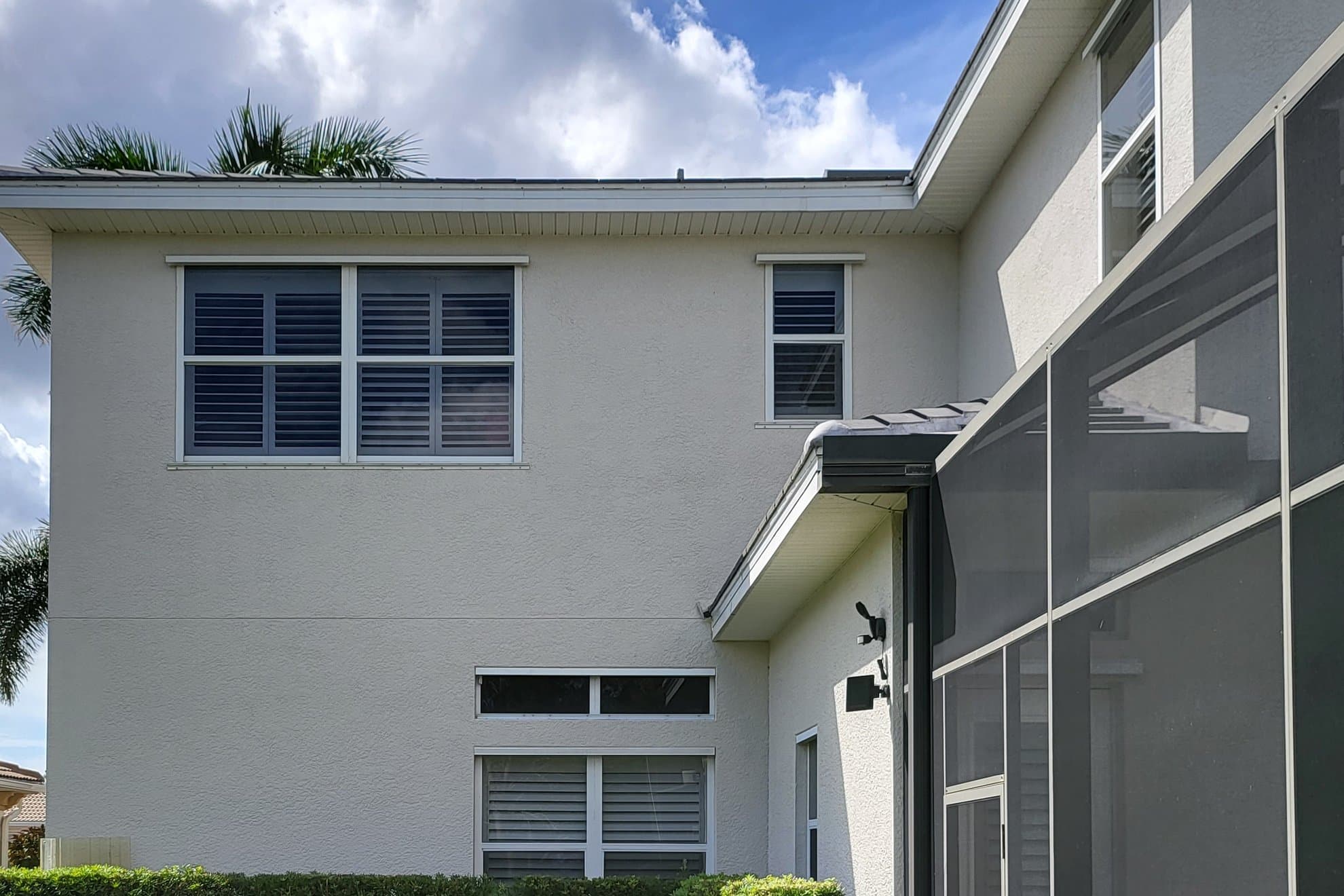
The vented soffit and fascia in the photo at the top of this post are on a Southwest Florida home, photographed before we built an outdoor kitchen there.
If your trim is peeling again, request a quote and tell us where it keeps failing.