The condo flooring worry is a specific one. The new floor goes in, it looks great, and a few weeks later a letter arrives from the association about noise in the unit below.
Here is the short answer. The sound a floor passes to the unit below is rated on the whole floor and ceiling assembly, not on the underlayment alone.
The Florida Building Code sets minimum ratings for floors between dwelling units. Your association's documents may set their own rule on top of that. So before you pick a floor, get the building's rule in writing, find out exactly which rating and which test it means, and match the product's test report to it.
Below is what the code says, what the ASTM test standards behind those ratings actually measure, and the questions to settle before anything is ordered. For the flooring work itself, start with flooring installation in Southwest Florida.
Two Kinds of Noise, Two Ratings
Sound moves between condo units in two ways, and each has its own rating.
Airborne sound is voices, music and TV. It is rated as a sound transmission class, or STC.
Impact sound is what happens when something strikes the floor itself, and the code calls it structure-borne sound. It is rated as an impact insulation class, or IIC.
A hard floor in an upstairs unit is mostly an impact question, so IIC is the rating this post spends most of its time on.
| Rating | What it covers | Code minimum, lab test | Code minimum, field test |
|---|---|---|---|
| STC | Airborne sound through walls and floors | 50 (ASTM E90) | NNIC 45 (ASTM E336) |
| IIC | Impact sound through floor and ceiling assemblies | 50 (ASTM E492) | AIIC 45 (ASTM E1007) |
The code sets these as minimums, so a higher number is the better result.
What the Florida Building Code Says About Floors Between Units
The Florida Building Code, Building, 8th Edition (2023), covers this in Section 1207, Sound Transmission. Its scope covers "common interior walls, partitions and floor/ceiling assemblies between adjacent dwelling units and sleeping units" and those between units and public areas such as halls and stairways.
For impact sound, Section 1207.3 reads:
"Floor/ceiling assemblies between dwelling units and sleeping units or between a dwelling unit or sleeping unit and a public or service area within the structure shall have an impact insulation class rating of not less than 50 where tested in accordance with ASTM E492, or have an Apparent Impact Insulation Class (AIIC) of not less than 45 if field tested in accordance with ASTM E1007."
For airborne sound, Section 1207.2 sets a sound transmission class of not less than 50 in a lab test under ASTM E90. The field alternative is a Normalized Noise Isolation Class of not less than 45 in a field test under ASTM E336. It also says penetrations for piping, recessed cabinets, bathtubs, soffits and ducts "shall be sealed, lined, insulated or otherwise treated to maintain the required ratings."
Section 1207.3 also allows a third route: an engineering analysis that compares the floor and ceiling assembly against assemblies that already have IIC ratings under ASTM E492.
Notice what every one of those requirements is about: the assembly. The rating belongs to the whole floor and ceiling between units, and the ASTM lab test counts the floor covering on top as part of that assembly.
Section 1207 does not mention replacing a floor covering in an existing unit. Your association's documents may have their own rule for that, which is the next stop.
Lab Ratings and Field Ratings Are Not the Same Number
A number on a product sheet and a number measured in your building are different measurements.
ASTM E492 is the lab test. It uses a standardized tapping machine on a floor and ceiling assembly built in a test lab, with a receiving room directly below.
The standard is candid about its limits. Because the lab is designed so the test floor is the main path for sound, it says lab ratings "do not relate directly to sound isolation in buildings; they represent an upper limit to what would be measured in a field test."
ASTM E1007 is the field test, done in a real building. It measures the floor as installed, including sound that travels around the floor through the structure, which acousticians call flanking.
The standard says that "good agreement between laboratory tests and field tests on similar floor-ceiling assemblies is not expected." It adds that "any single field measurement only represents the performance of the actual assembly tested."
The tapping machine is also not a person. ASTM E492 says it "is not designed to simulate any one type of impact, such as produced by male or female footsteps." So a rating is a standardized comparison, not a promise about how footsteps will sound downstairs.
The code's two minimums line up with that gap: 45 in the field and 50 in the lab. When an association names a number, the first question is which of those two kinds of number it means.
Why an Underlayment Has No Single Sound Number
Shopping for sound insulation under a laminate, vinyl plank or other hard floor often means comparing underlayment packages. If a package prints a sound rating, it describes a lab test, not your floor.
ASTM E2179 is the standard lab method for measuring how much a floor covering, including a layered one with its underlayment, reduces impact sound on a concrete floor. Its explanation of why the method exists is the most useful passage on this subject:
"The impact sound rating for a floor assembly is determined both by the basic floor assembly and the floor covering on the upper surface. The same floor covering in combination with different basic floor assemblies will not always give the same impact insulation class (IIC) ratings."
E2179 measures a covering on a standard concrete floor in a lab, and the improvement it reports is called a delta IIC. The standard says it "applies only to laboratory measurements" and does not apply "to the measurement of the effectiveness of a floor covering in a field situation."
So when you compare underlayments for a laminate or other hard floor, ask three things about any rating you are shown:
- Is it an IIC for a full assembly, or a delta IIC for the covering alone?
- What slab, ceiling and floor covering was it tested with, and how close is that to your building?
- Is there a test report from the lab that names the standard used?
If the floor is tile, our guide to installing a tile floor in a Southwest Florida bathroom covers the layers under it.
Some underlayments are sold as soundproof. No rating in the code or in these standards is called soundproof. The ratings are classes on a scale, and the honest goal is to meet the number your building actually requires.
Hard Floors in a Condo: What to Settle Before Anything Is Ordered
Our guide to remodeling a condo kitchen or bathroom in Southwest Florida covers how to get your declaration and rules and what they control. For flooring, read them with these questions in mind. If the documents do not answer one, ask your manager in writing.
- Is there a flooring or sound rule at all? Look in the declaration, the rules and the remodeling application.
- Which rating does it name? IIC, AIIC, delta IIC and STC are four different things.
- Is it a lab rating or a field rating? A lab IIC and a field AIIC are not interchangeable, and the code treats them differently.
- Does it name a product or a number? Ask whether the rule approves specific underlayments or sets a performance figure.
- What proof does the application need? Ask whether a manufacturer's test report must be submitted with the request.
- Does it apply to every room? Ask whether kitchens, bathrooms and closets are treated the same as living areas.
- Is a test required after installation? If the rule names a field rating, ask who arranges the test and who pays for it.
Keep the written answers with your copy of the application. Then the test report for the product you choose can be checked against the exact rating and test your building names.
Frequently Asked Questions
What IIC rating does my condo require?
The Florida Building Code sets IIC 50 in a lab test or AIIC 45 in a field test for the floor and ceiling assembly between units. Section 1207 does not mention replacing a floor covering in an existing unit. Your association's rule, if it has one, may name a different number or a different test, so get it in writing before you choose a floor.
Does a soundproof underlayment make a laminate floor quiet downstairs?
No underlayment can promise that on its own. ASTM E2179 says the same floor covering on different floor assemblies will not always give the same IIC. The building's slab and ceiling are part of the result.
Is a lab IIC the same as a field AIIC?
No. ASTM E492 says lab ratings represent an upper limit to what a field test would measure, and the code's minimums are 50 in the lab and 45 in the field. Ask your association which one its rule means.
Bring the Building's Rule to the Estimate
Whoever installs your floor, hand them your association's written flooring rule before they price the job, and ask for the test report behind any sound rating they quote. Our estimates are built from a recorded site visit, and the price comes with a 15 percent contingency disclosed up front.
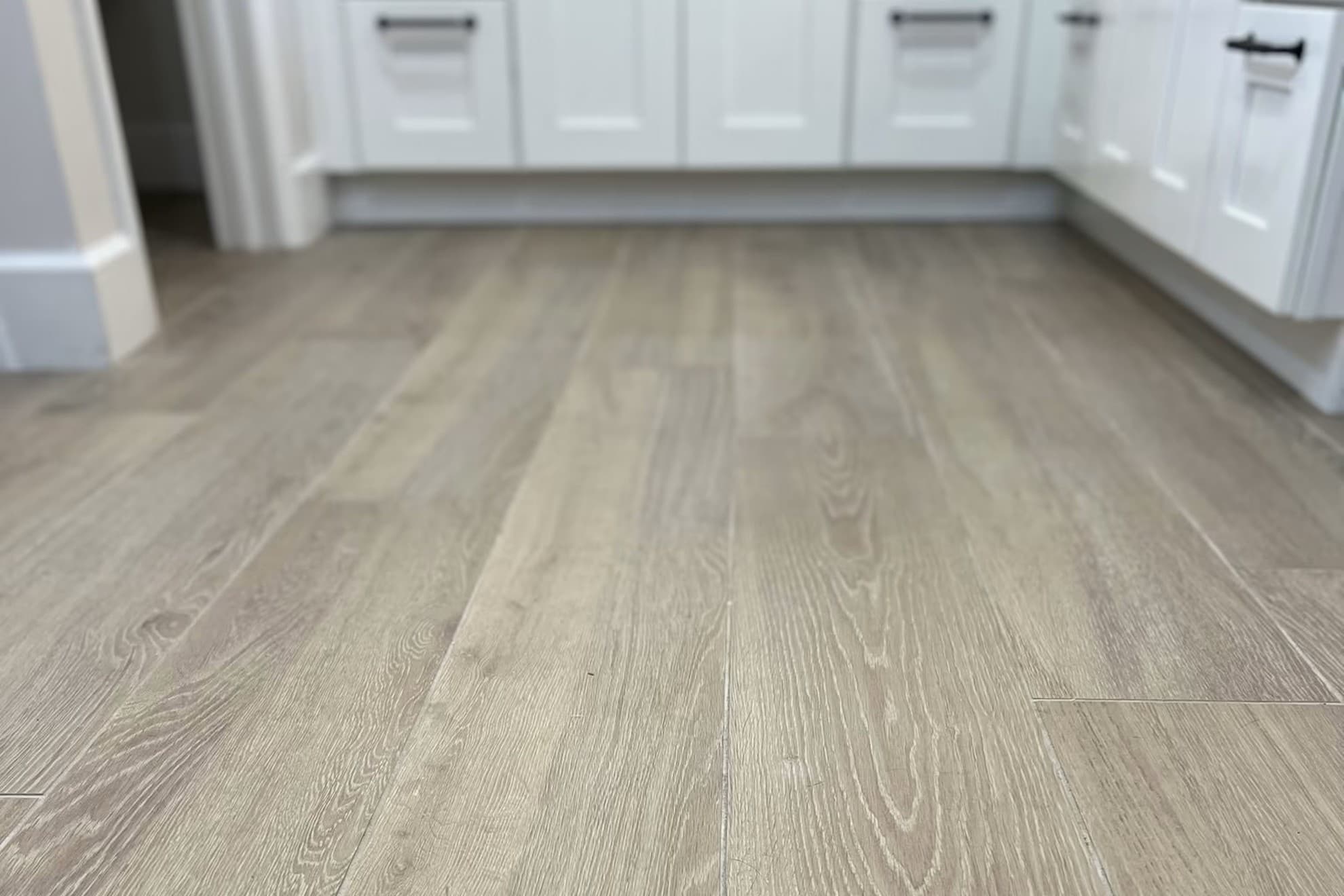
The floor in the photo at the top of this post is wood-look plank tile from one of our bathroom projects.
HomeWorks is owned by Chad and Lyndee and works across Lee and Collier County under Florida certified building contractor license CBC-1261775. Chad is on every project. Our projects run 81 percent on schedule, and we carry 4.8 stars across 60 Google reviews.
See a bathroom remodel by HomeWorks in Southwest Florida, or request a quote and bring your association's flooring rule with you.