Here is the paint job nobody wants. The color looked perfect on a small chip. On the house, in full Florida sun, it reads brighter than anyone expected, and then a letter arrives from the association saying the color was never approved. Now the house gets painted twice.
Both problems are avoidable, and both are settled before a single can is opened. This guide walks through choosing exterior paint colors for a Florida stucco home in the order the decisions should be made.
For the work itself, see our interior and exterior painting service.
Start With What Your Association Allows
If your home is in a community with a homeowners association, its guidelines come before any sample. Many communities publish approved colors or combinations, and picking from that list is the strongest request you can make.
Every community's rules are different. Read your own documents, not the house down the street, because a neighbor's color may have been approved under older rules.
Our guide to HOA paint approval in Southwest Florida explains what Florida law lets an association review, and what to put in the request so it is not sent back.
What the Florida Sun Does to a Wall Color
A wall's color decides how much sunlight it soaks up as heat. Lawrence Berkeley National Laboratory, a U.S. Department of Energy lab, says it directly in its 2019 article on its cool walls study: "Light-colored walls are coolest".
That study modeled homes in warm U.S. cities from Miami to Albuquerque. It found sunlight-reflecting walls could cut yearly heating and cooling energy costs by up to 8.3 percent for single-family homes.
The Florida Solar Energy Center at the University of Central Florida makes the same point for Florida homes. A guide by two of its researchers, Priorities for Energy Efficiency for Home Construction in Florida, gives owners of existing houses this advice: "Use light colors for walls when repainting". It also notes that "a light color is a matter of choice rather than cost".
Every exterior color also changes in strong sun over the years. How much, and how fast, depends on the paint and the pigments in that exact color. The paint maker's product information is the place to check that for the color you choose. Our post on how often to repaint a house in Florida covers the timing.
A Darker Color Is Still Possible
Light is coolest, but it is not the only option. The same Berkeley Lab article says "pigments that reflect the invisible half of sunlight" can be used to make cool paints "in a wide range of colors."
So if you love a deeper color, ask whether it can be made with solar-reflective pigments, and ask for the product's solar reflectance figure. For scale, the Berkeley Lab researchers suggest a cool wall should reflect at least 40 percent of solar energy, and their study assumed an average wall reflects 25 percent.
Why a Paint Chip Fools You on Stucco
A paint chip is small and flat, and you usually look at it indoors. A stucco wall is large and textured, and you see it in bright sun. The same color can look quite different in each place.
The only reliable test is your own wall. Here is how to run it without putting anything on the house before approval.
- Get samples of your top two or three choices for the body of the house.
- Paint each one on a sample board and hold it flat against the wall.
- Check it on the sunniest wall and on a shaded one. The difference can surprise you.
- Look at it in the morning, at midday and in the evening, and on a cloudy day if you get one.
- Step back to the street. That is where your neighbors and the association will see it.
Southwest Stucco Colors on a Florida House
Many homeowners are drawn to the earthy colors of the American Southwest: sand, adobe, clay and terracotta. They suit a stucco wall and a tile roof.
The deeper shades in that family are the ones to think about. Because light walls stay coolest, one balanced approach is a light sand or cream on the body of the house, with the deeper clay or terracotta saved for the trim or the front door, where there is less of it.
Choose the body color with the roof in view. A terracotta tile roof, a gray concrete tile roof and a metal roof each change which wall colors sit well beside them.
Body, Trim and Accent: Choose Them Together
Most houses carry three colors: the body, the trim, and an accent on the front door or shutters. Choose all three at the same time and test them side by side, because each one changes how the others look.
Submitting them together also keeps the association request complete, with every surface and every color named once.
If the trim needs attention before it is painted, our post on painting soffits and fascia on a Florida home covers what to check first. Whatever color you choose, the wall has to be clean and sound before it goes on, and that prep belongs in the written scope.
The Order That Avoids Painting Twice
- Read your association's guidelines and any approved palette.
- Narrow it to two or three choices for the body, the trim and the accent.
- Test the samples against the house in sun and in shade.
- Submit the request with the exact color names and numbers.
- Buy no paint until the approval is in writing.
- Prep the walls, then paint.
Frequently Asked Questions
What exterior paint colors work best on a Florida stucco home?
Light colors keep a sunny wall coolest, and a Florida Solar Energy Center guide recommends light colors for walls when repainting. If your association publishes a palette, the best choice is a color from that list that you have tested on your own wall.
Do light paint colors really keep a Florida house cooler?
Berkeley Lab's modeling says yes. It found that light-colored walls are coolest, and that sunlight-reflecting walls could cut yearly heating and cooling energy costs by up to 8.3 percent for single-family homes in warm U.S. cities from Miami to Albuquerque.
Can I paint my stucco house a dark color in Florida?
Yes, if your association allows it. A darker wall absorbs more sunlight, so ask whether the color can be made with solar-reflective pigments, and check the paint maker's information on how that color holds up in strong sun.
Do I need HOA approval to change my exterior paint color?
If your community's documents give the association review over exterior changes, yes. Check your guidelines before you buy paint. Our HOA paint approval guide walks through the request.
Settling the Colors Before Anyone Picks Up a Brush
HomeWorks is owned by Chad and Lyndee, and Chad is on every project. We are a Florida Certified Building Contractor, CBC-1261775, working across Lee and Collier County.
On a painting job, we set the scope at a recorded site visit and write it into the proposal before any paint is bought. The price is itemized, with a 15 percent contingency disclosed up front.
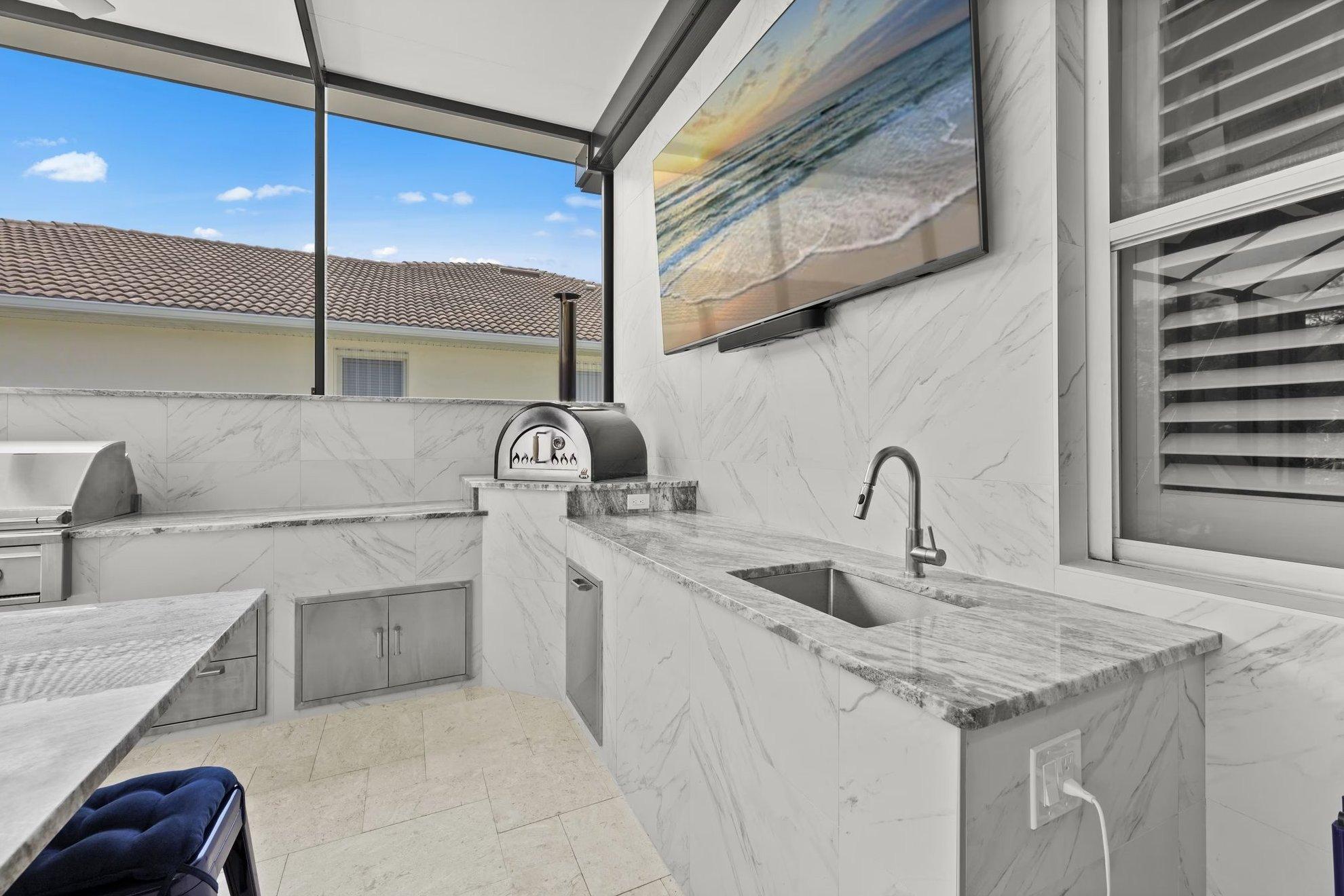
The outdoor kitchen in the photo at the top of this post is part of an outdoor kitchen built by HomeWorks in Southwest Florida. The house beyond the screen belongs to a neighbor and is not HomeWorks work.
When your colors are chosen, request a quote and tell us what your association has approved.