The rolling grill parked against the back of the house is on its way out.
For years the outdoor kitchen here was a cart, a propane tank, and a paver pad. That is not what people ask us to build anymore. The outdoor kitchens we build in Fort Myers, Naples, Estero, and Bonita Springs are rooms now. They have walls, counters, real lighting, shade, and an appliance plan that got decided before anyone poured anything.
Here is what we are actually building in 2026, and what we tell clients to skip.
The Lanai Is the Room
Most of these kitchens go inside a screen enclosure. So we design the enclosure and the kitchen together instead of dropping an island under a cage that was never planned for it.
That changes real things. The grill needs clearance from the screen frame and the cage posts. Cooking heat needs somewhere to go, so a vented bay above the grill goes in from the start. Ceiling fans get planned into the framing instead of added later on an extension cord. And the finishes have to look right from two places at once: from the pool deck a few feet away, and from inside the house looking out.
What we are building
- Layouts drawn around the cage posts, not squeezed between them
- Vented cooking bays so heat and smoke leave the enclosure
- Ceiling fans wired into the structure, on their own switch
- Counter runs deep enough to prep on with room to walk behind
- Finishes chosen to read well from the pool and from the living room
What fails here
- An island set tight against the screen frame with no clearance
- A covered grill with no vent path, which cooks the ceiling above it
- Fans hung after the fact off whatever framing was closest
- A run that blocks the walkway between the house and the pool
This gets decided early in Estero's planned communities, where the enclosure, the roofline, and the finish colors go in front of an architectural review board before the Village of Estero ever sees the permit application.
Porcelain Slab Walls and Counters
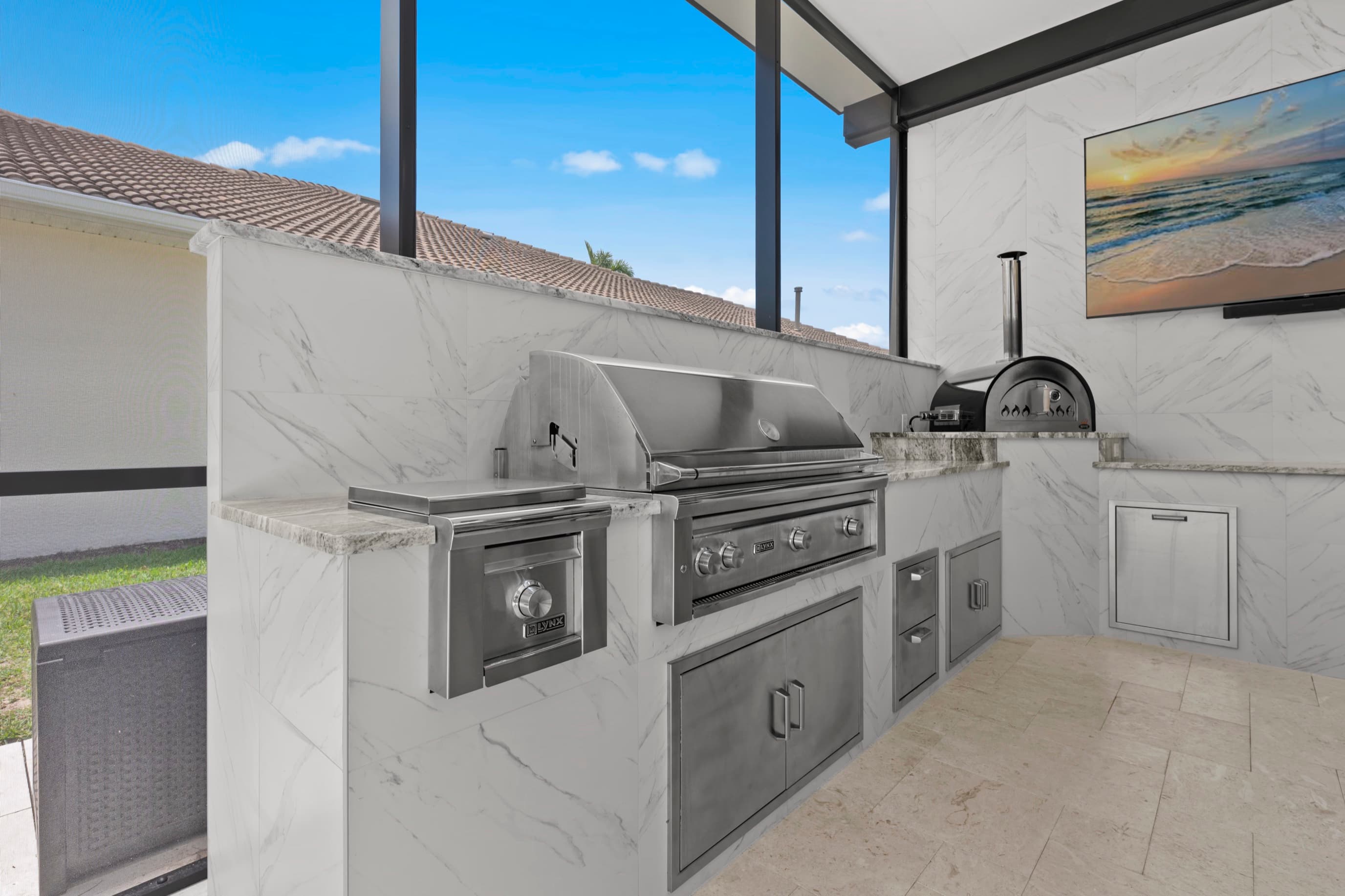
Porcelain is the biggest material change we have seen in outdoor kitchens in years. Full-body porcelain gives you the marble look without the marble problem. No etching from citrus, no yearly resealing, no fading where the afternoon sun lands.
Clients use it two ways. On the counters, where it takes heat and stays flat. And on the wall behind the grill run, floor to ceiling, as the backdrop that makes the whole thing read as a room instead of a cabinet run.
Sealed natural stone still works. Granite and quartzite hold up outside when they are sealed for outdoor exposure, and plenty of homeowners still want the real thing under their hands.
What fails here
- Indoor quartz outdoors. It is not built for direct sun and it discolors.
- Unsealed marble. Citrus etches it, and people cut a lot of limes out here.
- Thin tile with grout joints on a work surface. The grout stains and the joints hold water.
Color Is Back on the Cabinets
A wall of polished steel is no longer the only option, and most people are glad about it.
Navy is the color we hear requested most. Deep green is right behind it. Warm white is the safe pick that still reads warmer than bare stainless. The color goes on polymer doors or on powder-coated aluminum, both of which are made to sit outside and hold a finish through a summer.
The move is to put the personality on the parts that can be swapped and keep the structure underneath boring. Block or steel framing, then doors and drawer fronts that carry the color.
If you are still deciding what the boxes and doors should be made of, our comparison of outdoor kitchen cabinet materials puts the grades side by side.
What fails here
- Wood-look PVC in full sun. It chalks and it warps.
- Real wood doors anywhere outside. Humidity swells them and they stop closing square.
- Interior paint on an exterior box. It peels inside a season.
Pizza Ovens and Beverage Centers Over Bigger Grills
The trend is not a bigger grill. It is a second thing to cook on.
A pizza oven sits at the top of what Naples clients are asking for this year. Ceramic charcoal cookers are right behind it, usually dropped into the run beside the gas grill so the homeowner has both. On the drinks side, the ask is a beverage center: an under counter refrigerator, an ice maker, and enough counter to pour on without crowding the cooking side.
Know what each one commits you to before you fall in love with it.
- A gas pizza oven needs its own gas capacity, which can mean a larger line or a second run.
- A wood-fired oven needs a hearth and clearance, and it changes the structure underneath it.
- An ice maker needs a water supply and a drain, not just an outlet.
- A refrigerator needs its own circuit so it is not sharing power with the grill light.
Every one of those is easy on day one and expensive after the stone is set.
Shade and Fans Are Part of the Design
Shade is the line homeowners cut first and miss most. A kitchen you cannot stand at on a July afternoon is a kitchen you only use in January.
So the covered structure is part of the design now, not an add-on. We build powder-coated aluminum pergolas and roofs, engineered for the wind load the code requires and permitted like the structures they are. Aluminum does not rust and it can be engineered to hold.
Lighting got better too. One floodlight over the grill is not a lighting plan. Task light on the work surface, softer ambient light over the seating, a little accent light on the porcelain wall, each on its own switch. We spec 2700K to 3000K so the light stays warm. Cooler than that and the food looks gray and the lanai reads like a parking lot.
What fails here
- Shade sails and fabric. They stain, they sag, and they come down before every storm.
- A patio umbrella as the shade plan for a permanent built-in kitchen.
- One bright fixture doing every lighting job at once.
- Indoor-rated fans. Damp-rated is the spec outside.
Marine-Grade Where the Address Calls for It
Salt air does not care what the brochure says. We spec the stainless to the address, not to the price sheet.
Within about five miles of the coast we use 316 stainless for cabinet doors, drawers, and appliance housings. Inland, 304 stainless is the right call and it does the job. The difference shows up as the surface rust called tea staining, and that is what you are looking at when a coastal kitchen was built with the inland grade.
A waterfront lanai in Bonita Springs or Naples sits squarely in the first category, with the water a few steps off the counter.
The same logic runs through the rest of the hardware. Hinges, fasteners, and drawer slides fail first, and they are the parts nobody asks about. Ask about them.
What National Trends Don't Apply Here
Plenty of what looks good in a national outdoor kitchen photo does not survive a summer here.
- Open shelving. Dust, pollen, humidity, and bugs. Everything on it needs a wash before you use it.
- Exposed wood beams and wood fronts. They move with the humidity and they feed termites.
- Polished stainless on every surface. It shows every water spot and fingerprint, and in direct sun it gets too hot to touch.
- Black counters on an uncovered run. They photograph beautifully in a mild climate. Here you cannot rest a hand on them by two in the afternoon.
- The fully open, uncovered kitchen. Rain shows up fast most summer afternoons, and an uncovered kitchen is one you stop walking out to.
What a 2026 Outdoor Kitchen Costs in Lee and Collier County
Outdoor kitchens in Southwest Florida run $8,000 to $80,000. Every number below includes the gas and electrical work, the permits, and the construction, not just the appliances.
- Basic grill station ($8,000 to $15,000): one run of cabinetry, a built-in grill, a durable counter, storage, and the gas and electrical to support it
- Mid-range outdoor kitchen ($20,000 to $40,000): grill, refrigerator, a sink with supply and drain, more counter, and bar seating
- Full outdoor living space ($40,000 to $80,000 and up): a covered structure, layered lighting, a fire feature, better appliances, and the engineering a roof brings with it
Most of what is trending this year lives in the middle tier. Cabinet color, porcelain, and a real lighting plan do not move the number much. The second appliance, the covered structure, and the marine-grade spec do. Our full breakdown of outdoor kitchen cost in Southwest Florida walks through what moves the price inside each tier.
How to Think About Outdoor Kitchen Trends
Follow the trend on the things you can change later. Cabinet color, light fixtures, bar stools, planters, the appliance that bolts in. Those come out in an afternoon.
Stay classic on the things you cannot change. The block or steel structure under the counters. The counter material. The stainless grade your address calls for. The gas and electrical capacity, because adding a circuit after the stone is set means cutting into finished work.
Build it that way and you can change your mind about navy in six years without touching anything that matters.
Give us a call at (239) 880-4700 or fill out the contact form to talk through what you want to build.
HomeWorks Construction and Design serves Fort Myers, Estero, Bonita Springs, Naples, and the surrounding Southwest Florida communities.