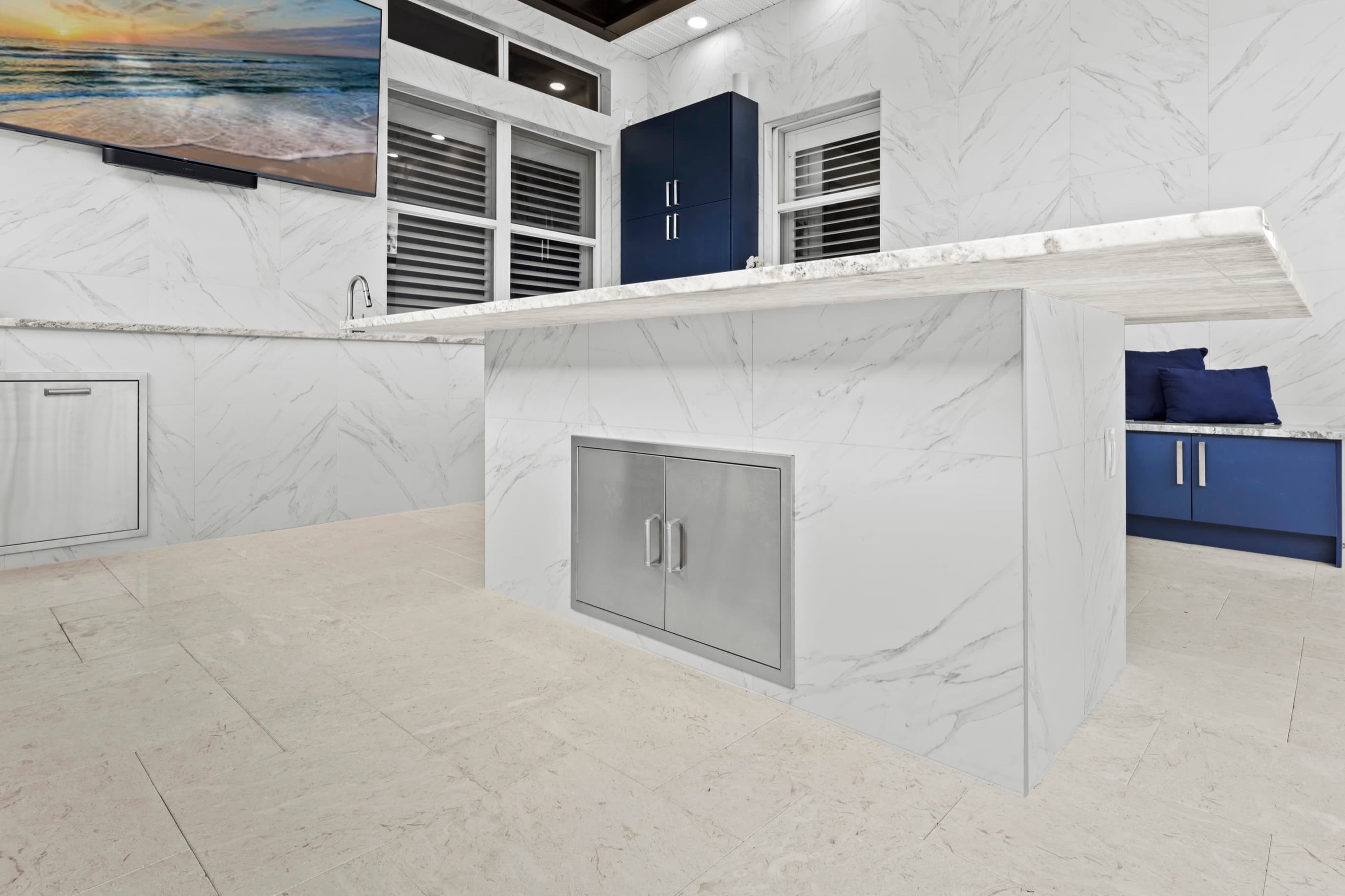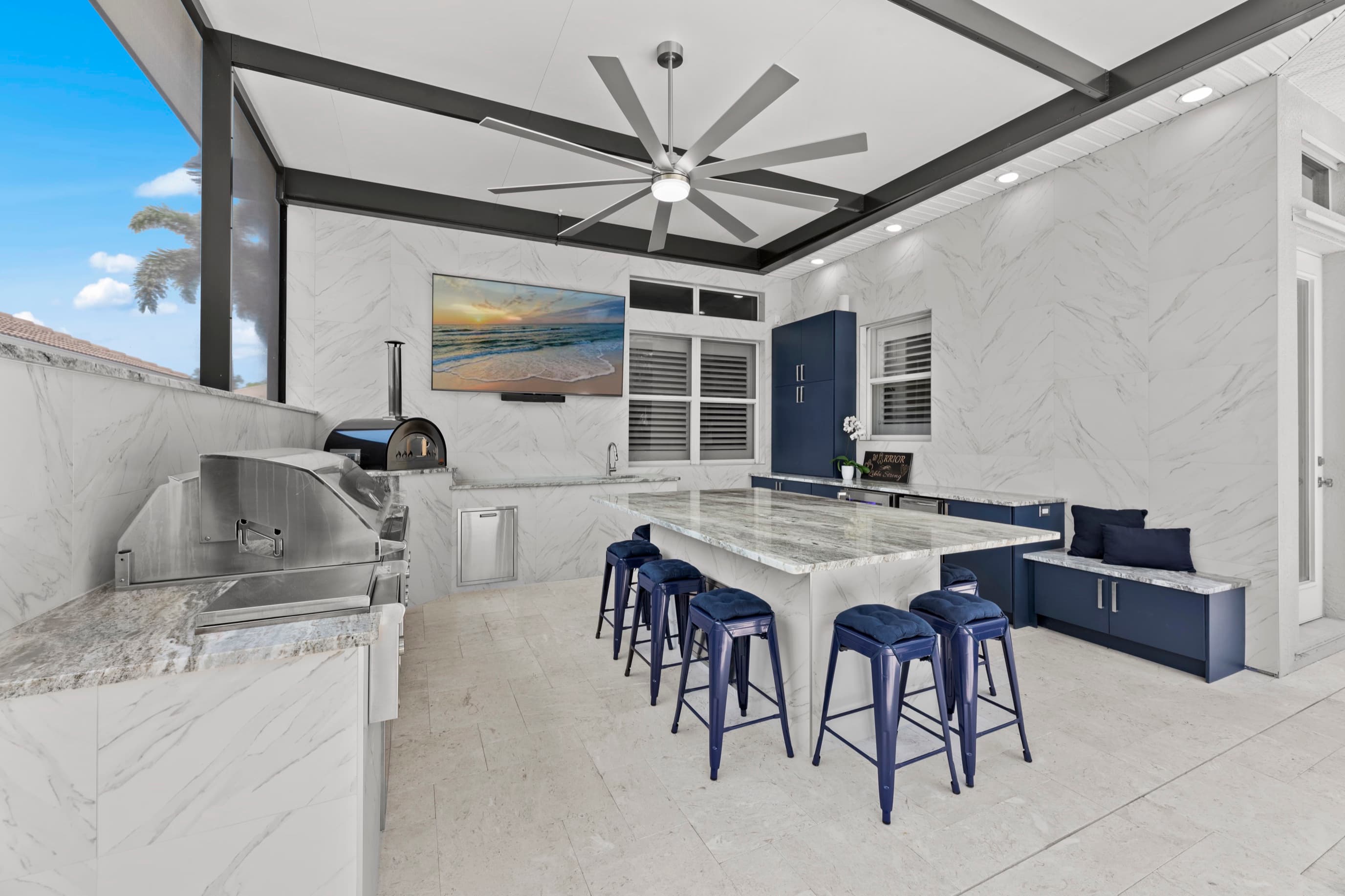
The all white kitchen is finally dying.
For nearly a decade, every kitchen remodel in Southwest Florida looked the same: white shaker cabinets, white/gray quartz counters, white subway tile, gray-washed floors. Homeowners would show us Pinterest boards that could have been the same kitchen photographed from different angles.
We're not going to miss it.
In 2026, kitchens in Fort Myers, Naples, and Estero are getting warmer, more personal, and—here's the important part—better suited to how people actually live in Florida. The trends we're seeing aren't just about aesthetics. They're about making kitchens work for our climate, our lifestyle, and the way Southwest Florida homeowners entertain.
Here's what's actually happening in the kitchens we're building this year.
The End of Gray-on-White
Walk through any Southwest Florida neighborhood built between 2015 and 2022, and you'll see the same kitchen repeated a hundred times. Gray was safe. Gray was "modern." Gray photographed well for real estate listings.
Gray can go back to Miami.
What's Replacing It
The palettes we're installing now take their cues from outside the window:
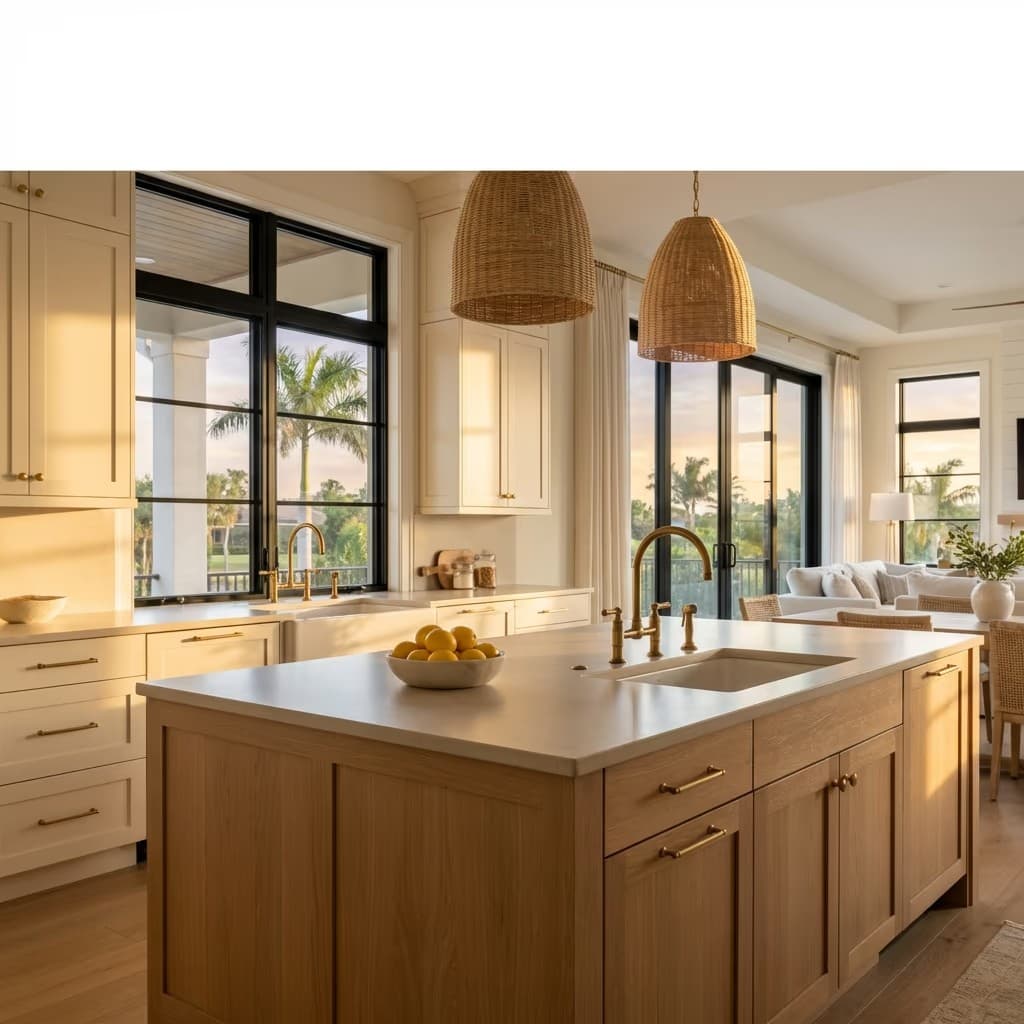
Warm whites and creamy tones — Not the stark, blue-white of the 2010s. Think the color of sand at Barefoot Beach. Soft, warm, actually pleasant to look at.
Natural wood tones — White oak, rift-cut for minimal grain, is everywhere. It reads clean and modern but adds warmth that painted cabinets can't match. We're also seeing walnut accents—usually on islands or floating shelves—for contrast.
Soft greens and blues — Not the teal-everything of a few years ago. Subtle sage on an island. A muted seafoam on the range hood surround. Colors that echo the Gulf without screaming "beach house."
Warm metallics — Brass and champagne bronze hardware are standard now. They play well with the warmer palette and don't show water spots like polished chrome (which matters in humid climates).
What to Do If You Already Have White/Gray
If you remodeled three years ago and your kitchen is peak gray, you don't need to rip it out. The easiest shifts:
- Swap hardware from brushed nickel to brass or bronze
- Add warm wood through a new island, floating shelves, or bar stools
- Replace cool-toned pendant lights with something warmer
- Introduce color through a statement range, a decorative hood, or even paint.
White cabinets with warm or colored accents look intentional. White everything looks dated.
The Double Island (When It Makes Sense)
The biggest layout change in high-end kitchens: two islands instead of one.
This isn't about showing off. It's about solving a real problem—the island that's supposed to do everything does nothing well.
The Problem with Single Islands
The traditional kitchen island tries to be:
- Prep space with a secondary sink
- Seating for casual meals
- Serving station for entertaining
- Storage for cookware and pantry items
- The spot where everyone congregates
The result: you're trying to chop vegetables while guests lean over their drinks two feet away, kids are doing homework at one end, and there's no clean surface to plate food.
How Double Islands Work
Island One: The Work Island
- Positioned closer to the range and main prep area
- Secondary sink for prep
- No seating—it's a work surface only
- Deeper than standard (30-36 inches) for serious cooking
Island Two: The Social Island
- Positioned between the kitchen and living area
- Seating for 4-6
- Cleaner surface for serving
- Can be lower than work island (counter height vs. bar height)
- Can include beverage fridge, wine storage
The separation means the cook stays in a defined work zone while guests have their own space. When you're hosting 15 people—which happens constantly in Southwest Florida—the kitchen doesn't become a traffic jam.
When It Doesn't Make Sense
Double islands need space. Minimum 42 inches of clearance on all sides of both islands, plus your perimeter walkways. Realistically, you need at least 15x18 feet of kitchen footprint before this layout works well.
If your kitchen is smaller, a single well-designed island with defined zones beats two cramped islands every time. The trend isn't the point—function is.
Storage That Actually Works Here
Florida kitchens have storage problems that northern kitchens don't.
No basement. Often no garage pantry (or a garage that's too hot for food storage). Humidity that makes certain storage solutions fail. And a lifestyle that involves more entertaining, which means more glassware, serving pieces, and bar accessories than the typical American household.
What We're Building
Appliance garages — Countertop appliances are kitchen clutter. Built-in garages with tambour or pocket doors hide the coffee maker, toaster, and blender while keeping them accessible. Bonus: protects electronics from humidity when not in use.
Deep pantry pull-outs — Floor-to-ceiling pantry cabinets with full-extension pull-out shelves. You can actually see and reach everything. We're typically doing 24-inch-deep cabinets with pull-outs rated for 100+ pounds.
Vertical tray storage — Dedicated slots for cutting boards, baking sheets, and serving platters. No more unstacking a pile to get to the one you need.
Drawer refrigeration and freezer — Undercounter units that supplement the main fridge. Keeps beverages and guest-forward items accessible without opening the primary refrigerator constantly. In Florida's heat, this actually saves energy—your main fridge door stays closed.
Dedicated bar storage — Glassware cabinets, wine storage, and cocktail supply drawers designed into the layout rather than crammed into whatever space is left over.
Pet feeding areas — It’s no surprise that our residents love their furry companions. A designated space for feeding and storing items to maintain their cuteness is a natural fit.
What Fails Here
Open shelving — Yes, it photographs beautifully. It also collects dust constantly, shows humidity damage on certain items, and requires you to keep everything Instagram-ready at all times. Most homeowners who install it end up putting doors back on within two years.
We'll do open shelving for display pieces, but we're honest about the maintenance.
Butcher Block Counters — Speaking of high maintenance; these trendy and cost effective tops can be pretty, but that’s about it. They are prone to dents, scratches, water-marks, and stains, therefore keeping a sanitary kitchen is an uphill battle. Save them for a walk-in pantry or laundry room.
Wire basket storage in humid areas — Looks good in catalogs, but wire baskets near sinks or in humid pantries develop rust spots, even with "rust-resistant" coatings.
Standard hinges on heavy doors — Florida's humidity causes wood expansion that off-the-shelf hinges can't handle over time. We spec soft-close hinges rated for heavier doors than we're actually installing. The upcharge is minimal; the headache of sagging doors is not.
Countertops: What's Working Now
The countertop market has shifted since we were all arguing about granite vs. quartz five years ago.
Quartz Is Still King (But Different)
Quartz dominates Southwest Florida kitchens, and for good reason: consistent appearance, doesn't need sealing, handles humidity, easy to maintain.
What's changed is the look. The polished, highly contrasting veined patterns are giving way to:
Matte and honed finishes — Less reflective, shows fewer fingerprints, feels more natural. The high-gloss look is starting to feel dated.
Concrete-look quartz — Subtle texture, warm gray-beige tones, works with the warmer palettes replacing gray-on-gray.
Two toned — In tandem with the double island trend, having two types of stone in a space is a great intention. If you love the slab with lots of color and movement – but not for the whole kitchen – just use it on the island. Great way to add color and interest while visually breaking up large kitchens.
Natural Stone Is Making a Comeback
Granite fell out of favor when everyone associated it with the early 2000s builder-grade beige-and-brown kitchens. But natural stone is returning—with different selections.
Quartzite (not quartz—different material) offers the look of marble with much better durability. Taj Mahal and similar varieties are popular in higher-end remodels.
Soapstone shows up occasionally for homeowners who want something unusual. It develops a patina over time, which is either a feature or a bug depending on your personality.
What We Recommend
For most Southwest Florida kitchens, we still recommend quartz with a matte or honed finish. It handles our climate, resists damage from the acidic citrus people are always cutting, and doesn't require the maintenance that natural stone needs.
If budget allows and you want the real thing, quartzite is a solid choice. But be honest with yourself about whether you'll do the sealing and maintenance natural stone requires.
The Working Kitchen vs. The Show Kitchen
Here's the split we're seeing more clearly in 2025: kitchens designed for people who actually cook versus kitchens designed to look impressive.
The Working Kitchen
These homeowners want:
Serious appliances — 36 or 48-inch ranges instead of standard 30-inch. Induction cooktops (faster, more precise, safer). Built-in steam ovens for the health-conscious. Commercial-style refrigeration.
Practical layouts — Work triangle still matters. Prep sink positioned where it's actually useful. Pot filler over the range (we used to think these were silly—they're not if you cook daily).
Durability over delicacy — Stain-resistant surfaces, easy-clean finishes, materials that can take abuse. Not precious.
Storage for equipment — A place for the stand mixer, food processor, Vitamix, sous vide, instant pot, and all the other appliances serious cooks accumulate.
The Show Kitchen
These homeowners want:
Statement pieces — A $15,000 range they'll use twice a month. Wine columns with glass doors. Dramatic hood designs.
Clean lines — Minimalist fronts, integrated appliances, no clutter visible anywhere. The kitchen as furniture.
Entertaining focus — More bar space than prep space. More seating than storage.
Both are valid. The problem is when homeowners think they want one but design for the other—the serious cook who chooses form over function, or the occasional cook who invests in equipment they'll never use.
We ask early: When you're not remodeling, how often do you actually cook? What do you cook? That conversation shapes everything.
Lighting That Makes Sense
The standard kitchen lighting formula—recessed cans everywhere plus pendants over the island—is giving way to more thoughtful approaches.
What's Changing
Layered lighting — Task lighting (under-cabinet), ambient lighting (recessed or indirect), and accent lighting (pendants, display lighting) on separate controls. You don't need operating-room brightness to pour a glass of wine at 8pm.
Larger-scale pendants — The tiny pendant clusters are out. Single statement fixtures or fewer, larger pendants make more impact.
Hidden fixtures — LED strips under cabinets, inside drawers (they turn on when you open them), and in toe kicks create ambient light without visible fixtures.
Warm color temperature — The 4000K "cool white" LEDs that dominated a few years ago feel sterile. We're back to 2700K-3000K for a warmer glow that works with the warmer color palettes.
The Practical Issue
Whatever lighting you choose, make sure it's properly positioned. We've fixed countless kitchens where recessed lights were centered in the room—which puts shadows exactly where you're trying to work. While that works for overall illumination, task lights should be positioned over work surfaces, not in the middle of open floor space. This issue runs into the bathroom space as well.
What National Trends Don't Apply Here
Every year, design publications push trends that make no sense for Southwest Florida. Before you commit to something because it's "in," consider whether it works here.
Prep kitchens or sculleries are making a major comeback. Reverting back to a somewhat enclosed layout, and helping hide the caterers equipment, these second kitchens are great for those who have a regular entertainment events schedule. However, not many homes have the space in SWFL.
The wood floor issue can also be used here.
Bold, Dark Cabinets
Deep navy, forest green, and black cabinets are having a moment nationally. In Florida's sunlight, dark colors show every fingerprint, water spot, and dust particle. They also absorb heat near windows and make spaces feel smaller.
If you want drama, do it on an island or a feature wall—not on every cabinet in the room.
Marble Everything
Marble is beautiful. Marble also etches from citrus acid, stains from coffee and wine, and requires regular sealing that's harder to maintain in humid climates.
In Southwest Florida, where people are constantly cutting lemons and limes, marble counters become maintenance headaches. If you love the look, quartzite or marble-look quartz give you the aesthetic without the anxiety.
Exposed Range Hoods in Polished Metal
The giant stainless hood as sculptural centerpiece is a staple of design magazines. In Southwest Florida's humidity, polished metal shows every water spot and fingerprint, and requires constant wiping to look good.
Painted hoods, wood-wrapped hoods, or hoods integrated into the cabinetry look better longer with less maintenance.
What a 2025 Kitchen Remodel Actually Costs
Trends are nice to talk about. Here's what implementing them actually costs in Lee and Collier County:
Cosmetic refresh ($25,000-$45,000)
- Cabinet refacing or repainting
- New countertops
- Updated hardware and fixtures
- Lighting upgrade
- Keeping existing layout
Mid-range remodel ($50,000-$85,000)
- New cabinets (semi-custom)
- Quartz countertops
- New appliances (quality but not commercial-grade)
- Minor layout changes
- Flooring replacement
- Electrical updates
Full renovation ($85,000-$150,000+)
- Custom or fully custom cabinets
- Premium countertops (quartzite, high-end quartz)
- Professional-grade appliances
- Layout reconfiguration (walls moved, island added/changed)
- Full electrical and plumbing updates
- Specialty features (double island, bar area, appliance garage, etc.)
These ranges are for a typical 150-250 square foot kitchen in Southwest Florida. Smaller kitchens cost less; larger kitchens and truly custom work cost more.
How to Think About Trends
A kitchen remodel should last 15-20 years before you're ready to update again. Trends come and go faster than that.
Our advice: follow trends for elements that are easy to change (hardware, paint colors, light fixtures, accessories) and stay classic on the permanent stuff (cabinet construction, countertop materials, layout).
The warm palette, thoughtful storage, and quality materials that work in 2025 will still work in 2035. The specific shade of green on your island might not—but repainting an island is a lot easier than replacing one.
Ready to Start Planning?
If you're thinking about a kitchen remodel in Southwest Florida, we're happy to talk through what makes sense for your space, your budget, and how you actually live.
No pressure to commit. No designs before you're ready. Just a conversation about what's possible and what it might cost.
Give us a call at 239-219-0828 or fill out the contact form to schedule a conversation.
HomeWorks Construction serves Fort Myers Beach, Sanibel, Estero, Bonita Springs, Naples, and surrounding Southwest Florida communities. We specialize in kitchen remodeling, bathroom remodeling, and whole-home renovations.