The backsplash is the smallest surface in a kitchen remodel, and it can be one of the hardest to settle. It is a few square feet of tile, and it can still hold up a project.
Here is the short answer. Choose the countertop first, then choose a backsplash for its contrast with the cabinets, then test the finish on your own wall in your own light before you order. Whatever you pick, the joint where the tile meets the counter and the inside corners should get a flexible sealant, not grout.
The stress comes from doing it in the wrong order, picking the tile from a photograph and then watching it fight with the counter. Below is the right order, what changing light does to a finish, what a humid house asks of the tile, and the one installation detail that has nothing to do with taste. It is a conversation that belongs early in any kitchen remodel.
The Counter Decides, and It Decides First
A backsplash and a countertop compete for the same wall. Only one of them can be the loud one.
If the counter has heavy movement, such as big veining, strong contrast or a dramatic pattern, then the backsplash should be the quiet one. It becomes a texture, not a feature, and its job is to give your eye somewhere to rest.
If the counter is calm, meaning a solid or near-solid surface with little movement, the backsplash is free to be the thing people notice. That is where pattern, color and shape earn their place.
When both are loud, the kitchen looks busy in person and photographs badly. That is the risk of choosing the tile before the slab.
So pick the counter first. Then stand a sample of it upright against the candidate tiles in the actual room, at the actual height, before anything is ordered.
| If the counter is | The backsplash should | And the finish question is |
|---|---|---|
| Heavily veined or high contrast | Stay quiet and textural, close in tone to the counter's background | Whether a gloss adds glare to a counter that is already busy |
| Calm or near-solid | Feel free to carry pattern, shape or color | Whether the pattern survives being interrupted by outlets |
| Dark | Go lighter, to keep the work surface readable | Whether the under-cabinet lighting is good enough for a dark run |
| Continuing up the wall as a slab | Be the slab itself, with no tile needed | Whether the seam placement was planned |
Contrast Is What You Are Actually Choosing
People describe a backsplash by its color. What they respond to is its contrast against the cabinets.
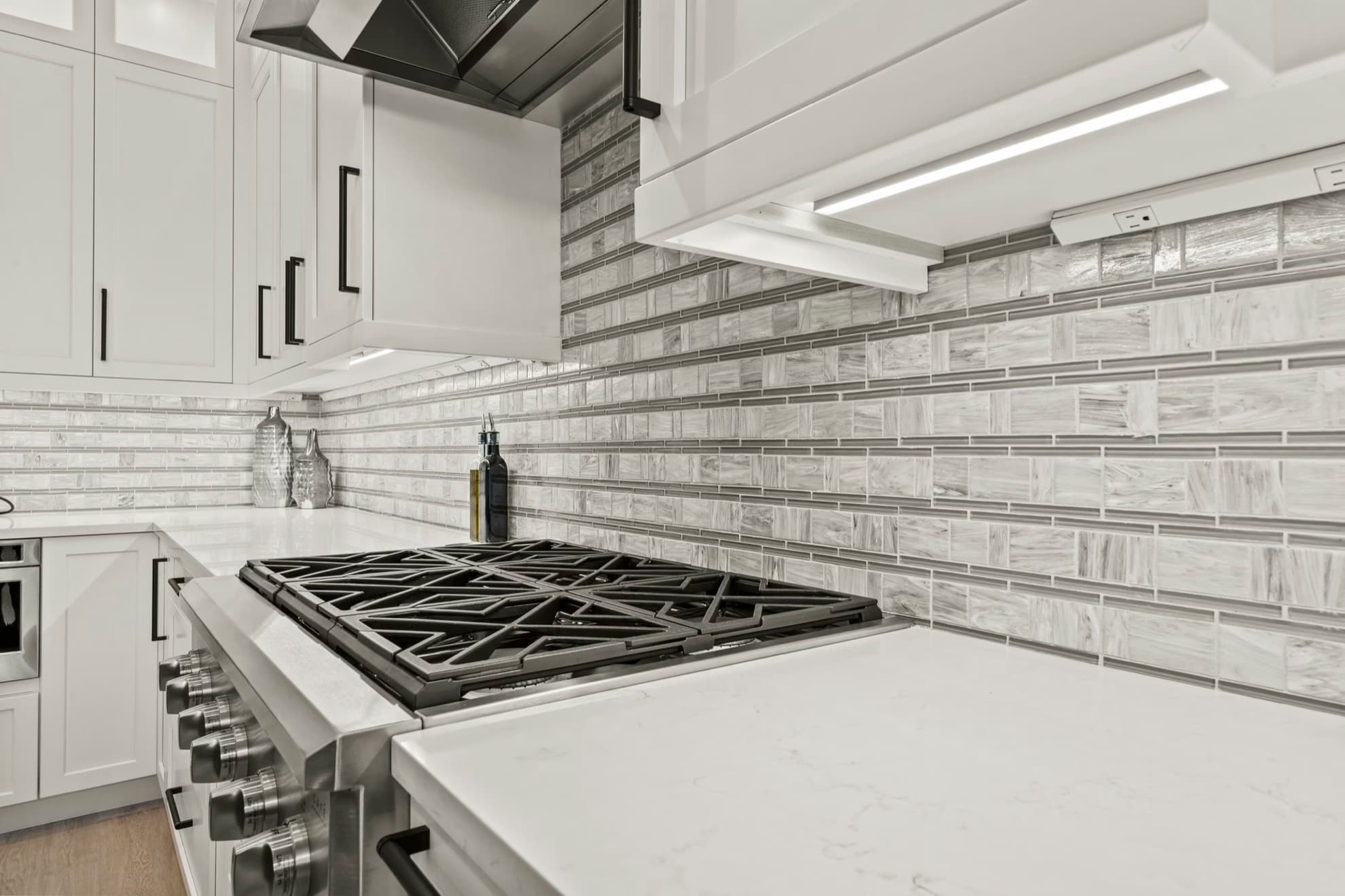
White cabinets with a near-white backsplash read as one calm, continuous surface, and the eye goes to the counter instead. White cabinets with a mid-tone backsplash put a horizontal band across the room and give it structure. Dark cabinets reverse the whole calculation, because now the backsplash is the light element.
A useful test is to squint at the samples together until the color drops out. What is left is the contrast, and that is what the room will feel like from the doorway.
What Changing Light Does to a Finish
A showroom display sits under the same fixed lighting all day. Your kitchen does not.
If your kitchen opens onto a lanai or a pool through sliders, transoms or wide windows, the backsplash will see bright daylight, reflected light off the water and the deck, and then only the under-cabinet lights at night. Each of those changes how a finish reads.
Gloss and glass reflect light. In a bright, open kitchen, a high-gloss backsplash can throw glare across the room at certain hours, and it shows water spots. In a darker galley kitchen, the same tile can be what brightens the room.
Matte and honed finishes reflect less. They stay readable at every hour, and they hide the fingerprints that gloss picks up around the range. They can also look flat, so a matte tile with no texture can read like painted drywall in strong light.
Undertones shift with the light, too. A greige that looked neutral under a showroom's lights can look noticeably warmer in late-afternoon sun.
None of that makes any finish wrong. It makes the sample test essential. Tape the candidates up on the actual wall and look at them in the morning, at midday, and at night with only the under-cabinet lights on. A tile you have seen in only one kind of light is a tile you have not really seen.
What a Humid House Asks of a Backsplash
In Southwest Florida, the backsplash lives in damp air, and the wall behind the sink and the range is where a kitchen adds more. A University of Florida IFAS Extension fact sheet, Moisture Control in Your Home, Part 1 (2007), puts it plainly: "Too much humidity can result in mold growth and indoor air quality problems." It notes that "we create indoor moisture through cooking, dishwashing, showering, and doing laundry," and it says "Experts recommend keeping indoor humidity below 60% RH."
That makes two questions part of the backsplash decision. First, what do the grout's and the tile's own data sheets say about sealing and cleaning, and are you prepared to keep up with it? Second, how will moisture leave the cooking area? The same fact sheet advises: "Use exhaust fans for short periods for odor and moisture removal." A range hood that vents outside removes that moisture at the source. For how materials hold up in a humid Florida house more broadly, see our guide to remodeling for Florida's humidity.
What to Ask Before You Buy Any Material
A ranking written by someone who sells the material is not an independent source. The product's own data sheet and the standards it is tested to are.
Porcelain tile. The Tile Council of North America says standards define porcelain tile "as an impervious tile with a water absorption of 0.5% or less, as measured by the ASTM C373 test method." The same page warns that some tile sold as porcelain does not meet that standard, which is why TCNA runs a certification program. Low water absorption is what the porcelain definition measures, so ask whether the tile is certified.
Ceramic tile. Porcelain is one type of ceramic tile, not the only one. TCNA describes ANSI A137.1, the ceramic tile standard, as one that "lists and defines various types, sizes, physical properties, and grading procedures for ceramic tile, including mosaic tile, quarry tile, pressed floor tile, glazed wall tile, porcelain tile, trim units, and specialty tile." A glazed wall tile and a porcelain tile are different types under that standard, so ask which type you are buying and what its data sheet reports for water absorption.
Glass tile. Glass has its own standard, ANSI A137.2. TCNA's description of the standard says it addresses "Thermal Shock resistance using real life temperature ranges" and "Definitions and test procedures for measuring translucence." Glass tile also has its own installation standards, separate from ceramic, on TCNA's list of ANSI standards. Behind a range, ask whether the glass tile is made to A137.2 and which setting material its maker calls for.
Natural stone. The Natural Stone Institute's care and cleaning guide sorts stone into two groups. Calcareous stone is composed mainly of calcium carbonate, which "is sensitive to acidic solutions," and the guide warns that "products containing lemon, vinegar or other acids may dull or etch calcareous stones." Siliceous stone, made mostly of silicates such as quartz, feldspar and mica, "is generally resistant to most acids found in kitchen settings," though the guide still advises against acidic cleaners for it. The same guide says sealing "does not make the stone stain proof, it makes it more resistant to staining." Ask your supplier which group a stone falls in before you put it behind a range or a prep sink.
Any material. Ask two questions of its own data sheet:
- What does the manufacturer say to clean it with? If its care sheet says to avoid acidic cleaners, the material is sensitive to what gets splashed behind a range. That is not a reason to reject it. It is a reason to know before you buy.
- Is it rated for this wall? Behind a range and behind a sink are two different environments in the same run of tile, and the data sheet either addresses heat and steam at close range or does not.
A supplier who cannot produce a data sheet is telling you something useful.
The Joint That Is Not a Style Choice
Everything above is taste. This part is not.
Wall tile falls under Chapter 7 of the Florida Building Code, Residential, 8th Edition (2023), where Section R702.4.1 requires ceramic tile surfaces to be installed to a list of ANSI tile standards. The building department for your address enforces that code, can add local amendments and its own procedures, and has the final word on how it applies to your kitchen.
Movement joints come from a separate industry standard that is not on that list: ANSI A108.02, the general workmanship standard for tile. Writing in TileLetter, the magazine of the National Tile Contractors Association, Scott Carothers of the Ceramic Tile Education Foundation quotes its Section 4.4.1, which requires movement joints "including terminations of tilework where it abuts restraining or dissimilar surfaces."
The line where the backsplash lands on the countertop is that kind of termination, and the same article lists inside corners as a place where movement joints are required. So the counter line and the inside corners should get a flexible sealant in a matching color, not grout. Ask about those joints by name before the tile goes up.
Where the Tile Should Stop, and Where the Outlets Go
Two layout decisions shape how the finished backsplash looks.
The first is height. Behind the range, running tile full height to the hood or the ceiling reads as intentional. Stopping at the upper cabinets everywhere else is the quieter choice.
The second is the outlets. Every receptacle and switch in that run punches a hole in the tile field. Where those land relative to your pattern is decided during electrical rough-in, long before the tile shows up. If the pattern has any geometry to it, settle the outlet locations in the plan, not on installation day.
Outlet placement is also a code question. Section E3401.1 of the Florida Building Code, Residential says electrical systems "shall comply with the applicable provisions of NFPA 70, National Electrical Code." NFPA, which publishes that code, notes that its ground-fault circuit-interrupter (GFCI) requirements have covered kitchens since 1987 and that the 2020 edition overhauled the receptacle rules for kitchen islands. The building department for your address enforces those rules and has the final word on where your countertop receptacles go and which ones need GFCI protection, so the tile layout has to work around them.
Frequently Asked Questions
Should you choose the backsplash or the countertop first?
Choose the countertop first. It is the larger surface and the harder one to change. Then choose a backsplash that either supports it or contrasts with it on purpose.
Should a kitchen backsplash be lighter or darker than the cabinets?
There is no rule. The real question is contrast: low contrast makes a kitchen feel larger and calmer, and higher contrast gives the room structure. Decide which you want before you look at a single tile.
Does the backsplash have to match the countertop?
No. Running the counter material up the wall is a deliberate look with its own effect. Choosing a tile that shares one undertone with the counter, without imitating it, is a different decision, and both can work.
Should the backsplash be grouted to the countertop?
No. The tile standard ANSI A108.02 calls for a movement joint where tile meets a restraining or dissimilar surface, and the counter is one. That joint and the inside corners get a flexible sealant instead of grout.
Getting the Order Right the First Time
Choose the counter first, then the contrast, then a finish tested in your own light, and settle the outlet locations while the walls are still open. At HomeWorks, our in-house designer can work through those choices with you, and Design Flex renderings come with your proposal, so you can see the backsplash against the counter before anything is ordered. There is no design fee in the normal course, and the first hour is free.
Lyndee and Chad own HomeWorks, and Chad is on every job, the small surfaces included. Your proposal shows the price and a 15 percent contingency up front. HomeWorks holds Florida Certified Building Contractor license CBC-1261775 and builds in Lee and Collier County. Our projects finish on schedule 81 percent of the time, and homeowners have given us 4.8 stars across 60 Google reviews.
For ideas, browse what is current in Southwest Florida kitchens, and see what a kitchen remodel costs in Southwest Florida for context.
Have a look at a kitchen remodeled by HomeWorks in Southwest Florida, or request a quote and bring your counter sample if you have one.